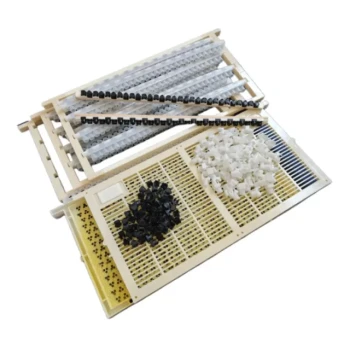
Specialized queen rearing equipment and package bee tools act as the essential technical infrastructure for scalable beekeeping operations. They provide the precision necessary to breed high-quality queens and efficiently assemble new colonies, transforming beekeeping from a passive maintenance activity into an active, industrial-scale production process.
The core value of this equipment lies in its ability to standardize biological growth. By leveraging precision tools for grafting and rearing, producers can rapidly renew aging populations and systematically expand apiary size to meet industrial demands without sacrificing colony health.
The Technical Foundation of Colony Expansion
Achieving Genetic Optimization
Expansion begins with the queen. Specialized equipment, such as precision rearing boxes and grafting tools, allows producers to move beyond natural swarming or supersedure methods.
By using these tools, beekeepers can selectively breed for specific traits, ensuring high-quality genetics are propagated throughout the apiary.
This results in a bee population with optimized genetic quality, which is critical for long-term productivity and disease resistance.
Scaling via Package Bee Assembly
To meet industrial demands, apiaries must produce new colonies at volume. Specialized tools for package bee assembly enable the creation of standardized colony units "at scale."
This equipment facilitates the safe and efficient separation of bees from established hives into transportable packages.
It transforms the biological asset of a strong hive into a marketable product or a new production unit, allowing for rapid calculation and adjustment of apiary size.
Proactive Colony Maintenance
Rapid Renewal of Populations
Colony health relies on the vigor of the queen. Specialized rearing tools provide the means for "rapid renewal" of the bee population.
Beekeepers can use these tools to proactively replace aging or unproductive queens rather than waiting for colony failure.
This maintains a consistent level of productivity and prevents the decline associated with older queen genetics.
Managing Demographic Balance
Successful maintenance requires balancing the number of colonies with available resources.
Artificial colony division, supported by high-precision tools, ensures a dynamic balance of colony numbers.
This proactive management prevents overcrowding and helps optimize the distribution of the workforce across the apiary.
Understanding the Trade-offs
Technical Complexity vs. Scale
While specialized equipment enables scale, it introduces a higher requirement for technical skill.
Tools like grafting needles and precision rearing boxes require a steady hand and deep understanding of bee biology; improper use can damage larvae or fail to produce viable queens.
Resource Dependency
Rapid expansion through package bees and rearing requires immense nutritional support.
As you expand using these tools, the demand for consumables—specifically high-purity bee pollen and standardized foundations—increases linearly.
Expanding colony numbers without a parallel investment in nutritional support (feeders and supplements) and standardized hardware (Langstroth hives) can lead to weak, unsustainable populations.
Making the Right Choice for Your Goal
To select the right equipment strategy, assess your primary operational objective:
- If your primary focus is Genetic Quality: Prioritize investment in precision grafting tools and rearing boxes to control specific traits and queen vitality.
- If your primary focus is Commercial Expansion: Focus on package bee assembly tools to maximize the speed at which you can split strong hives into new, marketable units.
- If your primary focus is Long-term Stability: Utilize rearing equipment for a strict schedule of queen replacement to prevent the natural decline of aging colonies.
True scalability is achieved not just by having more bees, but by possessing the tools to control their reproduction and quality with precision.
Summary Table:
| Feature | Strategic Benefit | Core Tools Involved |
|---|---|---|
| Genetic Optimization | Ensures high-quality traits and disease resistance | Grafting needles, precision rearing boxes |
| Scalable Expansion | Rapidly creates standardized units for sale or growth | Package bee assembly tools, transport cages |
| Population Renewal | Prevents colony decline by replacing aging queens | Mating nucs, queen cell protectors |
| Demographic Balance | Optimizes workforce distribution across the apiary | Artificial division tools, hive hardware |
Elevate Your Commercial Apiary with HONESTBEE
As a professional beekeeper or distributor, your success depends on the precision of your equipment. HONESTBEE empowers commercial operations with a comprehensive wholesale portfolio—from specialized queen rearing kits and high-capacity package bee tools to industrial honey-filling machines and hive-making hardware.
We provide the essential consumables and machinery required to transform biological assets into scalable profit. Let us help you optimize your production and expand your market reach. Contact us today to discuss your wholesale needs!
References
- R. B. Jones. Present Day Beekeeping in the Ukraine. DOI: 10.1080/0005772x.2013.11417537
This article is also based on technical information from HonestBee Knowledge Base .
Related Products
- Retractable Chinese Queen Rearing Grafting Tools Equipment
- No Grafting Queen Rearing Kit: System for Royal Jelly Production and Queen Rearing
- Nicot Queen Rearing Kit for Beekeeping and Grafting in Nicot System
- Premium Nicot Style Queen Rearing Kit with Hair Roller Bee Cages
- Stainless Steel Queen Grafting Tool for Beekeeping and Bee Queen Grafting
People Also Ask
- Which specialized tools are necessary for implementing standardized queen rearing? Scale Your High-Yield Apiary
- Why are specialized queen rearing tools necessary to mitigate winter hive losses? Boost Apiary Survival and Recovery
- How do queen-rearing tools facilitate the sustainability and expansion of a commercial apiary? Drive Scalable Growth
- In what ways do modern queen rearing equipment and grafting tools improve competitiveness? Boost Breeding Success Rate
- What role do specialized queen rearing tools and consumables play in modern large-scale apiculture? Drive Production & Scale