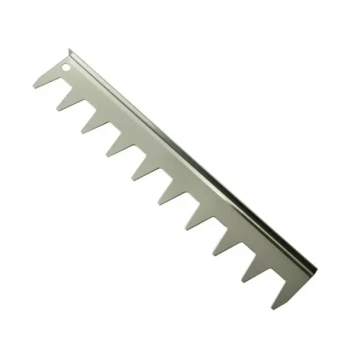
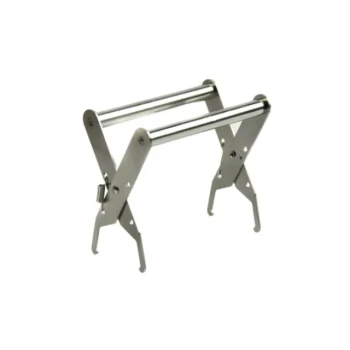
Langstroth beehive frames serve as the structural skeleton of the modern hive. They provide a defined boundary where honeybees build wax comb for raising brood and storing honey. By containing the comb within a standard, movable border, these frames act as a technical interface that allows beekeepers to interact with the colony without destroying the hive's infrastructure.
The defining value of the Langstroth frame is non-destructive manageability. Unlike traditional methods that required cutting comb to inspect a hive, these frames allow for individual removal, inspection, and extraction while keeping the honeycomb intact.
Transforming Colony Management
The introduction of the Langstroth frame shifted beekeeping from a destructive harvesting practice to a managed agricultural science.
Enabling Non-Destructive Inspection
The primary function of the frame is to make the comb movable.
In a frameless system, checking the colony often means damaging the hive structure. With Langstroth frames, a beekeeper can lift out a single sheet of comb to assess the queen’s laying pattern, check for pests, or monitor general health. This can be done without disrupting the rest of the colony.
Preventing Cross-Comb
Left to their own devices, bees will build "burr comb" or "cross-comb" in unpredictable, interlocking patterns to fill any available space.
Frames, typically equipped with a wax or plastic foundation, provide a geometric guide. This compels the bees to build straight, uniform combs along the length of the frame. This structural guidance is critical for ensuring the frames remain removable.
Streamlined Honey Extraction
Because the comb is secured within a sturdy wooden or plastic border, it can withstand mechanical stress.
During harvest, frames are removed from the hive and placed in extractors that spin out the honey. The frame protects the wax comb during this process, allowing the empty comb to be returned to the hive for immediate reuse by the bees.
Standardization and Scalability
Langstroth frames facilitate large-scale apiary management by standardizing equipment sizes and functions.
Specialized Frame Sizes
Frames are not "one size fits all"; they are categorized by depth to serve specific biological functions within the hive.
Deep frames are generally used in the bottom boxes (brood chambers). Their larger surface area provides ample room for the queen to lay eggs and for the colony to raise young.
Medium and Shallow frames are typically used in the upper boxes (honey supers). These are lighter when full of honey, making them easier for beekeepers to lift and harvest.
Consistent Metrics for Growth
Standardized dimensions allow for precise measurement of colony resources.
Because every deep frame has a fixed surface area, beekeepers can use grid-based techniques to calculate exactly how much brood or honey is present. This is essential for scientifically tracking colony growth or setting up experimental conditions.
Understanding Component Trade-offs
While the frame system is efficient, understanding the materials and components involved is necessary for optimal use.
The Role of Foundation
The frame itself is just the border; the foundation is the internal sheet that guides construction.
Most frames utilize a plastic or wax foundation. Without this foundation, bees may still fill the frame, but they are more likely to build irregular comb that defeats the purpose of the movable frame system.
Material Considerations
Frames are generally available in wood or plastic.
Plastic frames offer durability, are often less expensive, and can provide slightly more room for the queen to lay. Wooden frames are the traditional standard but may require assembly and wiring to support the wax foundation.
Making the Right Choice for Your Goal
Selecting the right frame configuration depends on which part of the hive lifecycle you are managing.
- If your primary focus is Colony Growth: Prioritize Deep frames for your bottom boxes, as they provide the continuous vertical space required for a healthy brood nest.
- If your primary focus is Honey Harvest: Utilize Medium or Shallow frames for your upper supers to reduce the weight you must lift and to separate the honey stores from the brood.
- If your primary focus is Ease of Management: Ensure all frames are equipped with foundation, as this is the critical factor in preventing cross-comb and ensuring frames remain movable.
By adopting the Langstroth frame system, you convert the chaotic biological activity of a bee colony into a structured, manageable, and measurable resource.
Summary Table:
| Feature | Function | Primary Benefit for Apiaries |
|---|---|---|
| Movable Comb | Allows individual removal of frames | Non-destructive colony inspections |
| Foundation Guide | Directs bees to build straight wax | Prevents messy cross-comb and burr comb |
| Structural Border | Protects wax during spinning | Enables efficient mechanical honey extraction |
| Depth Varieties | Deep, Medium, and Shallow options | Optimized for brood rearing vs. honey storage |
Partner with HONESTBEE for Professional Beekeeping Solutions
As a dedicated wholesale provider for commercial apiaries and distributors, HONESTBEE delivers a complete range of beekeeping infrastructure. Whether you need high-precision hive-making machines, automated honey-filling systems, or premium Langstroth frames and essential consumables, our portfolio is designed to maximize your operational efficiency and harvest yields.
Empower your business with equipment that stands the test of time and scale. Contact us today to explore our wholesale catalog and discover how our comprehensive beekeeping tools and machinery can support your business growth.
Related Products
- JZBZ Langstroth Queen Rearing Frame for Beekeeping
- Stainless Steel 9 Frame Hive Spacer Durable Precise for Commercial Beekeeping
- Wooden Bee Hive Frames for Beekeeping and Wholesale
- Durable Plastic Frame Spacer
- Langstroth Honey Bee Box Hive Boxes for Different Depths
People Also Ask
- Why use finishing colonies for queen cell capping? Secrets to Superior Queen Quality and Performance
- How do queen rearing frames and grafting needles function together? Master the Doolittle Method for High-Quality Queens
- What is the purpose of queen rearing frames? Master Controlled Queen Production for Your Apiary
- What are the functions of queen rearing frames and artificial queen cells? Master Bee Genetic Improvement
- What roles do professional queen rearing frames and artificial queen cells play? Scaling Your Queen Bee Production