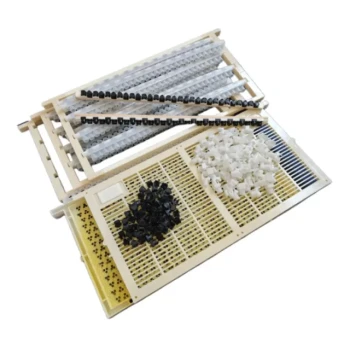
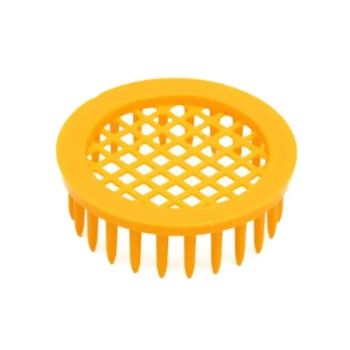
A queen oviposition controller serves as a precision constraint tool designed to isolate variables in honey bee behavior studies. By physically confining the queen to a specific test area of a honeycomb, researchers can compel her to interact with specific cell orientations within a defined timeframe. This eliminates random movement, enabling an accurate, standardized assessment of her egg-laying preference and performance across different structural variations.
Core Takeaway To objectively evaluate how honeycomb orientation impacts a queen bee's productivity, you cannot rely on natural roaming behavior. The queen oviposition controller forces interaction with specific variables, allowing researchers to gather comparative data on egg-laying preferences within a controlled 48-hour window.
The Mechanism of Controlled Evaluation
The primary value of an oviposition controller lies in its ability to transform a chaotic biological environment into a controlled experiment.
Eliminating Behavioral Variables
In a natural hive setting, a queen moves freely, choosing where to lay eggs based on various unmonitored factors. The controller physically restricts the queen to a designated section of the comb.
This ensures that any data collected regarding egg placement is a direct result of the specific honeycomb orientation being tested, rather than the queen's random wandering.
Standardizing the Timeframe
To compare performance across different honeycomb structures, the duration of exposure must be identical. The controller is used to define this period rigorously.
References suggest a standard window, such as 48 hours, is often used. This temporal boundary allows researchers to calculate a precise "eggs-per-hour" or total yield metric that is consistent across all trials.
Measuring Biological Performance
Once the queen is confined, the controller acts as the framework for gathering two distinct types of data: preference and performance.
Assessing Orientation Preference
The device allows researchers to determine if a queen accepts or rejects specific cell structures. By forcing the queen to inhabit a specific orientation, observers can see if she attempts to lay eggs or refuses the substrate entirely.
Quantifying Laying Efficiency
Beyond simple preference, the controller facilitates a hard count of productivity. Because the area is defined and the queen cannot leave, every egg found within the boundary is a data point for that specific orientation.
This makes it possible to generate a quantitative score for different honeycomb structures, identifying which orientations maximize the queen's biological output.
Understanding Methodological Trade-offs
While the oviposition controller provides necessary data, it introduces specific artificial constraints that must be acknowledged.
Artificial Confinement vs. Natural Behavior
The device relies on forced interaction. While this is necessary to isolate variables, the physical restriction creates an environment that is distinct from the open colony.
Short-Term Data Limitations
The evaluation is typically acute, lasting only for the defined period (e.g., 48 hours). This method captures immediate performance and preference but does not measure long-term sustainability or queen health over weeks of laying on a specific orientation.
Making the Right Choice for Your Goal
The use of an oviposition controller is a decision to prioritize data precision over natural observation.
- If your primary focus is comparative data: Use the controller to eliminate variables, ensuring that differences in egg counts are solely attributable to the honeycomb orientation.
- If your primary focus is rapid assessment: Utilize the defined 48-hour constraint to quickly screen multiple orientations without waiting for a full brood cycle.
By isolating the queen, you transform anecdotal observation into measurable, scientific fact.
Summary Table:
| Feature | Role in Evaluation | Impact on Data Accuracy |
|---|---|---|
| Queen Confinement | Eliminates random movement/wandering | Direct correlation between orientation and laying |
| Temporal Control | Standardizes exposure (e.g., 48 hours) | Enables consistent 'eggs-per-hour' metrics |
| Variable Isolation | Forces interaction with specific cell structures | Removes external hive environmental factors |
| Quantifiable Yield | Facilitates exact egg counts in defined areas | Provides objective, comparative performance scores |
Elevate Your Apiary Research and Productivity with HONESTBEE
At HONESTBEE, we understand that precision is the backbone of successful commercial beekeeping and distribution. Whether you are a large-scale commercial apiary or a dedicated distributor, we provide the industrial-grade tools and machinery you need to scale your operations effectively.
Our value to you includes:
- Comprehensive Wholesale Range: From specialized queen management tools like oviposition controllers to full-scale hive-making and honey-filling machinery.
- Industry Consumables: A complete supply chain for all your essential beekeeping hardware and honey-themed cultural merchandise.
- Expert Support: We cater to the high-volume needs of professionals seeking durability and efficiency.
Ready to upgrade your equipment or expand your inventory? Contact us today to discuss our wholesale solutions and see how HONESTBEE can drive your business forward.
References
- Shunhua Yang, Kun Dong. Cell orientation characteristics of the natural combs of honey bee colonies. DOI: 10.1371/journal.pone.0263249
This article is also based on technical information from HonestBee Knowledge Base .
Related Products
- Queen Bee Artificial Insemination Instrument Equipment for Instrumental Insemination
- Portable Queen Bee Incubator with 12V Car Adapter for Safe Transport
- Premium Nicot Style Cell Bar Holder and Queen Cell Cup Holder System
- JZBZ Style Push-In Cell Protector for Professional Queen Rearing Kits
- No Grafting Queen Rearing Kit: System for Royal Jelly Production and Queen Rearing
People Also Ask
- Why is maintaining sanitary conditions important during artificial insemination? Protect Your Queen from Fatal Infections
- Why are artificial insemination instruments critical in bee hybridization? Master Genetic Control & Pure Breeding
- What is the core value of bee artificial insemination instruments in breed improvement? Achieve Precise Genetic Control
- Why is professional bee artificial insemination equipment considered a core tool for genetic control in honeybee breeding? Ensure 100% Purity
- Why is high-purity CO2 used for queen bee artificial insemination? Unlock Precision Breeding & Faster Egg-Laying