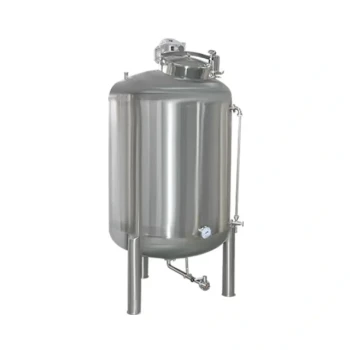
The technical mechanism of honey sedimentation is a static, gravity-driven separation process governed by specific gravity. Within the controlled environment of a food-grade stainless steel tank, substances with a density lower than honey—such as micro-bubbles and wax debris—rise to the surface. Simultaneously, heavier particulate matter settles to the bottom, leaving the central volume of honey clear and purified.
Core Takeaway Food-grade stainless steel tanks utilize static sedimentation to clarify honey naturally, exploiting density differences to separate impurities without mechanical agitation. Crucially, the tank’s airtight and non-reactive construction isolates the hygroscopic honey from moisture and contaminants, preventing fermentation while this slow physical process takes place.
The Physics of Separation
Utilizing Specific Gravity
The core mechanism at work is the difference in specific gravity between the honey and its impurities. Honey is a dense, viscous liquid.
When left static, materials lighter than the honey, such as air bubbles entrapped during extraction and beeswax fragments, naturally float upward. Conversely, heavier foreign particles sink to the tank's floor, effectively separating from the commercial-grade product.
The Necessity of a Static State
For this mechanism to function, the honey must remain undisturbed. This is referred to as "static sedimentation."
Agitation would re-suspend particles and re-introduce air bubbles. The stainless steel settling tank acts as a quieting vessel, allowing the necessary time for physics to clarify the product before the final bottling phase.
The Critical Role of Tank Design
Preventing Hygroscopic Spoilage
The sedimentation process requires time, and during this period, honey is vulnerable to its environment. Honey is highly hygroscopic, meaning it actively attracts and absorbs moisture from the air.
Food-grade stainless steel tanks solve this through an airtight design. By isolating the honey from external humidity, the tank prevents the moisture content from rising, which would otherwise decrease viscosity and trigger fermentation or spoilage.
Chemical Stability and Hygiene
Honey is naturally acidic. Food-grade stainless steel provides excellent acid and corrosion resistance, ensuring the container does not react with the product.
Furthermore, the surface smoothness of these tanks prevents the accumulation of pathogen residues in crevices. This facilitates thorough chemical disinfection and prevents cross-contamination between batches, maintaining the biological safety of the honey.
Understanding the Trade-offs
Passive vs. Active Processing
Sedimentation is a passive process that relies on gravity rather than force. While it preserves the honey's natural pollen and enzymes better than aggressive filtration, it is inherently slower.
This creates a production bottleneck where the honey must sit in storage for a set duration to achieve clarity.
The Integrity of the Seal
Because the process is static and takes time, the integrity of the tank's seal is a single point of failure.
If the tank is not perfectly airtight, the extended duration required for settling becomes a liability. Ambient moisture will infiltrate the honey, potentially ruining the batch through fermentation before it is ever bottled.
Optimizing Your Processing Setup
To ensure high-quality production, match your equipment handling to your specific processing goals.
- If your primary focus is product clarity: Ensure your tank capacity allows for sufficient "static time" to let specific gravity fully separate micro-bubbles and wax debris without interrupting your bottling workflow.
- If your primary focus is long-term stability: Prioritize tanks with superior sealing capabilities to neutralize honey’s hygroscopic nature, preventing moisture absorption that leads to fermentation.
Success in honey processing lies in balancing the patience required for gravity separation with the vigilance required for moisture control.
Summary Table:
| Mechanism Component | Technical Function | Impact on Honey Quality |
|---|---|---|
| Specific Gravity | Separates wax/bubbles (float) from heavy particles (sink) | Natural clarification without mechanical force |
| Static State | Prevents re-suspension of impurities | Ensures a clear, purified central honey volume |
| Airtight Seal | Blocks atmospheric moisture (hygroscopic protection) | Prevents fermentation and preserves viscosity |
| Stainless Steel | Acid-resistant and non-reactive surface | Maintains chemical purity and hygiene standards |
Elevate Your Honey Quality with HONESTBEE
Are you a commercial apiary or distributor looking to scale your honey processing with precision? HONESTBEE provides high-performance, food-grade stainless steel storage and settling tanks designed to optimize the sedimentation process. From airtight seals that neutralize moisture absorption to acid-resistant machinery that ensures biological safety, our equipment is built for professionals who value purity.
Our comprehensive wholesale offering includes everything from honey-filling machines and specialized hive-making equipment to essential industry consumables and honey-themed merchandise. Let us help you eliminate production bottlenecks and protect your harvest.
Contact us today to upgrade your honey processing workflow
References
- Etsemeskel Tadele, Abebe Melese. Comprehensive review on improved honey production: techniques, challenges, opportunities, and future prospects in Africa. DOI: 10.3389/frbee.2025.1588416
This article is also based on technical information from HonestBee Knowledge Base .
Related Products
- Stainless Steel Honey Storage Tank with Lid for Honey
- Heavy Duty Stainless Steel Honey Processing Machine Decrystallizing Tank
- Stainless Steel Uncapping Tank with Stand and Strainer
- Stainless Steel Honey Storage and Settling Tank with Double Strainer
- Stainless Steel Honey Tank Stand for Honey Storage
People Also Ask
- What economic role do honey storage tanks play? Boost Your Revenue Through Strategic Inventory Management
- What roles do industrial honey storage tanks and filtration meshes play in processing? Ensure Purity & Consistency
- What is the purpose of a honey storage tank? Streamline Your Honey Processing for Quality & Efficiency
- What are honey storage tanks used for? Essential Features for Quality Preservation and Profit
- How do large honey storage tanks and gravity fall filling systems improve honey packaging efficiency and safety?