Specialized hive hardware and two-queen systems give commercial honey producers more control over colony strength, labor, quality, and production capacity. A well-designed two-queen setup can increase worker populations and foraging intensity within a limited apiary footprint, while modular hives, frames, queen excluders, and division equipment make these colonies manageable. Together, they support higher honey yields, stronger pollination capacity, more efficient inspections, and more consistent extraction.
Core takeaway: Two-queen colonies increase biological production potential; specialized hardware makes that potential operationally manageable. The greatest commercial benefit comes from combining strong colony management with standardized equipment, reliable queen replacement, and efficient harvesting workflows.
How Two-Queen Systems Improve Commercial Output
More workers in a single production unit
A two-queen colony can support a larger population of worker bees than a conventional single-queen colony when properly managed. More workers can translate into greater foraging intensity and improved use of available floral resources.
This is particularly valuable where apiary space is limited or where producers need to maximize output from a defined production area.
Higher honey yield potential
Dual-queen systems are designed to build colony strength before and during a major honey flow. Stronger populations can collect and process more nectar, increasing the potential honey yield per hive.
The result depends on queen quality, timing, forage availability, colony health, and management precision. The system is a production strategy—not an automatic yield guarantee.
Greater pollination capacity per unit area
A larger and more active colony can provide greater pollination capacity in the same general area. This can benefit commercial operators who combine honey production with pollination services.
The advantage is strongest when colony development is synchronized with the target crop’s flowering period.
Better swarm-management opportunities
A strong colony can be divided vertically before the expected honey flow, with the two queens initially kept separate by a solid division board. This can help control colony organization while maintaining high bee populations.
Later, a queen excluder can permit worker movement while preventing the queens from meeting. Near the end of the flow, the colonies may be recombined under the younger queen, subject to local management conditions and beekeeper judgment.
How Specialized Hardware Makes the System Practical
Modular hive structures simplify colony manipulation
Modular hive bodies, division boards, internal frames, and queen excluders provide the physical structure needed to manage two brood areas within one hive configuration. They allow producers to separate, inspect, expand, and recombine colony units more systematically.
Without compatible hardware, dual-queen management becomes more labor-intensive and less predictable.
Standardized frames improve inspections
Modern frame hives allow beekeepers to remove and inspect individual frames without destroying the comb. This supports routine checks of brood patterns, queen performance, food stores, colony strength, and disease indicators.
For commercial apiaries, standardized inspection procedures are essential for managing many colonies consistently.
Queen excluders protect honey quality
A queen excluder placed between brood chambers and honey supers restricts the queen from entering the honey-storage area. This reduces the risk of brood being placed in honey frames and helps keep harvested honey cleaner and more suitable for extraction.
In a two-queen system, excluders also help maintain separation between queens while allowing workers to move through the hive.
Division boards enable controlled separation
Solid division boards temporarily isolate the two colony sections during setup. This gives the beekeeper greater control over queen placement, brood distribution, and worker allocation.
The ability to change from a solid divider to an excluder provides operational flexibility as the colony moves from buildup to honey production.
Extraction becomes more efficient
Standard frames and removable honey supers support faster removal, transport, and extraction of capped honey. They also reduce comb damage and make harvesting procedures more repeatable across a commercial operation.
This helps producers handle peak harvest periods with greater consistency.
Additional Hardware That Supports Consistent Operations
Queen-rearing equipment supports replacement planning
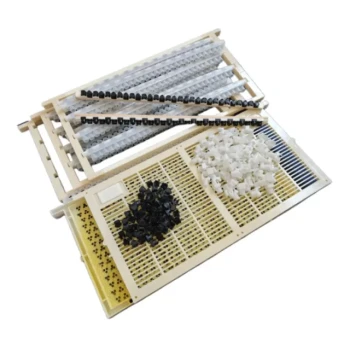
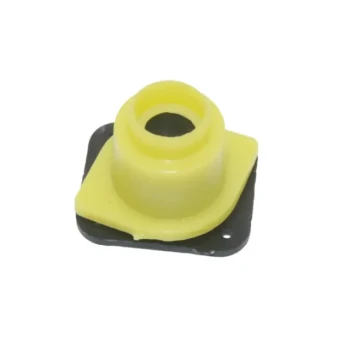
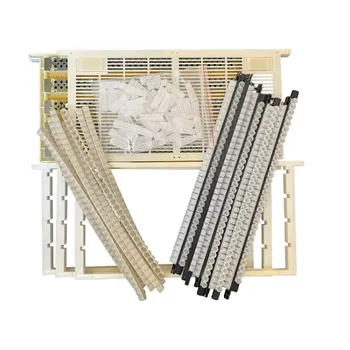
Queen-rearing equipment allows producers to raise or manage replacement queens rather than relying indefinitely on aging queens. Regular replacement can help maintain reproductive performance and colony cohesion.
Young, vigorous queens may also support stronger colony development and reduce the operational disruption associated with weak or failing queens.
Anti-robbing devices protect colony stability
Anti-robbing guards help deter bees from invading weaker colonies during nectar dearth periods. By reducing robbing pressure, they can limit colony disturbance and help reduce opportunities for disease transmission.
This is a relatively simple hardware intervention, but it supports more stable apiary-wide management.
Accurate hive manufacturing improves fleet consistency
Commercial apiaries need hive components that are dimensionally consistent and compatible across the equipment fleet. Specialized manufacturing machinery helps produce standardized hive bodies, frames, and related components at scale.
For distributors and wholesalers, this consistency is important because customers often require complete, compatible product systems rather than isolated components.
A complete equipment portfolio reduces procurement friction
Commercial producers benefit when modular hives, frames, excluders, division boards, queen-rearing equipment, and protective accessories can be sourced through one coordinated supply channel. This reduces compatibility problems and simplifies replenishment.
For B2B suppliers, a full-spectrum portfolio is therefore a practical service advantage, especially when rapid response and efficient order fulfillment are required during seasonal demand peaks.
Understanding the Trade-offs
Two-queen systems require advanced management
Dual-queen colonies are more complex than standard colonies. They require careful timing, accurate queen separation, appropriate brood and bee allocation, and close monitoring during buildup and recombination.
The additional management can offset productivity gains if workers are not trained or if equipment is poorly matched.
Equipment compatibility is critical
A queen excluder, division board, frame, or hive body must fit the relevant hive configuration accurately. Poorly fitting components can compromise queen separation, inspections, colony security, and harvesting efficiency.
Purchasing complete compatible systems is generally safer than combining unverified components from different specifications.
Strong colonies increase management demands
Larger populations may require more frequent inspections, additional supers, and faster responses to congestion, queen problems, or resource shortages. Commercial producers must have sufficient labor, transport, storage, and extraction capacity to handle the increased output.
More biological capacity is valuable only when the downstream operation can process it.
Results depend on local conditions
Two-queen systems perform differently depending on climate, forage availability, honey-flow timing, queen quality, and colony health. A setup that works well in one production region may require different timing or may not be appropriate in another.
Producers should validate the system on a controlled group of colonies before broad deployment.
Making the Right Choice for Your Goal
The best equipment strategy depends on whether the priority is production volume, labor efficiency, product quality, or scalable sourcing.
- If your primary focus is maximizing honey yield: Use a properly planned two-queen system with modular brood chambers, reliable queen separation, and sufficient supers to support strong colonies during the honey flow.
- If your primary focus is pollination capacity: Concentrate on building large, healthy colonies and synchronize queen and brood management with the target crop’s flowering period.
- If your primary focus is reducing labor: Standardize hive bodies, frames, excluders, and inspection procedures so components are interchangeable and routine tasks are repeatable.
- If your primary focus is honey quality: Use queen excluders and removable frames to reduce brood contamination and improve extraction consistency.
- If your primary focus is apiary expansion: Source compatible hive components and production equipment through a dependable supplier capable of rapid response, complete order fulfillment, and seasonal volume support.
With the right management skill and compatible hardware, commercial producers can turn stronger colonies into a more controlled, scalable, and efficient honey-production operation.
Summary Table:
| Advantage | How It Helps | Key Hardware |
|---|---|---|
| Increased worker population | More foragers → higher honey yield | Modular hive bodies, division boards |
| Higher honey yield potential | Strong colonies collect more nectar | Queen excluders, supers |
| Greater pollination capacity | Larger colonies cover more crop area | Frames, queen rearing equipment |
| Controlled colony separation | Manage two queens safely | Division boards, queen excluders |
| Efficient inspections & extraction | Standardized frames speed up work | Standard frames, extractors |
| Improved honey quality | Prevents brood in honey supers | Queen excluders |
Ready to optimize your commercial apiary with top-tier hive management hardware and complete two-queen systems? At HONESTBEE, we supply the full spectrum of beekeeping tools, machinery, and consumables to help you maximize yields and streamline operations. Whether you're a distributor or commercial beekeeper, our one-stop sourcing, rapid response, and dedicated support ensure you get the right equipment fast. Contact us today to discuss your needs and boost your productivity—get in touch with our team!
Related Products
- Twin Queen Styrofoam Honey Bee Nucs Mating and Breeding Box
- No Grafting Queen Rearing Kit: System for Royal Jelly Production and Queen Rearing
- Premium Nicot Style Cell Bar Holder and Queen Cell Cup Holder System
- HONESTBEE Improved No Grafting Queen Rearing Kit For Queen Rearing and Royal Jelly Production
- JZBZ Langstroth Queen Rearing Frame for Beekeeping
People Also Ask
- What are the benefits of using double nuc boxes in beekeeping? Boost Apiary Resilience & Growth
- What are the practical advantages of a double nuc box? Maximize Efficiency with Standardized Beekeeping Gear
- What is the frame capacity of each side in a double nuc box? Master Queen Rearing & Colony Starts
- What are the advantages of double nuc boxes in winter? Boost Survival Rates & Apiary Resilience
- What is the purpose of exploring double nuc boxes in beekeeping? Boost Apiary Resilience & Growth