Large-capacity industrial electronic scales act as the primary instrument for quantifying raw honey yield in a commercial setting. They determine production levels by weighing honey collection buckets, calculating the mass of finished storage tanks, and measuring the precise weight difference of honeycomb frames before and after extraction.
Core Takeaway While high-volume production requires speed, profitability requires data. These scales serve as the bridge between biological activity and business intelligence, transforming raw weight into an objective quantitative indicator used to evaluate the economic success of specific colony management strategies.
Quantifying Yield Through Precision Weighing
Measuring at Critical Production Stages
To accurately determine total output, large-capacity scales are utilized at multiple points in the harvesting workflow.
They measure the gross weight of honey collection buckets immediately after harvest.
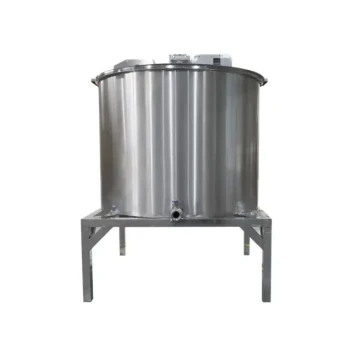
Additionally, they verify the total mass accumulated in finished honey storage tanks, providing a macro-level view of the apiary's production volume.
The Frame Differential Method
A crucial function of these scales is measuring the specific yield of individual hive components.
Operators weigh frames containing honey prior to extraction and weigh them again after the honey has been removed.
This "before and after" verification calculates the exact net weight of honey extracted per frame, offering granular data that bulk weighing alone cannot provide.
Transforming Data into Economic Intelligence
Evaluating Colony Management Groups
The primary value of this data lies in its ability to audit beekeeping strategies.
By isolating production data, apiary managers can assess the final economic output of different colony management groups.
This reveals which management techniques—such as specific feeding schedules or hive configurations—resulted in the highest honey yields over a flowering season.
Establishing Objective Indicators
Commercial beekeeping relies on consistency, yet environmental factors introduce variables.
Industrial scales remove subjective estimation from the equation, providing an objective quantitative indicator of performance.
This data allows producers to compare results across different seasons and apiary locations with scientific accuracy.
Understanding the Limitations
Weight vs. Composition
While industrial scales accurately measure mass, they do not analyze chemical composition.
A high yield in weight does not inherently guarantee high levels of specific sugars like maltose or sucrose, which are critical for commercial value.
Operators must remember that weight is a measure of quantity, not necessarily of nutritional quality or moisture content.
Production vs. Packaging
It is vital to distinguish between production scales and packaging equipment.
Large-capacity scales determine total harvest yield (bulk output), whereas industrial-grade honey-filling machines are used later for high-precision quantitative packaging.
Using large-capacity scales for small-unit packaging would lack the precision required for consumer goods consistency and international export standards.
Making the Right Choice for Your Goals
To leverage industrial weighing technology effectively, align your equipment use with your specific management objectives:
- If your primary focus is evaluating colony health: Use scales to track the weight difference of frames before and after extraction to isolate high-performing hives.
- If your primary focus is inventory management: rely on the total mass measurement of finished storage tanks to determine accurate stock levels for sale.
Accurate measurement is the foundation of commercial scalability; without it, you are guessing at your yield rather than managing your business.
Summary Table:
| Stage of Production | Measurement Method | Key Metric Provided |
|---|---|---|
| Raw Harvest | Gross weight of collection buckets | Initial total yield volume |
| Extraction | Frame weight differential (Before vs. After) | Net honey output per frame/colony |
| Storage | Total mass of finished tanks | Inventory levels for bulk distribution |
| Management | Data comparison across colony groups | ROI of specific management strategies |
Scale Your Apiary Success with HONESTBEE
Precise data is the backbone of a profitable beekeeping enterprise. At HONESTBEE, we specialize in empowering commercial apiaries and distributors with the robust tools needed to transform biological yields into business growth. From large-capacity weighing solutions to high-precision honey-filling machines and specialized hive-making hardware, our comprehensive wholesale portfolio covers your entire production cycle.
Ready to upgrade your infrastructure with industry-leading beekeeping machinery and essential consumables? Contact our expert team today to discover how our tailored equipment solutions can streamline your operations and maximize your commercial output.
References
- O. Mishchenko. THE STIMULATING EFFECT OF BROOD ON THE PRODUCTIVITY OF THE BEE COLONY. DOI: 10.46913/beekeepingjournal.2023.11.10
This article is also based on technical information from HonestBee Knowledge Base .
Related Products
People Also Ask
- What are commercial honey extractors used for? Boost Your Apiary's Efficiency & Profitability
- What is a commercial honey extractor? The Essential High-Volume Solution for Large Apiaries
- Who are commercial honey extractors designed for? Scaling Your Industrial Beekeeping Success
- How is honey extracted commercially? Maximize Your Apiary's Efficiency and Honey Yield
- What are commercial honey extractors and for what scale of beekeeping are they intended? Scale Your 200+ Colony Apiary