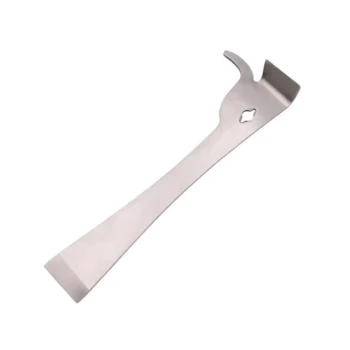
The single most critical safety precaution when using a hive tool is proper hand placement during leverage and scraping maneuvers. Because a hive tool must remain sharp to be effective, you must ensure your free hand is never positioned in the "slip path"—the direction the tool will travel if it suddenly releases from the wax or propolis you are prying.
Core Takeaway A hive tool is effectively a sharp, mini crowbar that requires significant force to use. Safety relies on directing that force away from your body to prevent deep cuts, while simultaneously maintaining strict hygiene protocols to prevent spreading pathogens between colonies.
Managing Physical Risk
Respecting the Blade Mechanics
To function correctly, a hive tool must be sharp. A dull tool requires excessive force, increasing the likelihood of slipping and causing injury or damage.
Because the tool is sharp, you must treat it with the same respect you would a knife or chisel.
The "Slip Path" Rule
When scraping propolis or wax off woodenware, the tool often meets resistance before suddenly breaking through.
Always anticipate the slip. Before applying pressure, visualize where the tool will go if the material gives way. Ensure your non-dominant hand is never holding the frame or box in that trajectory.
Proper Leverage Techniques
The hive tool is designed with a flat end for prying and a curved end for lifting. Use the flat end to pry boxes apart at the corners.
By using the tool as a lever rather than just a scraper, you reduce the amount of erratic force needed, thereby increasing your control and safety.
Operational and Biological Safety
Protective Equipment
Standard beekeeping safety gear is essential when handling tools near the hive.
Wear a bee suit, veil, and gloves. This protects you not only from stings but also provides a minor layer of buffering against accidental tool slips, though it will not stop a direct strike from a sharp blade.
Colony Biosecurity
Safety extends beyond physical injury; it includes the biological safety of your apiary.
You must clean and sterilize your hive tool before moving from one hive to another. This prevents the mechanical transmission of pathogens and diseases between healthy and infected colonies.
Minimizing Aggression
How you use the tool impacts the colony's defensive behavior.
Use the tool gently to avoid crushing bees or jarring the hive unnecessarily. Rough handling can trigger a defensive response (stinging), which increases the danger to the beekeeper during the inspection.
Understanding the Trade-offs
Sharpness vs. Safety
There is an inherent trade-off regarding the tool's edge. A sharper tool cuts more easily, posing a higher risk of injury if it touches skin.
However, a dull tool is often more dangerous because it requires the beekeeper to apply excessive force. High-force slips are harder to control and often result in more severe damage to the hive or the user than a controlled slice from a sharp blade.
Force vs. Finesse
Applying significant leverage is necessary to break propolis seals, but excessive force can damage woodenware or snap frames.
The trade-off is finding the balance where you apply enough pressure to separate components without "popping" them open violently, which agitates the bees and risks tool slippage.
Making the Right Choice for Your Goal
To operate safely and effectively, prioritize your actions based on your immediate objective:
- If your primary focus is personal injury prevention: Always position your free hand behind the direction of the blade's movement, ensuring it is never in the potential slip path.
- If your primary focus is apiary health: rigorous sterilization of the tool between every hive is mandatory to stop disease transmission.
- If your primary focus is colony temperament: Work slowly and use the lever action of the tool to pry gently, avoiding the vibration and crushing that triggers aggressive behavior.
Treat the hive tool as a precision instrument, not a blunt object, to ensure the safety of both the beekeeper and the bees.
Summary Table:
| Safety Category | Key Precaution | Benefit |
|---|---|---|
| Physical Safety | Maintain a clear "Slip Path" | Prevents deep cuts from accidental tool slips |
| Tool Condition | Keep the blade sharp | Reduces the excessive force that causes accidents |
| Biosecurity | Sterilize between hives | Prevents the spread of pathogens between colonies |
| Colony Management | Use gentle leverage | Minimizes bee aggression and hive damage |
Elevate Your Apiary Safety with HONESTBEE
At HONESTBEE, we understand that professional beekeeping requires precision tools that balance durability with safety. As a leading supplier for commercial apiaries and distributors, we provide a comprehensive wholesale range of high-quality beekeeping tools, specialized hive-making machinery, and essential industry consumables.
Whether you are scaling your honey production with our advanced honey-filling machines or stocking up on ergonomic hardware, our team is dedicated to supporting your growth with expert solutions and premium equipment.
Ready to upgrade your equipment? Contact us today to explore our wholesale catalog and discover how HONESTBEE can enhance your commercial operations.
Related Products
- HONESTBEE Professional Long Handled Hive Tool with Precision Cutting Blade
- Professional Multi-Function Stainless Steel Hive Tool
- HONESTBEE Premium Italian Style Hive Tool with Hardwood Handle
- Ergonomic Plastic Frame Spacer Tool for Rapid Hive Management Beekeeping
- Professional Grade Foldable Beehive Handles
People Also Ask
- Why are professional hive tools considered indispensable? Master Beekeeping Maintenance with Precision Leverage
- What is the role of professional hive tools in routine apiary maintenance? Expert Tips for Hive Health and Longevity
- What is a bee hive tool? Discover Why It’s the Most Essential Hand Tool for Every Beekeeper
- How do hive tools and queen rearing equipment facilitate the bee colony splitting process? Restore Your Apiary Faster
- Why are professional hive tools & observation equipment necessary for queen rearing evaluation? Master Your Quality