Natural giant-bee comb is exceptionally large, deep, and vertically zoned. An Apis dorsata open single-comb nest may reach approximately 2 m wide and 1.5 m high, with a honey-storage bulge up to 30 cm thick, followed by pollen storage, worker brood, and lower drone or queen cells. These dimensions indicate that commercial equipment should prioritize correct cell sizing, high load capacity, deep-cap handling, reinforced frames, and modular replacement of the natural comb.
The natural comb provides a design reference, not a direct equipment format. Commercial operations should convert the giant bee’s large, heavy, irregular comb into standardized foundation sheets and reinforced frames that can be inspected, transported, extracted, and processed efficiently.
What Makes Giant Honeybee Comb Structurally Distinct?
A very large single-comb architecture
Unlike colonies that build multiple combs inside a hive, giant honeybees construct a single, exposed comb suspended in the open air. Its broad dimensions create substantial mechanical loads, particularly when the honey-storage area is full.
The comb may reach roughly 2 m in width and 1.5 m in height. This scale makes the natural structure unsuitable for direct use in standard hive bodies, frame systems, or conventional centrifuges.
Strong vertical zoning
The comb is organized from top to bottom according to colony function:
- Upper honey-storage section
- Pollen-storage zone
- Worker brood area
- Lower drone and queen cells
The upper honey area may form a bulged section up to 30 cm thick, creating a deep and concentrated weight load above the brood region.
Worker-cell dimensions
Worker brood cells are reported at approximately 5.28–5.64 mm in width. This range should be treated as a key reference when evaluating foundation embossing molds, cell-grid specifications, and frame components intended for giant honeybee populations.
Cell dimensions are not universally interchangeable among honeybee ecotypes. Other populations can construct smaller cells, so equipment should be matched to the target bee rather than selected solely from a generic standard.
How These Dimensions Guide Comb Foundation Selection
Match the foundation cell grid to the bee population
Foundation should reproduce a cell pattern compatible with the target bee’s morphology. For Apis dorsata, the 5.28–5.64 mm worker-cell range provides a practical starting reference for foundation design and procurement.
For commercial distributors and equipment manufacturers, this means specifying the cell pitch and embossing pattern rather than simply ordering “standard foundation.” Incorrect sizing can discourage acceptance, reduce construction efficiency, or produce irregular comb.
Use modular foundation instead of reproducing the natural comb
A natural giant-bee comb is too large and irregular for routine commercial handling. Commercial systems therefore divide the comb function into manageable wax foundation sheets installed in standardized frames.
This modular approach supports hive inspection, transport, non-destructive harvesting, and repeated equipment use. It also allows wholesalers to offer a coordinated product range covering foundation sheets, frames, hive bodies, and processing machinery.
Consider reinforced foundation systems
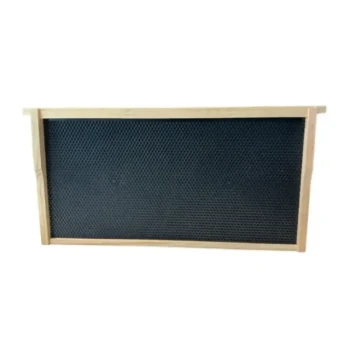
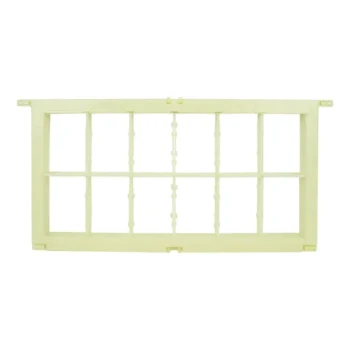
Deep honey storage creates a greater risk of sagging, distortion, or breakage, especially in warm conditions. Plastic foundation with a wax-pattern coating can provide additional structural support while still presenting a surface that encourages comb construction.
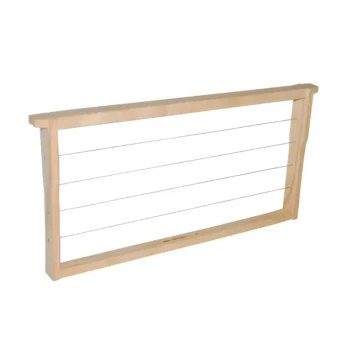
For wired beeswax foundation, vertical support wires help prevent downward slipping, while horizontal cross-wiring provides lateral reinforcement. A split bottom bar can also allow deeper sheets to expand slightly without buckling.
How the Comb Dimensions Guide Frame Design
Design for heavy upper loading
The thick upper honey section concentrates weight near the top of the comb. Frames used to approximate this storage function should therefore have strong top bars, square alignment, secure joints, and reliable side support.
Well-joined wooden frames, reinforced with suitable glue and brads, are better suited to repeated handling and centrifugal extraction than poorly aligned or weakly assembled frames.
Prevent sagging during transport and extraction
Large, honey-filled combs are vulnerable to deformation from gravity, heat, vibration, and centrifugal force. Frame supports must hold the foundation securely while maintaining sufficient rigidity for repeated extraction cycles.
Vertical wires, horizontal cross-wires, and properly secured foundation edges are particularly important where deep comb or high-speed extraction is expected.
Keep the system compatible with standard handling
The objective is not to build a two-meter frame. It is to translate the natural comb’s structural demands into smaller, repeatable modules that fit hive bodies, transport boxes, uncapping stations, extractors, and filling lines.
For B2B buyers, compatibility across these stages is more valuable than maximizing the size of any individual frame.
How the Comb Guides Honey Extraction Equipment
Provide capacity for deep honey storage
A honey-storage section up to 30 cm thick may contain a substantial volume of honey and wax. Equipment must therefore accommodate deep cappings and heavier comb without excessive compression or structural failure.
Extractors should be selected with appropriate basket depth, frame support, load capacity, and operating controls. The equipment must be evaluated as a complete system rather than by nominal drum size alone.
Protect fragile comb during centrifugal extraction
Centrifugal forces can tear foundation or collapse poorly supported comb. Reinforced frames and correctly wired foundation reduce this risk and extend service life through repeated extraction cycles.
If the operation handles delicate or premium comb honey, mechanical extraction may be inappropriate for every product grade. Cutting, draining, or gentle pressing may better preserve the visual structure of selected comb sections.
Use immediate processing where moisture is high
Some Himalayan giant-bee honeys are reported to have high moisture content and rapid fermentation risk. Where this applies to the target product, extraction, filtration, and downstream filling should be arranged for rapid processing after harvest.
This requirement affects equipment selection beyond the extractor itself. Filtration, hygienic transfer, filling, and short response times in the processing workflow become part of the operating specification.
Standardization Is the Commercial Conversion Point
Replace irregular open-air comb with reusable modules
Standard hive bodies, foundation sheets, and frames transform a naturally massive open-air structure into a controlled production system. This makes colonies easier to manage and allows honey to be harvested without destroying the entire comb.
For distributors, the strongest offering is often a complete compatible package rather than a single machine: hive components, foundation, wired frames, cutting tools, extraction equipment, filtration, and filling systems.
Match equipment to the intended product
Extracted liquid honey and comb honey require different handling priorities. Liquid honey systems emphasize drainage, filtration, extraction efficiency, and hygienic filling, while comb honey systems emphasize clean cutting, gentle manipulation, and preservation of appearance.
Premium white comb honey, for example, may justify specialized cutting and filling equipment that minimizes crushing and surface damage.
Specify the bee ecotype before quoting equipment
Cell size, frame spacing, and foundation requirements can vary among honeybee populations. A reliable commercial specification should identify the target bee, intended hive format, foundation cell size, frame dimensions, extraction method, and expected operating temperature.
This preliminary information helps suppliers respond quickly with compatible products instead of offering equipment based on unsuitable generic dimensions.
Understanding the Trade-offs
Larger comb capacity versus handling efficiency
Deep comb can support substantial honey storage, but it also increases weight and structural stress. Oversizing frames or extractor baskets may reduce handling convenience and make equipment more difficult to standardize.
The practical solution is usually to preserve the natural comb’s capacity concept while dividing it into smaller reinforced modules.
Natural comb preservation versus mechanized extraction
Manual squeezing or gentle draining can preserve more of the natural comb structure, but these methods are slower and less uniform. Centrifugal extraction is faster and more scalable, but it requires strong frames, stable foundation, and careful control of mechanical stress.
The correct choice depends on whether the business prioritizes throughput, comb appearance, wax recovery, or premium product positioning.
Standard cell sizing versus biological variation
The Apis dorsata worker-cell range is useful for planning, but it should not be applied blindly to every honeybee population. A foundation pattern designed for one ecotype may be unsuitable for another.
Distributors should offer multiple foundation specifications where regional bee morphology varies, and confirm requirements before finalizing machinery or bulk orders.
High-speed processing versus product quality
Fast extraction and filling can improve throughput, particularly for moisture-sensitive honey. However, excessive speed, heat, or mechanical force can damage comb and compromise product handling.
Equipment should therefore be selected around the desired product grade and processing conditions, not speed alone.
How to Apply This to Your Project
The following selection priorities connect natural comb structure with practical commercial equipment decisions:
- If your primary focus is foundation production: Specify a cell grid near the target Apis dorsata worker-cell range of 5.28–5.64 mm, then validate it against the local bee population before ordering molds or embossing machinery.
- If your primary focus is frame durability: Choose square, strongly joined frames with vertical support, horizontal cross-wiring, and secure foundation retention to resist sagging and centrifugal stress.
- If your primary focus is honey extraction throughput: Select extractors with adequate basket depth, structural support, load capacity, and compatible filtration and filling equipment for heavy or deep-capped comb.
- If your primary focus is premium comb honey: Use specialized cutting and gentle handling equipment that protects comb geometry, cleanliness, and visual quality rather than relying only on high-speed centrifugation.
- If your primary focus is fast fulfillment and one-stop sourcing: Define the bee ecotype, cell size, frame format, processing method, and capacity together so a supplier can provide a compatible full-spectrum package.
The most reliable commercial system converts giant honeybee comb’s exceptional natural dimensions into standardized, reinforced, and purpose-matched modules.
Summary Table:
| Feature | Natural Comb Dimensions | Equipment Requirement |
|---|---|---|
| Comb Size | ~2 m wide, 1.5 m high | Modular frames and hive bodies |
| Honey Storage Thickness | Up to 30 cm | Deep-capable extractors and reinforced frames |
| Worker Cell Width | 5.28-5.64 mm | Foundation with matching cell grid |
| Vertical Zoning | Honey, pollen, brood, drone/queen | Segregated harvesting and processing systems |
| Structural Load | High weight in honey zone | Reinforced frames and strong top bars |
Equip your apiary with precision-engineered foundation, frames, and extraction systems tailored to giant honeybee comb dimensions. As a leading B2B supplier, HONESTBEE offers comprehensive wholesale solutions, including hive-making machinery, honey-filling lines, and premium consumables. Benefit from our rapid response, dedicated support, and ultra-fast delivery. Whether you're a distributor seeking OEM/ODM customization or a beekeeper needing one-stop sourcing, our professional team ensures your success. Contact us today to optimize your operations with HONESTBEE.
Related Products
- Assembled Wooden Bee Frames with Beeswax Foundation Ready to Use by HONESTBEE
- HONESTBEE Wired and Assembled Wooden Bee Frames Foundation for a Thriving Hive
- Assembled Wooden Bee Frames with Plastic Foundation for Durability and Convenience by HONESTBEE
- Food Grade Plastic bee Foundation for Bee Frames
- Colorful Silicone Beeswax Foundation Mold Mould for Beekeeping
People Also Ask
- Do bee frames need foundation? Choose the Right Approach for Your Apiary
- How should frames be rearranged as a bee colony grows? Master Hive Expansion and Nest Management
- Under what circumstances should bee frames be destroyed? Protect Your Apiary from American Foulbrood
- How do you re-wax bee frames? A Simple Guide to Faster Comb Building
- Can beekeepers switch between wooden and plastic frames? Optimize Your Hive's Performance