Dwarf honeybee honey is defined by high levulose, unusually high dextrin, and low crystallization. Honey from Apis florea can contain dextrin levels up to four times higher than standard Apis honeys, while its high levulose content gives it a low tendency to granulate. For commercial processors, this reduces the need for aggressive preheating and heavy-duty de-crystallization equipment, but the honey’s limited colony yield makes precise, low-loss filling essential.
Dwarf honeybee honey is comparatively easy to keep liquid, but difficult to waste economically. The best processing line combines gentle thermal management with adjustable, high-precision filling equipment designed for small premium packages.
What Makes Dwarf Honeybee Honey Different?
High levulose content reduces crystallization
The high levulose content of Apis florea honey contributes to its low tendency to granulate. Unlike honey varieties that crystallize rapidly and require repeated warming, dwarf honeybee honey can generally remain liquid for longer periods under suitable storage conditions.
This is commercially important because processors can reduce the frequency and intensity of crystal-melting cycles before bottling.
Dextrin levels can be exceptionally high
Dwarf honeybee honey may contain up to four times more dextrin than standard honeybee honeys. Dextrin is a complex carbohydrate that contributes to the product’s distinctive physical behavior and may affect flow characteristics during transfer and filling.
High dextrin content does not automatically mean the honey requires aggressive heating. Instead, equipment should be selected to accommodate possible viscosity variation while preserving the honey’s natural quality.
The honey is produced in small quantities
A standard Apis florea nest may produce approximately 500 grams to 1 kilogram of honey, while colonies in forage-rich areas may yield up to about 4 kilograms.
This limited supply supports positioning as a high-value or medicinal honey, but it changes the economics of processing. Product losses at pumps, valves, nozzles, or changeover points become more significant when each batch is small and valuable.
How Composition Changes Processing Requirements
Less dependence on heavy de-crystallization equipment
Because dwarf honeybee honey has a low crystallization tendency, processors typically do not need the same level of high-temperature preheating or intensive de-crystallization agitation used for strongly crystallizing honey varieties.
A production line can therefore be simpler in this area, with lower reliance on large thermal treatment vessels and heavy-duty agitators.
Gentle temperature control remains necessary
Reduced crystallization does not eliminate the need for thermal management. Honey contains sensitive enzymes and bioactive compounds, and excessive heat can reduce their nutritional and functional value.
Processing systems should use controlled, moderate warming only when needed to support pumping, filtration, or filling. The objective is to improve flow without treating the honey as a product that must be repeatedly melted.
Pump selection must account for viscosity
Dextrin-related viscosity variation can make flow less predictable than a simple low-crystallization label suggests. Pumps should provide stable, controlled delivery across the expected operating range.
For commercial equipment, adjustable positive-displacement pumps, accurate flow controls, and suitable high-torque drives are more appropriate than systems designed only for low-viscosity liquids.
What Filling Machinery Should Include?
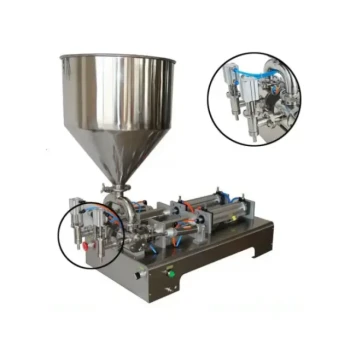
High-precision dosing for small containers
The limited yield of dwarf honeybee colonies makes accurate volumetric filling a central requirement. Filling machines should be calibrated for smaller containers and low batch volumes so that operators can minimize overfill, underfill, and residual product loss.
This is especially important for premium retail formats, sample-size jars, medicinal presentations, and specialty gift packaging.
Anti-drip filling nozzles protect product yield
Anti-drip volumetric nozzles help prevent stringing, leakage, and product accumulation around the container mouth. These issues can create both direct product losses and inconsistent seals.
A clean shutoff is particularly valuable when filling dense honey into narrow-neck or small-format containers.
Adjustable positive-displacement pumps improve consistency
A positive-displacement pump can deliver a controlled quantity even when the product’s viscosity changes during storage or temperature adjustment. Adjustable settings allow the line to be tuned for different package sizes and operating conditions.
This flexibility also helps distributors and contract packers serve multiple specialty honey formats without requiring a completely separate filling line.
Low-shear handling protects quality
Honey should be transferred with gentle mechanical handling. Excessive shear, turbulence, or air entrainment can affect appearance and increase the risk of foaming or bubbles in the finished container.
Pump and piping layouts should therefore prioritize short, efficient product paths, smooth internal surfaces, and controlled flow rates.
Food-grade, corrosion-resistant contact surfaces
Honey is naturally acidic, with an average pH of approximately 3.9, and contains chemically active components such as invertase and glucose oxidase. Product-contact components should therefore use food-grade, corrosion-resistant materials, particularly high-grade stainless steel.
This protects both product safety and equipment service life during repeated cleaning and production cycles.
How Small-Batch Processing Affects Line Design
Minimize hold-up volume
Large tanks, oversized manifolds, and long transfer lines can retain a disproportionate amount of product when processing only a few kilograms. Equipment for dwarf honeybee honey should be sized around the actual batch volume rather than copied from a high-throughput bulk honey line.
Low hold-up design improves yield and simplifies product recovery during batch completion.
Support fast and clean changeovers
Specialty honey processors may handle multiple varietals or batches with different color, flavor, or market positioning. Filling machinery should allow quick cleaning and changeover without requiring excessive dismantling.
This is a practical advantage for distributors supplying modular systems, compact fillers, pumps, filtration units, and packaging equipment as a coordinated package.
Match the filler to the packaging strategy
The correct machine depends on whether the buyer is filling small jars, sample containers, medicinal bottles, or larger wholesale packs. Nozzle configuration, hopper capacity, pump range, and control software should all be selected around the target package sizes.
A flexible machine is often more valuable than a high-speed machine when supply is limited and product value is high.
Understanding the Trade-offs
Low crystallization does not mean low viscosity
The honey may remain liquid while still requiring substantial pumping force. High dextrin content and the naturally concentrated nature of honey can produce a dense flow profile, particularly at lower temperatures.
Processors should not select equipment based solely on crystallization behavior. Crystallization resistance and pumping ease are separate design considerations.
Less heating can increase the importance of pump design
Reducing thermal treatment preserves quality but places more responsibility on the pumping and filling system. If the equipment cannot handle the honey at its natural or minimally warmed viscosity, operators may compensate with excessive heating.
The better approach is to combine suitable pump capacity, controlled temperature adjustment, and accurate flow management.
Small batches can make automation harder to justify
A fully automated high-speed line may be uneconomical when colony yields are only hundreds of grams or a few kilograms. Large equipment can also create excessive product retention and cleaning losses.
Compact or modular semi-automatic equipment may deliver better overall economics for specialty producers, while larger distributors can offer scalable configurations as supply volumes grow.
Premium positioning increases quality expectations
High-value medicinal or specialty honey is typically sold on authenticity, purity, and careful handling. Contamination, overheating, inaccurate labeling volumes, or visible filling defects can undermine the product’s commercial value.
Equipment selection must therefore address not only throughput, but also traceability, hygienic design, dosing accuracy, and gentle processing.
Making the Right Choice for Your Goal
The most suitable machinery package should reflect both the honey’s composition and the limited volume available from Apis florea colonies.
- If your primary focus is preserving natural honey quality: Choose food-grade, corrosion-resistant equipment with gentle low-shear pumping and precise, moderate temperature control.
- If your primary focus is minimizing product loss: Select a compact system with low hold-up volume, accurate positive-displacement dosing, and anti-drip filling nozzles.
- If your primary focus is specialty retail packaging: Prioritize high-precision filling for small containers, adjustable volume settings, and clean container-mouth shutoff.
- If your primary focus is serving multiple B2B customers: Source modular pumps, fillers, nozzles, and controls that can be configured for different viscosities and package sizes.
- If your primary focus is reducing capital cost: Avoid oversized de-crystallization systems and high-speed lines unless your supply volume clearly justifies them.
With the right combination of gentle processing, flexible pumping, and precision filling, dwarf honeybee honey can be packaged efficiently without sacrificing its premium value.
Summary Table:
| Characteristic | Impact on Processing | Required Equipment Features |
|---|---|---|
| High levulose, low crystallization | Less need for de-crystallization heating | Gentle thermal management, no heavy-duty de-crystallizers |
| High dextrin, viscosity variation | Need for stable flow control | Positive-displacement pumps, adjustable flow |
| Small colony yield (0.5-1 kg) | High value, possible losses significant | Low hold-up volume, high-precision filling, anti-drip nozzles |
| Premium positioning | Quality expectations high | Food-grade corrosion-resistant materials, hygienic design, low-shear handling |
| Multiple B2B customers | Need for flexibility | Modular, configurable systems for different viscosities and packages |
Looking to process dwarf honeybee honey efficiently? HONESTBEE offers comprehensive beekeeping equipment, including gentle processing and precision filling solutions tailored for specialty honey. Our one-stop sourcing, rapid response, and expert support ensure you maximize yield and quality. For distributors and B2B buyers, we provide OEM/ODM support, certifications, and reliable supply. Contact us today to optimize your honey processing line.
Related Products
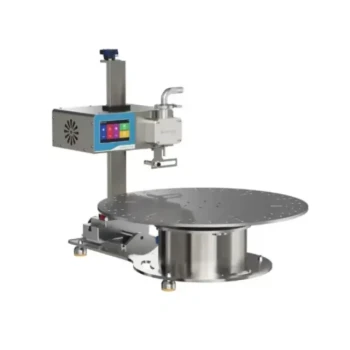
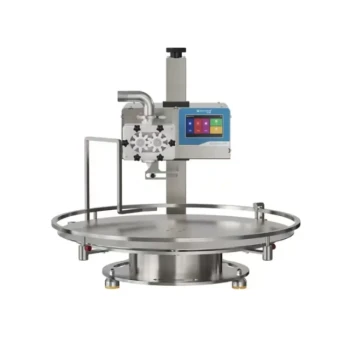
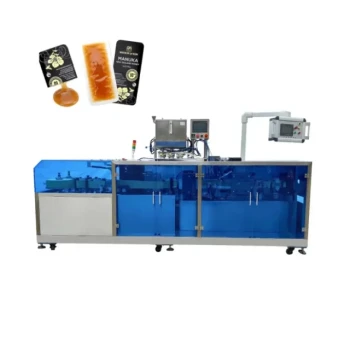
- Fully Automatic Honey Filling Packaging Machine for Processing Line
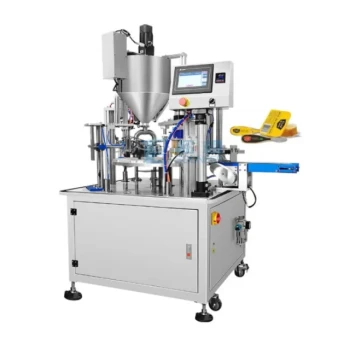
- Precision Durable Efficient HONESTBEE Rotary Honey Filling Machine
- Automatic Honey Filling and Filtering Machine for Beekeeping Bottle Filling
- Economy Small Honey Filling Machine Honey Bottle Filler Packaging Machine
- Small Honey Filling Machine Sachet Packing Equipment Single Nozzle
People Also Ask
- Why are fully automatic honey filling and packaging lines essential? Boost Your Honey's Market Value and Quality
- What is a fully-automatic honey filler? Streamline Your Production with High-Precision Automation
- How do automated honey filling and packaging machines affect profitability? Boost Margins with HONESTBEE Technology
- How do automated honey filling and packaging machines contribute to the market value of honey products? Maximize Your ROI
- How do industrial-grade automated honey filling and packaging machines mitigate the risk of physical contamination?