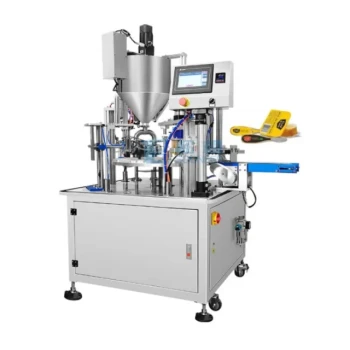
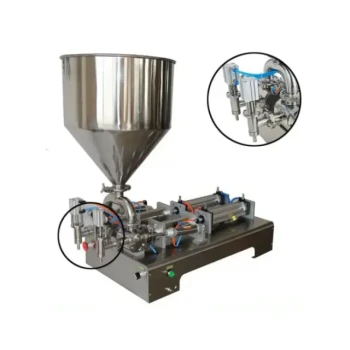
Accurate volume-to-weight conversion is essential because automated honey equipment fills by volume, while commercial transactions and regulations usually depend on weight. Honey is significantly denser than water—approximately 1.4 kg per liter, compared with 1 kg per liter for water—so applying water-based settings can cause substantial filling errors. Correct conversions help operators calibrate filling volumes, size storage vessels, control product giveaway, and meet international net-weight requirements.
The central issue is density, not just arithmetic: the same volume of honey weighs more than the same volume of water, and US, Imperial, and Metric units are not interchangeable. Accurate conversion provides the link between machine settings, actual honey weight, and compliant commercial packaging.
Why Honey Cannot Be Calibrated Like Water
Honey Has a Higher Density
A useful working reference is approximately 1.4 kg of honey per liter. Therefore, a 1-liter fill of honey weighs about 1.4 kg, not 1 kg.
Using water as the calibration basis would make the machine appear accurate by volume while producing the wrong net weight. This is especially serious when packaging is sold by declared weight.
Volume and Weight Measure Different Things
Volume describes how much physical space the honey occupies. Weight describes the mass of the product in the container.
Automated filling systems may dispense a target volume, but labels, invoices, and trade regulations commonly specify a target weight. The conversion between them must account for honey density.
Regional Units Create Additional Risk
Commercial equipment and packaging may use Metric, US Customary, or Imperial units. Key references include:
- 1 US gallon ≈ 3.8 liters
- 1 UK gallon ≈ 4.5 liters
- 1 fluid ounce ≈ 28 milliliters
- 1 kilogram ≈ 2.2 pounds
These units are not interchangeable. A US gallon and a UK gallon represent different volumes, so confusing them can create systematic filling and storage errors.
How Conversion Accuracy Affects Machine Calibration
Setting the Correct Fill Target
If the required package weight is known, the operator must convert that weight into the corresponding honey volume before programming the filler.
For example, a target of 1.4 kg of honey corresponds approximately to 1 liter at the reference density. A different target weight requires a proportional volume adjustment.
Compensating for Honey’s Viscosity
Honey is considerably more viscous than water. The machine must therefore be configured for the product’s flow behavior, not simply for the container’s nominal capacity.
Precision sensors and feedback controls help compensate for filling variation. However, those systems can only maintain the correct target if the initial volume-to-weight relationship is accurate.
Preventing Underfill and Overfill
An underfilled container can fail declared-weight requirements and damage customer trust. An overfilled container may remain compliant but create unnecessary product giveaway across thousands of units.
Accurate conversion establishes the correct operating point before the machine’s sensors and controls fine-tune individual fills.
Why Accuracy Matters Across the Processing Line
Selecting the Right Storage Vat
Storage tanks and vats are generally specified by volume, while honey inventories may be purchased or reported by weight.
Using the correct density conversion allows operators to determine how much honey a tank can actually hold by weight. This helps prevent overloading, underutilization, and inaccurate production planning.
Coordinating Filling and Packaging
A processing line may include pumps, holding tanks, fillers, capping systems, and labeling equipment. If one stage uses liters, another uses gallons, and the commercial specification uses kilograms or pounds, conversion errors can propagate through the entire line.
A consistent conversion standard keeps equipment settings, batch records, packaging specifications, and order quantities aligned.
Supporting Product Quality
Accurate automated filling reduces the need for manual correction and helps maintain consistent package quantities. Rapid sealing also limits exposure to air and moisture, which supports stable storage and distribution.
Automation therefore contributes not only to quantity control but also to hygienic, repeatable packaging operations.
The Commercial Importance of Net-Weight Compliance
Meeting International Trade Requirements
Honey distributors often sell across markets that use different measurement systems. Correct conversions help ensure that a package declared in kilograms, pounds, ounces, or another unit contains the required net quantity.
This is particularly important for wholesalers, exporters, and private-label suppliers serving multiple regions.
Protecting Margins
A small overfill may appear insignificant on one bottle. Across a large production run, however, the cumulative loss can become commercially material.
Accurate calibration minimizes avoidable product giveaway while maintaining the required fill tolerance.
Maintaining Brand Consistency
Retail customers expect every bottle in a product range to have a consistent quantity and presentation. Automated equipment supports that consistency, but only when the underlying conversion and calibration parameters are reliable.
For beekeepers and decentralized apiaries, standardized filling can help transform variable small-batch production into a more consistent commercial offering.
Understanding the Trade-offs
Nominal Density Is Not a Universal Constant
The approximately 1.4 kg-per-liter figure is a practical reference, not a substitute for checking the actual product. Honey characteristics can vary between batches, and operating conditions can affect flow behavior.
For high-value or tightly regulated production, calibration should be verified using the specific honey being processed and the actual equipment configuration.
Volume-Based Calibration Can Still Drift
Even with correct conversion factors, filling accuracy can be affected by viscosity, temperature, pump performance, nozzle behavior, sensor response, and container variation.
Operators should use routine weight checks to confirm that the programmed volume produces the required net weight.
Unit Shortcuts Cause Expensive Errors
Treating a US gallon as an Imperial gallon, or assuming that one liter of honey weighs one kilogram, creates predictable but avoidable mistakes.
The safest approach is to document the selected unit system, density assumption, conversion factors, and verification method for each product and market.
Precision Has an Operational Cost
High-precision fillers, sensors, and feedback systems require proper setup, maintenance, and trained operators. The investment is justified when production volume, regulatory exposure, labor savings, and product value make consistency commercially important.
For smaller operations, a simpler system may be appropriate, provided manual verification is rigorous and repeatable.
How Distributors and Buyers Should Evaluate Equipment
Check Measurement-System Compatibility
Confirm whether the machinery, documentation, and controls use Metric, US Customary, Imperial, or configurable units. This is particularly important when equipment is sourced internationally or deployed across multiple facilities.
Request Calibration and Verification Procedures
A capable supplier should explain how the filler is calibrated, how weight checks are performed, and how the system compensates for honey viscosity and flow variation.
Clear technical support can reduce commissioning delays and help operators achieve reliable performance faster.
Match Equipment to the Full Workflow
The right purchase is not always the machine with the highest nominal speed. Evaluate compatibility with storage vats, pumps, bottle formats, sealing systems, labeling requirements, and expected order volumes.
A supplier offering a broad product portfolio and responsive fulfillment can simplify sourcing, but technical fit should remain the primary selection criterion.
How to Apply This to Your Project
Use a documented conversion and verification process before commissioning or changing an automated honey line.
- If your primary focus is filling accuracy: Convert the target package weight using honey’s density, program the corresponding volume, and verify the result with repeated scale checks.
- If your primary focus is international distribution: Confirm whether every specification uses Metric, US Customary, or Imperial units, and prevent US-gallon and UK-gallon values from being mixed.
- If your primary focus is reducing product giveaway: Set the machine to the minimum reliable fill that satisfies the declared net weight, then monitor actual weights throughout production.
- If your primary focus is storage capacity: Convert the vat’s volume into the expected honey weight before finalizing tank size and batch planning.
- If your primary focus is equipment procurement: Choose machinery with suitable sensors, feedback controls, viscosity handling, documentation, and supplier support for your operating environment.
Accurate volume-to-weight conversion turns automated honey filling from a nominal volume exercise into a controlled, compliant, and commercially reliable process.
Summary Table:
| Aspect | Impact of Accurate Conversion | Consequence of Inaccurate Conversion |
|---|---|---|
| Filling Accuracy | Correct weight per container | Under/overfill, product giveaway |
| Regulatory Compliance | Meets net-weight requirements | Fines, customer distrust |
| Storage Sizing | Proper tank capacity planning | Over/underutilization |
| International Trade | Consistent units across markets | Unit confusion, shipping errors |
| Brand Consistency | Uniform product presentation | Customer perception issues |
Optimize your honey packaging line with HONESTBEE's precision equipment and comprehensive support. Our solutions ensure accurate filling, reduce giveaway, and meet global compliance. Contact us today to enhance your operational efficiency and profitability—Get in touch!
Related Products
- Fully Automatic Honey Filling Packaging Machine for Processing Line
- Precision Durable Efficient HONESTBEE Rotary Honey Filling Machine
- Automatic Honey Filling and Filtering Machine for Beekeeping Bottle Filling
- Economy Small Honey Filling Machine Honey Bottle Filler Packaging Machine
- Small Honey Filling Machine Sachet Packing Equipment Single Nozzle
People Also Ask
- Why are fully automatic honey filling and packaging lines essential? Boost Your Honey's Market Value and Quality
- What is a fully-automatic honey filler? Streamline Your Production with High-Precision Automation
- How do automated honey filling and packaging machines affect profitability? Boost Margins with HONESTBEE Technology
- How do automated honey filling and packaging machines contribute to the market value of honey products? Maximize Your ROI
- How do industrial-grade automated honey filling and packaging machines mitigate the risk of physical contamination?