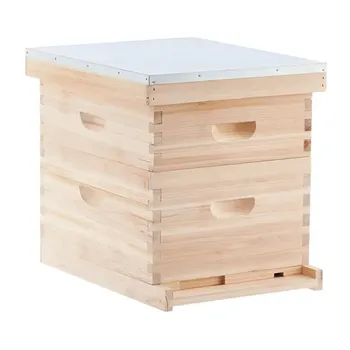
Beehive boxes are stacked rather than permanently nailed together because the hive must remain modular. Beekeepers need to add or remove honey supers, inspect brood chambers, harvest honey, and perform maintenance without dismantling the entire colony housing. The components are designed to align securely by weight and fit while remaining separable when required.
The hive’s stackable design turns it into an adjustable system rather than a fixed structure. Individual sections can be inspected, expanded, reduced, replaced, or serviced according to colony needs and seasonal conditions.
Why Modular Stacking Matters
Colonies Need Different Amounts of Space
A colony’s space requirements change throughout the year. Beekeepers may add honey supers during a nectar flow and remove them when honey is harvested or activity declines.
If every box were nailed together, changing the hive’s capacity would be slow and disruptive. Stackable sections allow the hive to grow or contract as needed.
Beekeepers Must Inspect Individual Sections
Routine inspections often require access to specific parts of the hive, especially the brood chamber, where the queen and developing bees are located.
A modular hive allows the beekeeper to lift off upper sections and examine the colony without permanently dismantling the entire structure.
Honey Harvesting Requires Access
Honey supers must be removed when honey is ready for extraction. Because the supers are separate units, beekeepers can take them away while leaving the brood chamber and the rest of the colony in place.
This separation supports more efficient harvesting and reduces unnecessary disturbance to the bees.
Maintenance Is Easier
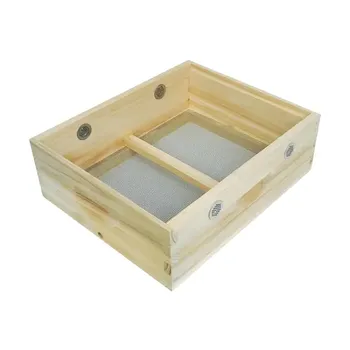
Hive components can eventually require cleaning, repair, replacement, or treatment. Separate sections make it possible to service a floor, brood box, super, crown board, or roof without replacing or rebuilding the complete hive.
For beekeepers and suppliers, this also makes replacement-part sourcing more practical. A damaged component can be ordered individually rather than requiring a complete hive assembly.
How the Stack Stays Secure
Weight and Interlocking Geometry Provide Stability
The boxes are designed to sit accurately on one another. Their weight, dimensions, and construction provide stability while still allowing the beekeeper to separate them when necessary.
The hive is not intended to be casually unstable. In windy or mobile conditions, beekeepers may use external straps or other securing methods while preserving the modular arrangement.
The Components Work as a System
A typical arrangement may include:
- Hive stand
- Floor
- Brood chamber
- Honey supers
- Crown board
- Roof
Each component performs a different function, but the complete hive works through vertical assembly rather than permanent fastening.
Why Nailing the Hive Together Would Be Impractical
It Would Restrict Expansion and Reduction
Nailing the boxes together would make it difficult to add or remove supers as colony conditions change. This would undermine one of the most important management features of a modern hive.
It Would Make Inspections More Disruptive
A fixed structure would force the beekeeper to access multiple sections together, increasing handling time and potentially disturbing more of the colony than necessary.
It Would Complicate Transport and Storage
Modular boxes are easier to move, stack, store, and distribute as separate units. This is valuable for commercial beekeepers, wholesalers, resellers, and suppliers managing different hive configurations and replacement requirements.
Understanding the Trade-offs
Stacking Requires Correct Alignment
Because the components are not permanently joined, they must be positioned correctly during assembly. Poor alignment, damaged edges, or unsuitable component dimensions can compromise the fit.
Consistent manufacturing tolerances and compatible hive components are therefore important when sourcing products from multiple suppliers.
Unsecured Hives May Be Vulnerable to Weather
Stacked sections can be affected by strong wind, accidental impact, or rough handling. Appropriate external restraints may be necessary, particularly for hives in exposed locations or during transportation.
The solution is usually to secure the stack externally—not to eliminate the modular design by permanently nailing the hive sections together.
Individual Boxes Still Need Strong Construction
The fact that hive sections are stackable does not mean each box should be weak or loosely built. Brood boxes and supers must withstand repeated lifting, seasonal use, and handling.
Individual box joints can be nailed or otherwise fastened during manufacture or assembly. The key distinction is that the box itself is permanently constructed, while the completed hive remains modular.
Making the Right Choice for Your Goal
Choose the modular hive format according to how the equipment will be managed and supplied.
- If your primary focus is colony management: Use stackable components so hive capacity, inspections, harvesting, and maintenance can be handled section by section.
- If your primary focus is product sourcing: Offer compatible stands, floors, brood boxes, supers, crown boards, roofs, and securing accessories as a complete one-stop portfolio.
- If your primary focus is durability: Prioritize well-constructed boxes with properly fastened joints, while keeping the finished hive sections removable.
- If your primary focus is distribution efficiency: Favor standardized, modular components that can be stored, replaced, consolidated, and delivered efficiently.
A stackable hive is not a compromise in construction; it is a deliberate design that makes beekeeping more adaptable, maintainable, and commercially practical.
Summary Table:
| Aspect | Stackable Hive | Nailed Single Structure |
|---|---|---|
| Flexibility | Can add/remove supers as needed | Fixed capacity, difficult to adjust |
| Inspections | Easy access to brood chambers | Disruptive, requires dismantling |
| Harvesting | Remove supers without disturbing colony | Must separate whole structure |
| Maintenance | Individual components replaceable | Entire structure must be serviced |
| Transport/Storage | Modular, easy to stack/store | Bulky, hard to move/store |
Upgrade Your Beekeeping Operations with Modular Hive Solutions
At HONESTBEE, we specialize in providing top-quality, modular beehive components that enhance your apiary's efficiency and productivity. Whether you're a commercial beekeeper, distributor, or reseller, our comprehensive range includes brood boxes, supers, stands, and accessories, all manufactured to precise tolerances for perfect stacking. Enjoy rapid response, dedicated support, and ultra-fast delivery with our one-stop sourcing. Maximize your profit margins with our OEM/ODM services and certified products. Contact us today to discover how our modular solutions can transform your beekeeping operations!
Related Products
- Australian Langstroth Beehive Boxes for Beekeeping Wholesales
- Metal Bee Hive Stand Bee Box Stand for Beekeeping
- Langstroth Honey Bee Box Hive Boxes for Different Depths
- High-Performance Langstroth Bee Hives for Global Professional Beekeeping
- Professional Beekeeping Quilt Box with Multi Vent Moisture Control
People Also Ask
- What are the primary advantages of using standardized Langstroth boxes? Scale Your Commercial Beekeeping Operation
- What are the differences between the three standard depths of Langstroth boxes? Choose the Best Size for Your Apiary
- What role do standardized Langstroth boxes play in commercial apiary management and honey bee research? | HONESTBEE Guide
- How many beehive boxes are needed when starting a new hive? A Guide to Proper Hive Setup
- What are the disadvantages of using a combination of deep and medium boxes? Avoid Costly Incompatibility Issues