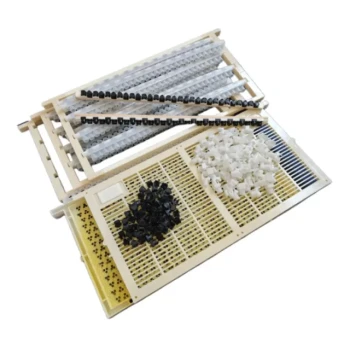
Mini-hives are the strategic cornerstone of high-yield royal jelly production because they function as refined management units that artificially optimize colony population density. Unlike full-sized hives designed for honey storage, mini-hives restrict space to force a higher density of nurse bees, ensuring that the colony's biological energy is focused almost exclusively on feeding larvae and secreting royal jelly.
Success in royal jelly production is not determined by the total size of the colony, but by the density of care. Mini-hives act as specialized "nursing factories," prioritizing the intensive rearing of queen larvae over general hive maintenance.
The Biological Advantage: Density and Focus
To understand why mini-hives are essential, you must look at how colony geometry influences bee behavior.
Creating High Nurse Bee Density
The primary driver of royal jelly production is the ratio of nurse bees to larvae. Mini-hives utilize a restricted volume to maintain a consistently high density of nurse bees.
Concentrating Colony Energy
In a standard hive, energy is dispersed across foraging, guarding, and honey processing. The smaller environment of a mini-hive channels the colony’s collective resources directly into nursing tasks.
Triggering the Feeding Instinct
This concentration of nurse bees creates a competitive biological pressure. It compels the bees to feed the grafted larvae in queen rearing frames more aggressively, resulting in higher quantities of royal jelly per cell.
Operational Efficiency in Production
Royal jelly production is a high-frequency, labor-intensive process. Mini-hives transform this process from a chore into a streamlined operation.
Refined Management Units
Mini-hives are designed as refined management units. Their smaller size makes them physically easier to manipulate during the frequent inspections required for production.
Supporting High-Frequency Harvesting
Royal jelly harvesting requires strict timing and frequent repetition. The mini-hive structure facilitates the frequency of larval grafting and collection cycles without the logistical burden of dismantling large honey supers.
Synergy with Consumables
These hives are engineered to work specifically with production consumables. They integrate seamlessly with grafting needles and queen rearing frames, allowing for a standardized, high-intensity workflow.
Understanding the Trade-offs
While mini-hives are superior for royal jelly, they represent a specialized approach with distinct limitations.
Single-Purpose Specialization
These units are not generalists. By optimizing for nurse bee density and royal jelly secretion, you effectively sacrifice honey production capacity.
Intensive Management Requirements
The high density and small space require precise management. The system is designed for high-intensity harvesting, meaning the operator must be prepared for a rigorous schedule of grafting and collection.
Optimizing Your Production Setup
Deciding to use mini-hives is a commitment to a specific type of apiary management.
- If your primary focus is maximizing yield per colony: Implement mini-hives to enforce the high nurse bee density required for peak royal jelly secretion.
- If your primary focus is process efficiency: Use these smaller units to reduce the physical labor and time associated with the frequent removal and insertion of queen rearing frames.
Mini-hives transform the biological imperative of the nurse bee into a scalable, industrial advantage.
Summary Table:
| Feature | Standard Hive | Mini-Hive (Royal Jelly) |
|---|---|---|
| Primary Objective | Honey storage & colony growth | High-density nurse bee concentration |
| Management Unit | Large/Bulky | Refined & easy to manipulate |
| Labor Frequency | Seasonal harvesting | High-frequency grafting & collection |
| Resource Focus | Foraging & guarding | Larvae feeding & jelly secretion |
| Tool Integration | Standard frames | Specialized queen rearing frames |
Elevate Your Royal Jelly Yield with HONESTBEE
At HONESTBEE, we specialize in empowering commercial apiaries and distributors with the precision tools needed for high-intensity production. Whether you are scaling up your royal jelly output or streamlining your operation, we provide the complete spectrum of specialized hardware—from mini-hives and queen rearing frames to advanced honey-filling and hive-making machinery.
Our comprehensive wholesale offering ensures you have access to essential consumables and honey-themed merchandise designed for global success. Partner with HONESTBEE today to optimize your specialized beekeeping workflow.
Contact Us for Wholesale Pricing and Equipment Solutions
References
- Maria Cláudia Colla Ruvolo-Takasusuki, Denise Alves Lopes. Relationship Between Hygienic Behavior and Varroa destructor Mites in Colonies Producing Honey or Royal Jelly. DOI: 10.13102/sociobiology.v59i1.682
This article is also based on technical information from HonestBee Knowledge Base .
Related Products
- No Grafting Queen Rearing Kit: System for Royal Jelly Production and Queen Rearing
- Automatic Heat Preservation 6 Frame Pro Nuc Box for Honey Bee Queen Mating
- Portable Bee Mating Hive Boxes Mini Mating Nucs 8 Frames for Queen Rearing
- Plastic Chinese Queen Grafting Tool for Bee Queen Rearing
- 4 Frame Plastic Nuc Boxes for Beekeeping Bee Nuc Box
People Also Ask
- What is the primary function of a queen rearing kit? Eliminate Manual Grafting for Superior Bee Breeding
- How do specialized queen rearing kits and queen management tools improve the success rate of bee colony expansion?
- What are some alternative methods to grafting for queen cell production? Discover Graft-Free Queen Rearing Systems
- Are queen rearing systems generally suitable for all honeybee species? Master Efficient Breeding Methods
- Are queen rearing systems suitable for all beekeepers? Modern Tools for Every Experience Level