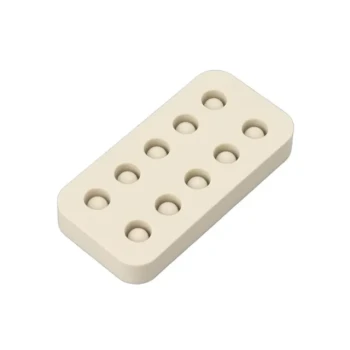
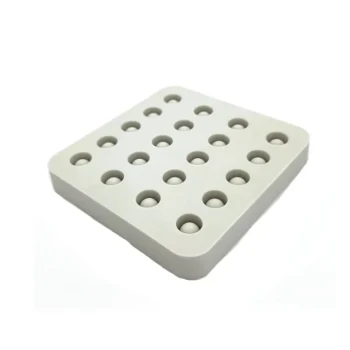
Standardized hardwood molds are essential instruments in royal jelly production because they provide the exact geometric precision required to mimic natural queen cells. By replicating specific dimensions, such as a 9mm diameter, these tools trigger the natural instincts of nurse bees to accept transferred larvae and begin the intense secretion of royal jelly.
The Core Insight Success in royal jelly harvesting is not about forcing the colony to produce, but about effectively simulating nature to trigger a biological response. Precision-molded artificial cells achieve larval acceptance rates exceeding 95%, stabilizing the production environment and transforming royal jelly from a scarce resource into a scalable commodity.
The Role of Precision in Biomimicry
Simulating the Natural Cell Structure
The primary function of the hardwood mold is to create an artificial environment that is indistinguishable from a natural queen cell to the bees.
Specialized artificial cells serve as a core consumable in commercial beekeeping. They are designed to induce worker bees to deposit massive quantities of royal jelly, far exceeding what is needed for a single larva.
The Critical 9mm Standard
The effectiveness of these molds relies entirely on dimensional accuracy.
Primary references indicate that a 9mm diameter is the specific standard used to simulate the natural cell. This precise measurement is the biological "key" that unlocks the colony's rearing behavior.
High Rates of Larval Acceptance
Using standardized molds significantly increases the likelihood that worker bees will care for the transferred larvae.
When the dimensions are exact, acceptance rates for transferred larvae often exceed 95 percent. Without this high level of acceptance, the bees would simply remove the larvae rather than filling the cup with royal jelly.
Scaling for Commercial Production
Stabilizing the Secretion Environment
Standardized molds do more than just house larvae; they create a consistent secretion environment.
By stabilizing this environment, beekeepers improve both the yield and the consistency of the harvest. This turns a biological variable into a predictable production metric.
Enabling High-Density Harvesting
Artificial cells transform royal jelly from a substance that is difficult to collect into a product suitable for mass harvesting.
Beekeepers arrange these cups at high density on hive frames. This alters the natural regulation of the colony, allowing for systematic collection.
The Harvest Timeline
The use of standardized cells supports a strict production schedule.
Beekeepers transfer 1-2 day old larvae into these cells and can harvest high-purity royal jelly every 48 to 72 hours. This allows for large-scale manual or mechanical collection workflows.
Understanding the Operational Constraints
The Necessity of Precision
The system relies entirely on the accuracy of the hardware.
If the molds deviate from the standardized dimensions (e.g., the 9mm diameter), larval acceptance rates will plummet. The colony will reject the artificial environment, resulting in zero yield for those specific cells.
Operational Intensity
While the tools standardize the structure, the process remains labor-intensive.
The workflow requires the manual transfer of delicate larvae (grafting) and rigid adherence to the 48-72 hour harvest window. The hardware provides the foundation, but it does not automate the biological care required by the bees.
Making the Right Choice for Your Operation
- If your primary focus is maximizing yield: Prioritize molds with verified high-precision dimensions (specifically 9mm) to ensure larval acceptance rates remain above 95%.
- If your primary focus is process efficiency: Utilize standardized cell cups that allow for high-density arrangement on frames to facilitate mechanical or bulk manual harvesting.
Standardization in hardware is the critical variable that allows beekeepers to convert natural bee behavior into a predictable industrial process.
Summary Table:
| Feature | Specification/Benefit | Biological Impact |
|---|---|---|
| Cell Diameter | 9mm (Standardized) | Triggers natural nurse bee feeding instincts |
| Acceptance Rate | > 95% | Ensures high efficiency and minimal larval rejection |
| Harvest Window | Every 48–72 Hours | Enables predictable, high-frequency production cycles |
| Production Goal | Biomimicry | Simulates natural queen cells to stimulate jelly secretion |
| Scale | High-Density Frames | Transforms royal jelly into a scalable commercial commodity |
Elevate your commercial royal jelly production with HONESTBEE’s precision-engineered equipment. As a leading partner for commercial apiaries and global distributors, we provide the high-accuracy hardwood molds and specialized machinery needed to stabilize your yields and scale your operations. From essential hive consumables to advanced honey-filling machines and unique cultural merchandise, HONESTBEE delivers the complete toolkit for beekeeping success. Contact our experts today to optimize your wholesale supply chain!
References
- İbrahim ŞEKER, Murat Yılmaztekin. Volatile organic compounds of royal jellies obtained from honeybee (Apis mellifera L.) colonies fed with different industrial sugars at different locations. DOI: 10.1007/s11694-025-03097-w
This article is also based on technical information from HonestBee Knowledge Base .
Related Products
- 10-Cell Silicone Beeswax Bee Queen Cups Forming Mold
- High-Efficiency 20-Cell Silicone Mold for Beeswax Bee Queen Cup Production
People Also Ask
- How do beeswax queen cell cups function? Optimize Queen Rearing with Biological Mimicry
- What is the biological function of beeswax queen cell cups? Boost Acceptance in Artificial Queen Rearing
- What role do specialized queen rearing tools play in developing mite-resistant honeybee stock? Master Genetic Selection
- What materials are used to make artificial queen cell cups for grafting? Beeswax vs. Plastic Guide
- What roles do specialized queen cell cups play in royal jelly production? Optimize Your Hive's Secretion and Yield