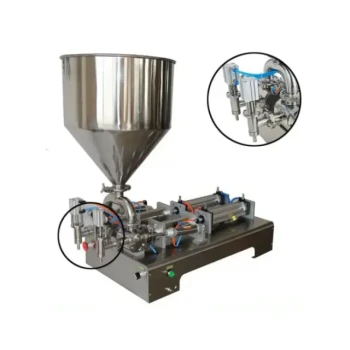
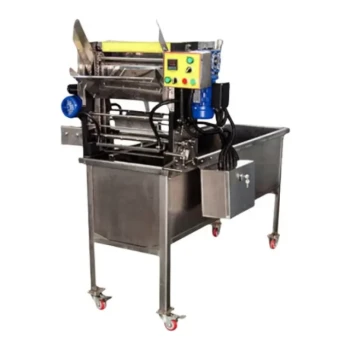
Commercial viability relies on precision and speed. Automated honey filling machines are necessary because they utilize precise flow metering systems and closed filling environments to guarantee weight consistency and hygienic safety. By eliminating the inconsistencies of manual handling, these systems significantly improve production efficiency while effectively preventing secondary contamination, ensuring every unit meets the strict standards required for modern retail.
The Core Insight: Automation is not just about speed; it is the hardware foundation for product integrity. It transforms variable raw honey into a standardized, contamination-free commodity necessary for maintaining a high-quality brand image and ensuring traceability in a competitive market.
Elevating Hygiene and Safety Standards
The Closed-Loop Environment
Manual handling inherently introduces risks of bacteria and foreign particles entering the product. Automated machines utilize closed filling environments to isolate the honey during processing. This effectively prevents secondary contamination, a critical requirement for food safety compliance.
Protecting Product Purity
Beyond bacteria, honey is sensitive to environmental factors. Sealed packaging processes minimize oxidation, which can degrade quality over time. This technology preserves the honey's natural state, enhancing shelf life and ensuring the consumer receives a safe, high-quality product.
Ensuring Traceability
Advanced industrial equipment enables a closed production cycle from the hive to the final packaging. This minimizes the risk of external pollen contamination or the unauthorized introduction of adulterants like sugar syrup. By keeping the pollen fingerprint consistent from apiary to bottle, these machines provide the physical proof needed for reliable traceability systems.
Achieving Commercial Standardization
Precise Quantitative Control
Commercial apiaries cannot afford the variances caused by human error. Automated systems use precise flow metering to ensure strict net weight consistency across all units. This guarantees that every customer receives exactly what is stated on the label, building consumer trust.
Handling Varying Viscosities
Honey is not a uniform liquid; its thickness changes based on the floral source (e.g., acacia vs. multi-flower). Automated machines are capable of processing honey with varying viscosities without sacrificing speed or accuracy. This allows large-scale operations to maintain production consistency regardless of the specific honey type being bottled.
Minimizing Product Loss
Manual filling frequently leads to spills, overfilling, or residue left in transfer containers. Professional filling equipment drastically minimizes product loss. This efficiency maximizes the yield from every harvest, directly impacting the profitability of the operation.
Understanding the Operational Requirements
The Necessity of Maintenance
While automation solves manual labor issues, it introduces a need for technical oversight. To maintain precise metering control, the equipment requires regular calibration and cleaning. Neglecting the hardware can lead to the very inconsistencies the machine was purchased to solve.
Transitioning Business Models
Implementing this machinery is essential for transitioning from bulk wholesale to differentiated retail. It is a commitment to a business model that values branding and packaging over simple raw volume. Apiaries must be prepared to manage the labeling and certification requirements that come with entering higher-value consumer markets.
Making the Right Choice for Your Goal
To determine how to best leverage this technology for your apiary, consider your immediate business objectives:
- If your primary focus is Market Access: Implement automation to ensure the supply stability, weight consistency, and hygiene standards required by large retail chains and distributors.
- If your primary focus is Brand Integrity: Utilize closed-loop filling systems to protect the pollen fingerprint of your honey, providing indisputable proof of origin and purity to your customers.
Automated filling is the definitive step that allows a commercial apiary to evolve from a raw material supplier into a trusted, scalable consumer brand.
Summary Table:
| Feature | Manual Filling | Automated Filling Machines |
|---|---|---|
| Consistency | High variance due to human error | Precise flow metering and weight control |
| Hygiene | Risk of secondary contamination | Closed-loop environment for food safety |
| Efficiency | Slow and labor-intensive | High-speed processing for volume orders |
| Waste Reduction | Common spills and overfilling | Minimal product loss and drip control |
| Traceability | Difficult to verify cycle | Guaranteed pollen fingerprint integrity |
Elevate Your Commercial Beekeeping with HONESTBEE
Transitioning from bulk supply to a premium retail brand requires the right hardware. At HONESTBEE, we empower commercial apiaries and distributors with the specialized machinery needed to thrive in a competitive market.
Our comprehensive wholesale offering includes everything from high-precision honey-filling machines and hive-making equipment to specialized beekeeping tools and industry consumables. We don’t just supply hardware; we provide the foundation for product integrity, ensuring your honey meets strict global standards for safety and traceability.
Ready to scale your operations and maximize your harvest's value? Contact HONESTBEE today to explore our professional equipment solutions
References
- Alina Piątyszek-Pych. The state and the development prospects of the Lubusz cluster initiative „The Lubusz Wine and Honey Route”. DOI: 10.2478/v10286-012-0063-z
This article is also based on technical information from HonestBee Knowledge Base .
Related Products
- Fully Automatic Honey Filling Packaging Machine for Processing Line
- Automatic Honey Filling and Filtering Machine for Beekeeping Bottle Filling
- Precision Durable Efficient HONESTBEE Rotary Honey Filling Machine
- Semi Automatic Small Honey Bottle Filling Machine Honey Filler
- Precision Automated Packaging Turntable Honey Spoon Filling Sealing Packing Machine
People Also Ask
- Why are fully automatic honey filling and packaging lines essential? Boost Your Honey's Market Value and Quality
- What is a fully-automatic honey filler? Streamline Your Production with High-Precision Automation
- How do automated honey filling and packaging machines affect profitability? Boost Margins with HONESTBEE Technology
- How do automated honey filling and packaging machines contribute to the market value of honey products? Maximize Your ROI
- How do industrial-grade automated honey filling and packaging machines mitigate the risk of physical contamination?