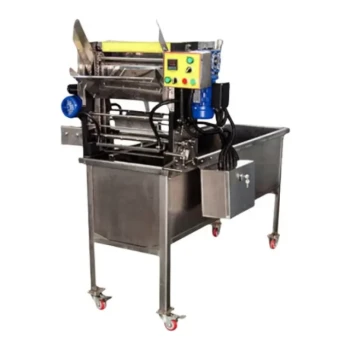
Automation is the critical defense against environmental volatility in modern apiculture. In regions facing invasive wasp expansion, manual processing becomes a liability as honey odors attract predators that disrupt operations and cause significant economic losses. Automated, closed-loop equipment mitigates these risks by accelerating the harvest cycle and sealing scents within a mechanized system, ensuring both worker safety and product integrity.
Core Takeaway: To maintain a resilient supply chain in wasp-heavy regions, distributors must prioritize automated processing that minimizes environmental exposure. This transition effectively neutralizes biological threats while guaranteeing the high-precision output and rapid marketization required for global competitiveness.
Neutralizing Biological Risks Through Closed-Loop Engineering
Minimizing Scent Emission to Prevent Infestation
Invasive wasps are highly sensitive to the volatile organic compounds released during honey extraction. Automated, closed-loop systems significantly reduce the "scent trail" that attracts these pests, preventing the swarming behavior that often halts manual operations.
By containing the honey within a sealed environment from extraction to bottling, producers can maintain a secure facility perimeter. This technical barrier is the first line of defense in maintaining a consistent production schedule regardless of outside pest pressure.
Accelerating the Harvest Cycle
Time is the most critical factor when invasive species threaten a harvest. High-efficiency machinery shortens the processing window, allowing commercial apiaries to move honey from the hive to a sealed container in a fraction of the time required by manual labor.
For distributors, this speed translates to ultra-fast delivery and fulfillment. Rapid processing ensures that honey is moved out of high-risk zones and into secure warehouses before environmental factors can impact the seasonal yield.
Guaranteeing Product Purity and Market Readiness
High-Precision Metering and Volume Consistency
Beyond pest mitigation, automated systems utilize high-precision metering pumps to ensure every unit meets strict commercial standards. This eliminates the "overflow loss" common in manual pouring, which not only saves revenue but also prevents sticky residues from attracting more wasps to the packaging area.
Wholesalers benefit from this standardized consistency, as it ensures that every batch meets the precise physicochemical indicators required for international trade and medical-grade applications.
Maintaining Bioactive Integrity
Modern automated equipment incorporates integrated temperature control and filtration. These systems preserve the delicate bioactive components and unique flavor profiles of the honey while removing impurities that could lead to fermentation or spoilage.
For the B2B reseller, this technical precision guarantees product stability during long-distance transport. This reliability is essential for maintaining a premium brand reputation in competitive global markets.
Understanding the Trade-offs and Implementation Challenges
Initial Capital Expenditure vs. Long-Term ROI
The primary hurdle for many operations is the high initial investment required for industrial-grade automation. While the upfront costs are significant, they must be weighed against the potential for total crop loss or severe labor disruptions caused by wasp infestations.
Distributors should view this equipment not just as a tool, but as risk insurance for their supply chain. The reduction in manual labor costs and the elimination of product waste typically lead to a rapid return on investment in high-risk regions.
Technical Complexity and Maintenance Requirements
Sophisticated automated systems require dedicated technical expertise for calibration and maintenance. A failure in a closed-loop system can halt production entirely if spare parts are not readily available or if the staff lacks the training to troubleshoot the machinery.
Working with a one-stop sourcing partner who provides comprehensive support and rapid response times is critical. This ensures that any technical bottlenecks are resolved quickly, maintaining the "always-on" capability required during peak harvest seasons.
Maximizing Value for Your Distribution Network
Choosing the right equipment requires balancing regional environmental threats with your specific commercial goals. Our expertise allows us to tailor solutions that prioritize both safety and throughput.
- If your primary focus is Risk Mitigation in pest-heavy zones: Prioritize fully enclosed, high-speed extraction lines that offer the lowest possible scent profile.
- If your primary focus is Large-Scale Export Consistency: Invest in systems with high-precision metering and integrated physical filtration to meet international food safety regulations.
- If your primary focus is Operational Efficiency: Focus on modular automation that allows for rapid order fulfillment and minimizes manual contact to reduce labor overhead.
By integrating advanced automation today, you secure a stable, high-quality honey supply chain that remains resilient against the evolving challenges of the natural environment.
Summary Table:
| Key Challenge | Automation Solution | Operational Benefit |
|---|---|---|
| Invasive Wasp Swarms | Closed-loop, sealed systems | Minimizes scent emissions to prevent pest attraction |
| Harvest Delays | High-efficiency machinery | Rapidly moves product from hive to container |
| Product Waste | High-precision metering pumps | Eliminates sticky residue and ensures volume consistency |
| Quality Degradation | Integrated temperature control | Preserves bioactive integrity and flavor profiles |
| Labor Costs | Modular mechanized lines | Reduces manual overhead and human error |
Scale Your Success with HONESTBEE’s Industry-Leading Solutions
Protect your margins and future-proof your operations against environmental threats. HONESTBEE specializes in serving commercial apiaries and distributors with a comprehensive, one-stop sourcing experience. Whether you need advanced honey-filling machines, specialized hive-making hardware, or a steady supply of essential consumables, we deliver the professional expertise your business demands.
Why partner with us?
- Full-Spectrum Portfolio: Everything from heavy machinery to cultural merchandise.
- Elite Service: Rapid response times and dedicated technical support.
- Optimized Logistics: Ultra-fast delivery to keep your supply chain resilient.
- B2B Excellence: Premium trading services designed for wholesalers and resellers.
Contact us today to explore our wholesale offerings and see how our automated solutions can transform your productivity.
References
- Xueyou Zhang, Jianmeng Feng. Future Range Expansions of Invasive Wasps Suggest Their Increasing Impacts on Global Apiculture. DOI: 10.3390/insects15070546
This article is also based on technical information from HonestBee Knowledge Base .
Related Products
- Fully Automatic Honey Filling Packaging Machine for Processing Line
- Automatic Honey Filling and Filtering Machine for Beekeeping Bottle Filling
- Precision Automated Packaging Turntable Honey Spoon Filling Sealing Packing Machine
- Precision Durable Efficient HONESTBEE Rotary Honey Filling Machine
- Manual Honey Filling Machine Bottling Machine for Honey
People Also Ask
- Why are fully automatic honey filling and packaging lines essential? Boost Your Honey's Market Value and Quality
- What is a fully-automatic honey filler? Streamline Your Production with High-Precision Automation
- How do automated honey filling and packaging machines affect profitability? Boost Margins with HONESTBEE Technology
- How do automated honey filling and packaging machines contribute to the market value of honey products? Maximize Your ROI
- How do industrial-grade automated honey filling and packaging machines mitigate the risk of physical contamination?