The Gateway and the Liability
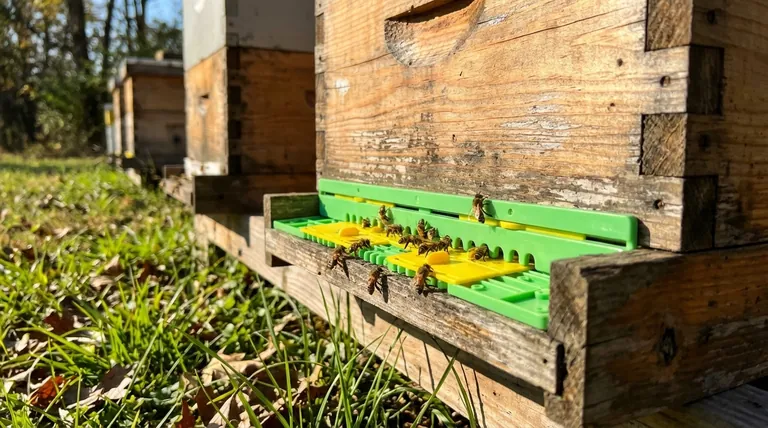
A beehive entrance is not merely a door. It is a port of commerce, a thermal regulator, and the single greatest point of vulnerability for the colony within.
For the bees, it is the boundary between the known world of the hive and the unpredictable world outside. For the beekeeper, it is the most important control point for managing the colony's risk.
The decision to leave that gateway wide open or to narrow it is one of the most consequential choices in hive management. It’s a constant negotiation between access and security.
The Psychology of a Defensible Space
A honey bee colony operates with a kind of collective cognition. It allocates resources—bees—to tasks based on perceived needs. A wide, undefended entrance represents a significant and constant threat.
This forces the colony to dedicate more bees to guard duty, pulling them away from other critical tasks like nursing brood or foraging.
By constricting the entrance with a reducer, you fundamentally change the psychological equation for the colony. You create a chokepoint, a defensible funnel.
The problem of defense becomes simpler, less demanding. It allows a smaller security force to be profoundly effective against robbers like wasps, hornets, and bees from competing hives. The colony can then reallocate its energy toward growth.
The Physics of Climate Control
Inside the hive, bees are engaged in a relentless battle with physics. They must maintain the brood nest at a stable temperature and humidity, regardless of the weather outside.
An open entrance is a massive source of heat loss.
During the cold months, a reduced entrance dramatically lessens the energy the winter cluster must expend to stay warm. It minimizes drafts and contains the heat generated by their collective metabolism. This is a simple law of thermodynamics applied to colony survival.
Conversely, it serves as a physical barrier. In the fall, as mice seek shelter, a beehive offers a warm, food-rich prize. The smallest setting on a quality entrance reducer is often the only thing standing between a colony's survival and its complete destruction by a nesting rodent.
A Seasonal Guide to Access Management
The optimal size of the hive entrance is not static. It changes with the seasons and the colony’s own internal state.
Spring: The Vulnerable Startup
A new package or nucleus colony is like a startup: small, with limited resources and a skeleton crew. Its primary goal is rapid growth.
- Action: Use the smallest entrance opening.
- Rationale: It provides maximum defense, allowing the colony to focus its energy on building comb and raising the next generation of workers without the stress of defending a wide-open front.
Summer: The Open Market
A strong, populous hive during a heavy nectar flow is a logistics machine. Foragers are a constant stream of traffic, importing resources at a staggering rate.
- Action: Remove the reducer entirely.
- Rationale: An open entrance is now a high-throughput port. Restricting it would create a bottleneck, slowing down foraging, and trapping heat and humidity inside the hive on hot days.
Late Summer: The Time of Scarcity
When the nectar flow ceases, a dearth begins. Resources become scarce, and the risk of robbing skyrockets as desperate colonies try to steal from their neighbors.
- Action: Reduce the entrance on all hives, strong and weak.
- Rationale: This is a system-wide defensive measure. It helps every colony protect the stores it worked all summer to build.
Winter: The Long Siege
As temperatures fall, the colony shrinks into its winter cluster. Foraging ceases. The primary goals are now survival, heat conservation, and protection from the elements.
- Action: Use the smallest entrance opening.
- Rationale: This is the most critical time for a reducer. It provides maximum heat retention and is the primary defense against mice.
Managing the Inevitable Trade-Offs
Using an entrance reducer is an act of balancing competing needs. The two primary trade-offs are:
- Security vs. Throughput: A smaller entrance is more secure, but it limits the rate at which foragers can come and go.
- Insulation vs. Ventilation: A smaller entrance retains heat better but restricts airflow, which is critical for cooling and curing honey in the summer.
Good beekeeping is about observing the colony and the environment, and adjusting the entrance to meet the most pressing need at that moment.
| Situation | Recommended Action | Primary Benefit |
|---|---|---|
| New or Weak Colony | Use Smallest Opening | Creates a highly defensible space |
| Nectar Dearth | Reduce All Entrances | Prevents robbing and protects stores |
| Winter Preparation | Use Smallest Opening | Blocks mice and conserves colony heat |
| Strong Summer Hive | Remove Reducer Entirely | Maximizes forager traffic & ventilation |
For commercial apiaries, where efficiency and colony health are paramount, having durable and precisely-sized equipment is not a luxury—it's essential for effective management. HONESTBEE provides high-quality entrance reducers and beekeeping supplies designed for the demands of wholesale operations, ensuring you have the right tool to manage your colonies' most critical access point.
To equip your apiary for every season and every strategic challenge, Contact Our Experts
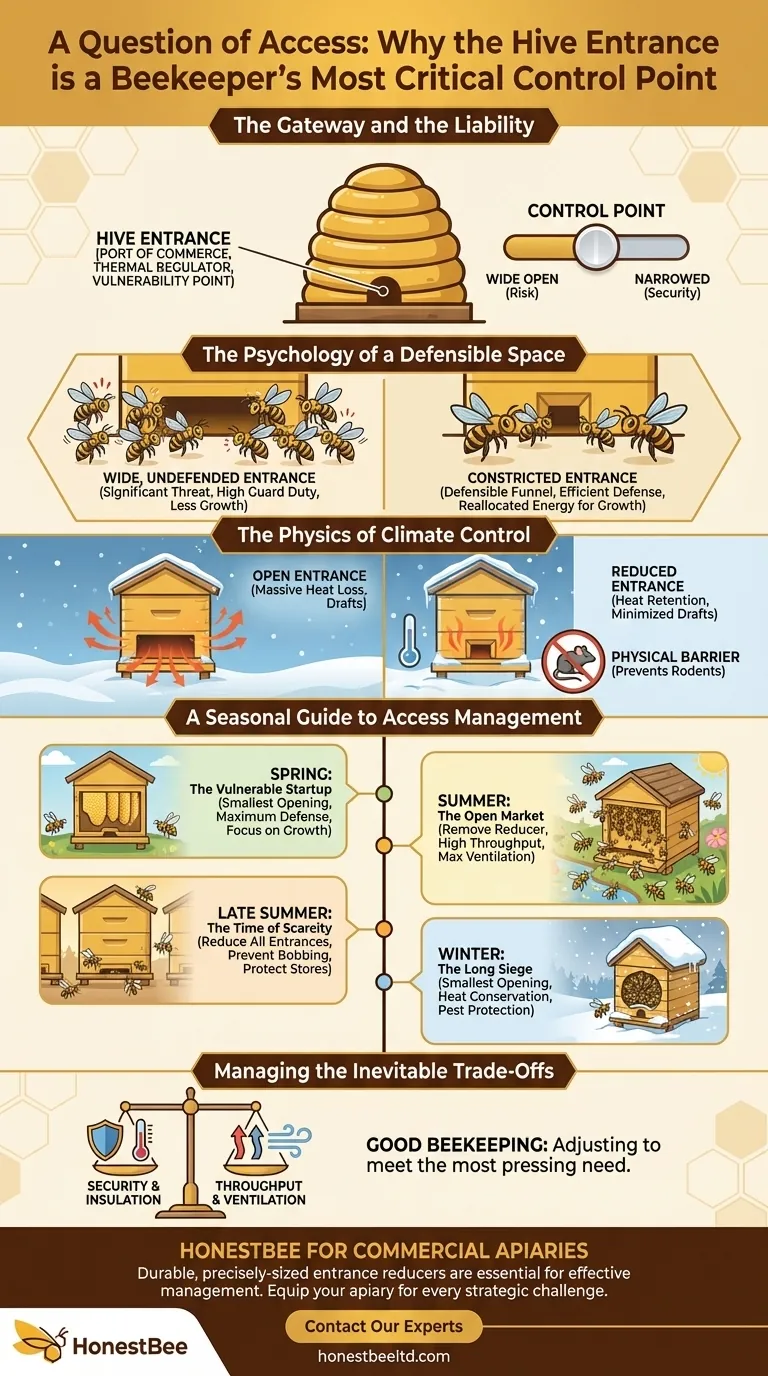
Visual Guide
Related Products
- Steel Round Disc Entrance Reducer for Flexzion Bee Hive Nuc Box Gate
- Beehive Entrance Reducer Guardian Metal Hive Entrance for Bees
- HONESTBEE Entrance Bee Feeder Professional Hive Nutrition Solution for Beekeeping
- Professional Hive Front Entrance Bee Feeder
- Professional Reversible Beehive Hive Entrance
Related Articles
- Strategic Entrance Reducer Management: From Hive Defense to Colony Growth Optimization
- Mastering Entrance Reducers: Seasonal Strategies for Hive Defense and Health
- Defensible Space: How a Simple Tool Reduces a Bee Colony's Collective Stress
- Managing Vulnerability: The Strategic Trade-offs of a Hive Entrance Reducer
- More Than a Block of Wood: How the Hive Entrance Reducer Governs a Colony's Fate




