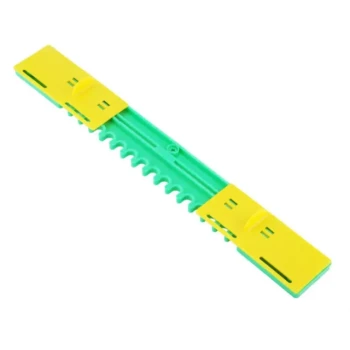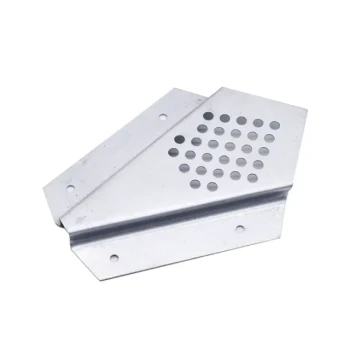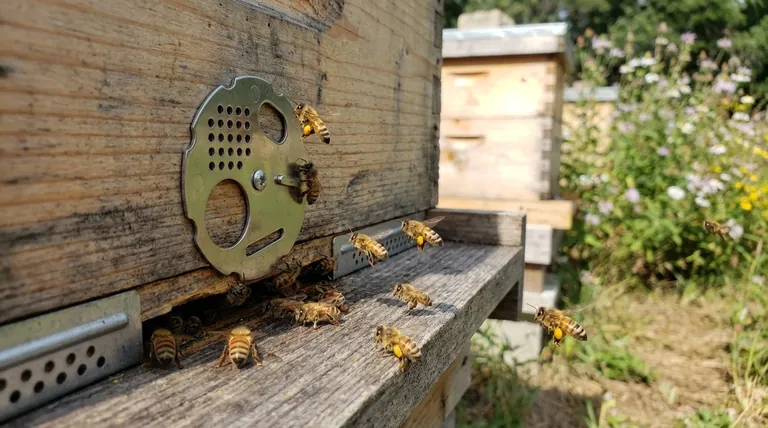
The Interface to a Superorganism
A beehive is not a box of insects. It's a superorganism—a self-regulating, living system with its own metabolism, defenses, and reproductive cycle.
As a beekeeper, your role is less a commander and more a system administrator. You don't dictate; you nudge. You observe feedback loops and make subtle adjustments to help the system thrive. The most direct interface for these adjustments is a deceptively simple piece of steel: the entrance disc.
This small, rotating gate is not just a door. It's a strategic control panel that defines the hive's relationship with the outside world. Mastering its four settings is about understanding the fundamental pressures a colony faces.
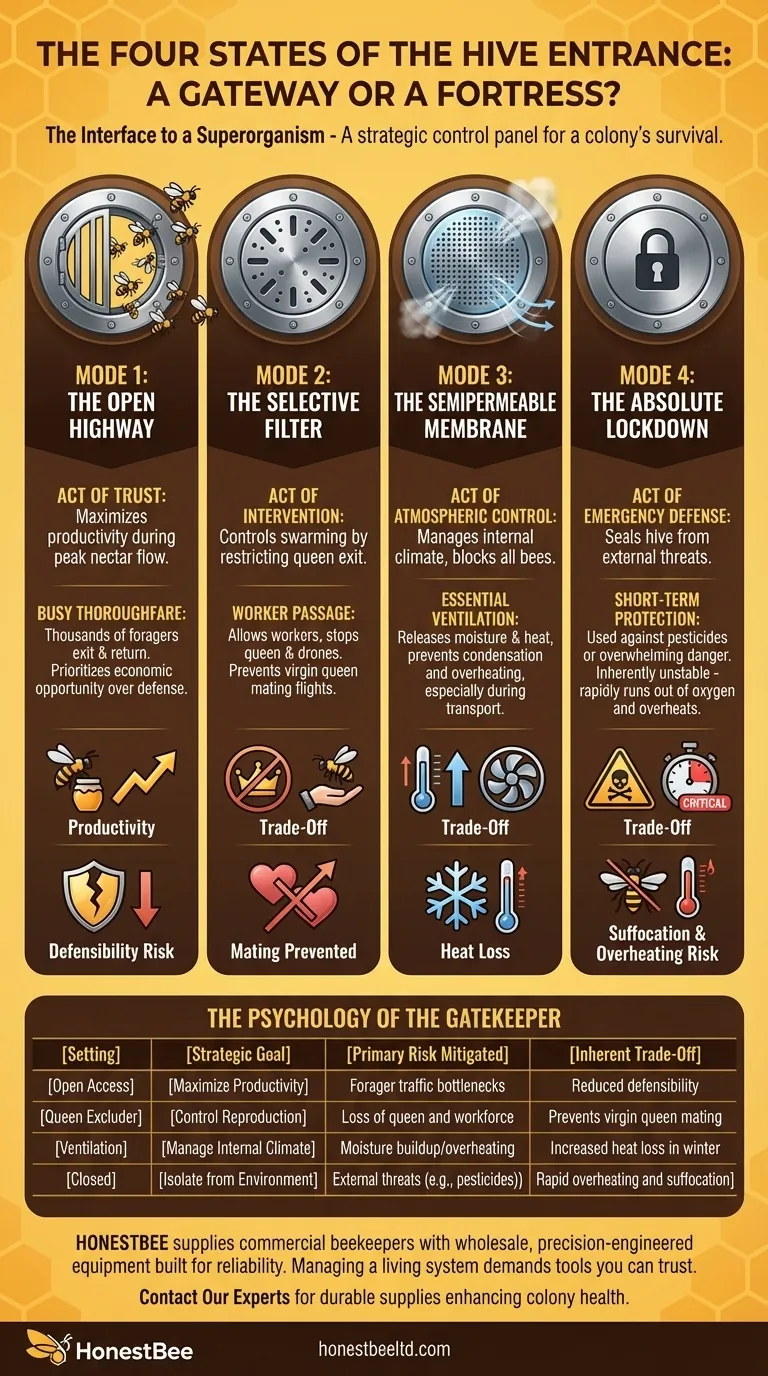
Mode 1: The Open Highway
The fully open setting is an act of trust.
During a peak nectar flow, the entrance becomes a bustling highway. Thousands of foragers per hour must exit and return without delay. A bottleneck here is a direct tax on productivity. By leaving the entrance wide open, a beekeeper is making a calculated decision: the economic opportunity of the nectar flow outweighs the risk of invasion.
This mode assumes the colony is strong, populous, and capable of defending a large perimeter. It's the default state for a thriving colony in a time of abundance.
Mode 2: The Selective Filter
The queen excluder setting is an act of intervention.
It reduces the entrance to slots or holes large enough for worker bees but too small for the queen or drones. Its primary function is to override one of the colony's most powerful instincts: swarming. By physically preventing the queen from leaving, the beekeeper can halt the swarm and retain the hive's workforce.
But this control comes with a critical trade-off. It also traps a new virgin queen, preventing her from taking her essential mating flights. Using this setting requires precise timing and a deep understanding of the colony's life cycle. It is a powerful tool for population management, but a blunt instrument if misapplied.
Mode 3: The Semipermeable Membrane
The ventilation setting is an act of atmospheric control.
A grid of tiny holes allows air to pass but blocks all bees. This mode addresses two invisible, existential threats: moisture and heat.
In the winter, a colony's collective respiration produces a surprising amount of water vapor. If trapped, this moisture will condense, drip onto the cluster, and kill the bees. Ventilation allows this damp air to escape.
When transporting a hive, especially in warm weather, the metabolic heat from thousands of agitated bees can raise the internal temperature to lethal levels within minutes. Ventilation provides the airflow needed for life support while keeping the population securely contained.
Mode 4: The Absolute Lockdown
The closed setting is an act of emergency defense.
It seals the hive completely. This is a short-term, last-resort measure. It’s used when an overwhelming external threat, like pesticide spraying in a nearby field, makes any exposure to the outside world unacceptable.
A closed hive is a closed system—inherently unstable. It immediately begins to run out of oxygen and overheat. A beekeeper who closes a hive is starting a clock. The decision to use this setting is a trade-off between a certain external danger and a rapidly escalating internal one.
The Psychology of the Gatekeeper
The challenge of beekeeping is not just knowing what each tool does, but understanding the competing priorities it forces you to balance. The entrance disc makes these strategic choices tangible.
| Setting | Strategic Goal | Primary Risk Mitigated | Inherent Trade-Off |
|---|---|---|---|
| Open Access | Maximize Productivity | Forager traffic bottlenecks | Reduced defensibility |
| Queen Excluder | Control Reproduction | Loss of queen and workforce | Prevents virgin queen mating |
| Ventilation | Manage Internal Climate | Moisture buildup/overheating | Increased heat loss in winter |
| Closed | Isolate from Environment | External threats (e.g., pesticides) | Rapid overheating and suffocation |
For commercial apiaries managing hundreds or thousands of colonies, these decisions are amplified. The equipment used to implement them must be reliable, durable, and precisely manufactured. A warped disc or a poorly sized excluder slot isn't a minor inconvenience; it's a systemic failure point.
The elegance of the steel entrance disc lies in its simplicity. It’s a minimalist piece of engineering that provides a robust interface for managing the most complex biological challenges. At HONESTBEE, we supply commercial beekeepers and distributors with wholesale equipment built on this principle of engineered reliability—because managing a living system demands tools you can trust.
If you're ready to equip your operation with durable, precision-engineered supplies that enhance colony health and operational efficiency, Contact Our Experts.
Visual Guide
Related Products
- Beehive Entrance Discs Plastic Bee Entrance Disc for Bee Hives
- Multi-Functional Rotary Hive Entrance Disc for Beekeeping
- Steel Round Disc Entrance Reducer for Flexzion Bee Hive Nuc Box Gate
- Professional Reversible Beehive Hive Entrance
- Multi-Functional Sliding Hive Entrance for Beekeeping
Related Articles
- Optimizing Beehive Entrance Discs: When Freedom Boosts Hive Performance
- Hive Security is a Geometry Problem: Mastering the Beehive Entrance
- More Than a Door: The Beehive Entrance Disc as a System Controller
- The Four-Way Gate: Mastering the Deceptive Simplicity of the Hive Entrance Disc
- How Hive Entrance Size Shapes Bee Health: Balancing Ventilation and Security