The Architect of the Threshold
Imagine moving a 50,000-member honeybee colony at night. The hive is sealed, the air inside is thick with the heat of clustered bodies, and every minute of confinement pushes them closer to overheating—a fatal condition.
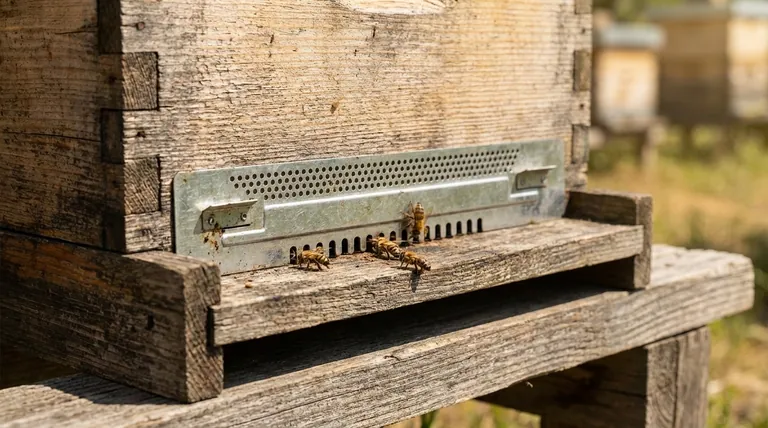
Your primary tool in this high-stakes operation is not a complex machine. It is a simple, often overlooked block of wood: the entrance reducer.
This single piece of equipment is a masterclass in elegant design. It's a physical interface between the controlled chaos inside the hive and the unpredictable world outside. How a beekeeper uses it reveals their understanding of risk, efficiency, and the subtle psychology of a superorganism.
A System of Three Choices
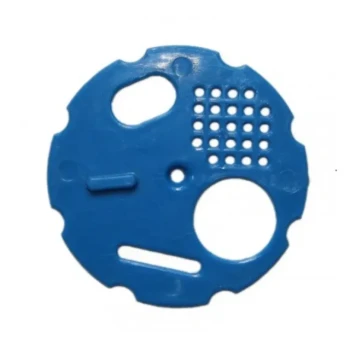
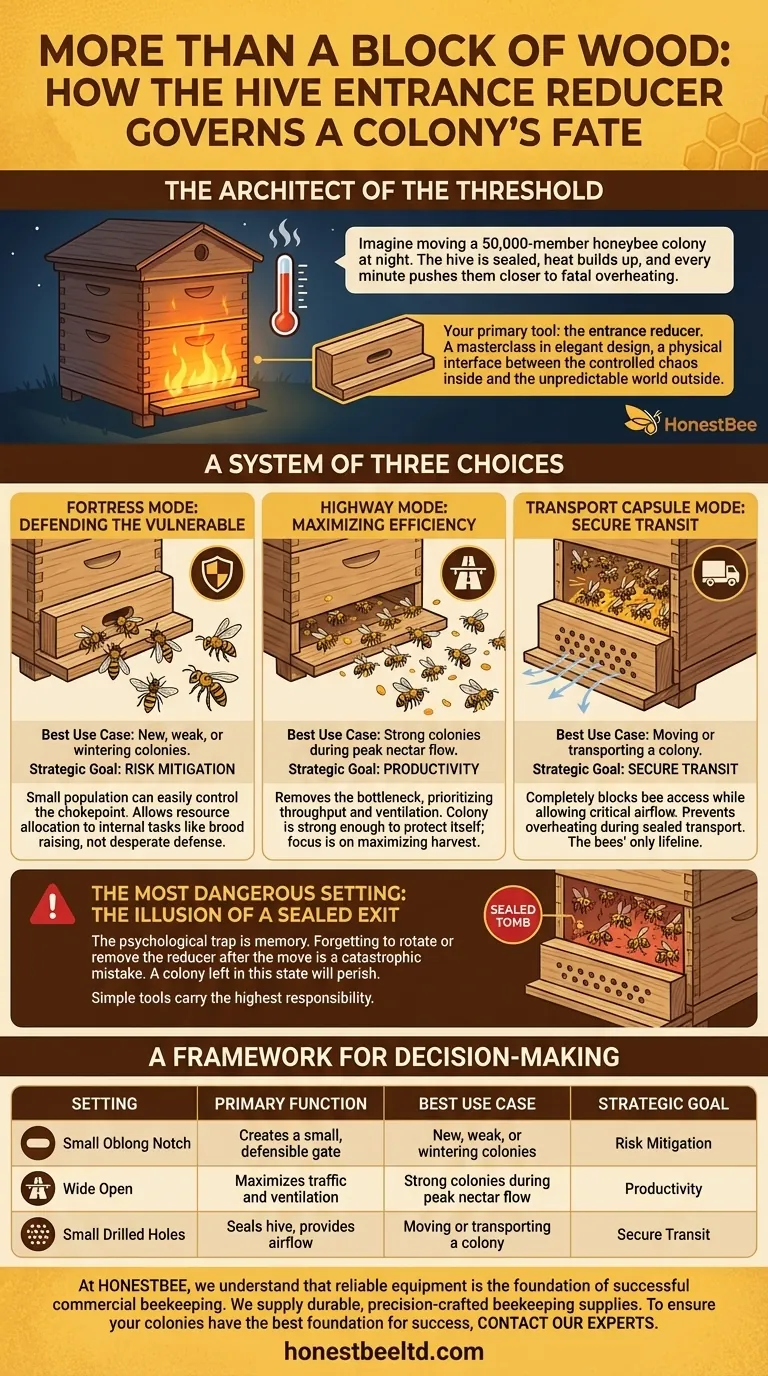
The entrance reducer isn't one tool, but three distinct control systems built into one. Each setting represents a strategic decision about the colony's posture towards the world: fortress, highway, or transport capsule.
Fortress Mode: Defending the Vulnerable
A new, small, or wintering colony is fragile. Its population is too low to effectively guard a full-width entrance against robbing bees or wasps. It’s like leaving the main gate of a castle open with only a few guards on duty.
By rotating the reducer to its small, oblong notch, the beekeeper fundamentally changes the defensive equation. The entrance shrinks to a chokepoint that a handful of guard bees can easily control.
This isn't just about security; it's about resource management. The colony can allocate more bees to internal tasks—raising brood, building comb—instead of diverting them to a desperate, sprawling defense.
Highway Mode: Maximizing Efficiency
Now, picture a booming colony in the peak of summer. Thousands of foragers are cycling in and out every minute, heavy with nectar. The air inside is humid, and the bees are working furiously to evaporate water from the honey.
In this scenario, a small entrance is a bottleneck. It creates a traffic jam, reduces foraging efficiency, and traps hot, moist air inside, stressing the colony.
Removing the reducer entirely—the wide-open setting—is the right choice. It prioritizes throughput and ventilation over defense. The colony is strong enough to protect itself; its primary goal is now maximizing the harvest during the short window of a nectar flow.
The Most Dangerous Setting: The Illusion of a Sealed Exit
The third setting is the most specialized and the most unforgiving of error. It's the side with a series of small, drilled holes.
This configuration completely blocks bee access while allowing for critical airflow. Its purpose is singular and absolute: safely transporting a hive. When a colony is sealed for a move, the bees generate immense heat. Without ventilation, they will cook themselves alive. These small holes are their only lifeline.
The psychological trap here is memory. The most catastrophic mistake a beekeeper can make is one of omission: forgetting to rotate or remove the reducer after the move is complete. A colony left in this state is a sealed tomb. They cannot forage, they cannot perform cleansing flights, and they will perish. It’s a stark reminder that the simplest tools often carry the highest responsibility.
A Framework for Decision-Making
Managing a hive is a series of trade-offs. The entrance reducer is the physical manifestation of those decisions. Your choice should always align with the colony's current strategic needs.
| Setting | Primary Function | Best Use Case | Strategic Goal |
|---|---|---|---|
| Small Oblong Notch | Creates a small, defensible gate | New, weak, or wintering colonies | Risk Mitigation |
| Wide Open | Maximizes traffic and ventilation | Strong colonies during peak nectar flow | Productivity |
| Small Drilled Holes | Seals hive, provides airflow | Moving or transporting a colony | Secure Transit |
Understanding this simple block of wood is to understand a core principle of beekeeping: you are not just a keeper, but a systems manager. The health and productivity of your operation depend on making the right choices with the right tools.
At HONESTBEE, we understand that reliable equipment is the foundation of successful commercial beekeeping. We supply durable, precision-crafted beekeeping supplies, including entrance reducers designed for the rigors of large-scale apiary management. To ensure your colonies have the best foundation for success, Contact Our Experts.
Visual Guide
Related Products
- Steel Round Disc Entrance Reducer for Flexzion Bee Hive Nuc Box Gate
- Beehive Entrance Reducer Guardian Metal Hive Entrance for Bees
- Professional Hive Front Entrance Bee Feeder
- Multi-Functional Rotary Hive Entrance Disc for Beekeeping
- HONESTBEE Entrance Bee Feeder Efficient Hive Front Liquid Feeding Solution for Beekeeping
Related Articles
- Strategic Entrance Reducer Management: From Hive Defense to Colony Growth Optimization
- A Question of Access: Why the Hive Entrance is a Beekeeper's Most Critical Control Point
- Defensible Space: How a Simple Tool Reduces a Bee Colony's Collective Stress
- Managing Vulnerability: The Strategic Trade-offs of a Hive Entrance Reducer
- The Bottleneck Principle: Why Reducing a Hive Entrance is Critical Winter Engineering