The Psychology of the Five-Dollar Bucket
It’s a familiar scenario for any producer. You stand in a hardware store, looking at a stack of generic, five-gallon buckets. They’re cheap. They seem sturdy enough. The thought is tempting: "It's just a bucket. Why pay more for a specialized one?"
This is a cognitive trap—the lure of a small, immediate saving obscures the risk of a much larger, delayed loss.
A honey pail is not "just a bucket." It is a piece of precision-engineered equipment designed to solve a specific set of physical, chemical, and logistical problems. Choosing the wrong container isn't a savvy shortcut; it's a gamble with your product, your reputation, and your bottom line.
The Guardian's Anatomy
The value of honey is a direct reflection of its purity. The purpose of a proper honey pail is not merely to hold this value, but to actively defend it. Every feature is a deliberate choice.
Material Integrity: The First Line of Defense
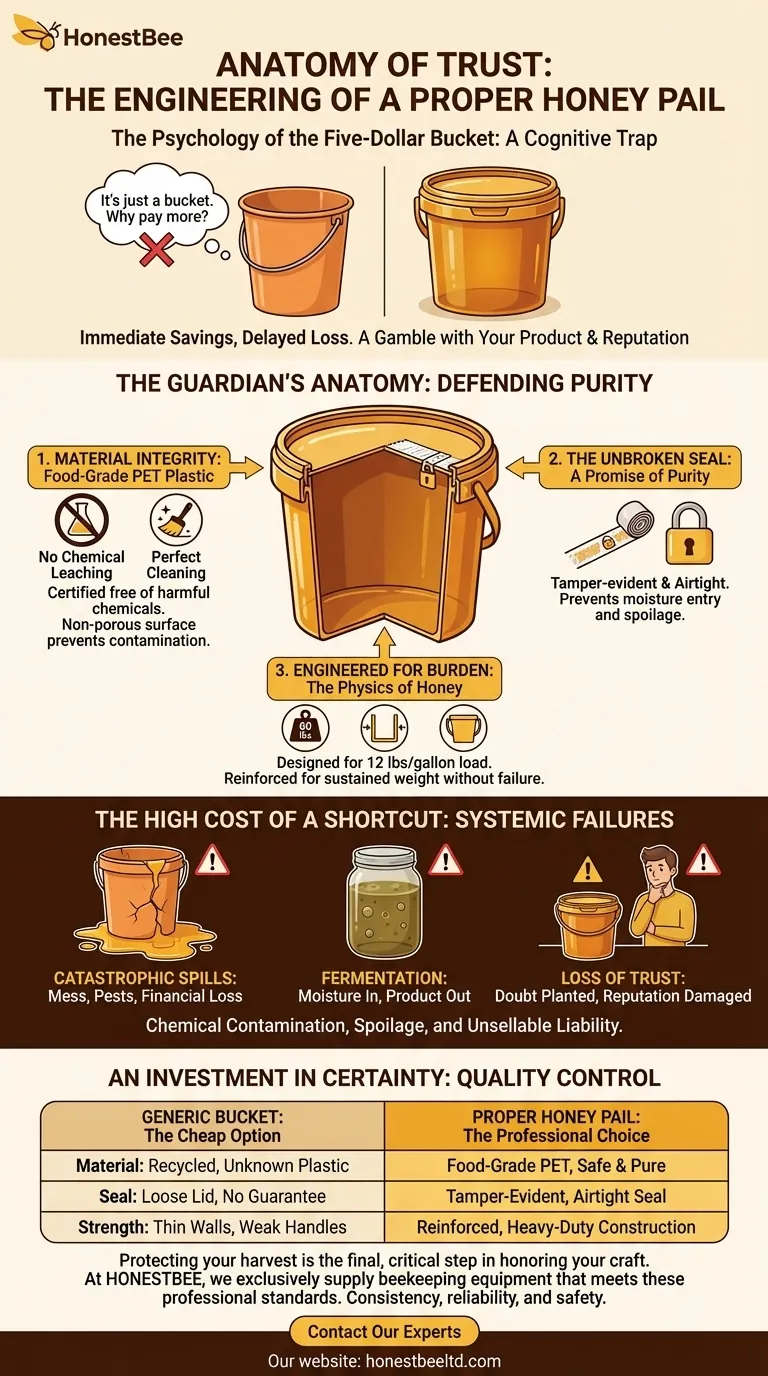
The first and most critical feature is the material itself: food-grade PET (Polyethylene terephthalate) plastic.
Unlike the recycled, dyed, or mystery-origin plastics of a general-purpose bucket, food-grade plastic is certified free of chemicals that can leach into honey. This prevents the introduction of off-flavors or harmful contaminants. Its non-porous surface also ensures it can be cleaned perfectly, preventing microbial growth between uses.
The Unbroken Seal: A Promise of Purity
Professional honey pails feature a tamper-evident seal. This small plastic strip is a powerful psychological tool.
For you, your distributor, or your final customer, it is a clear, unambiguous signal that the contents are exactly as they were when they left your care. It’s a silent promise of integrity. An ordinary snap-on lid offers no such guarantee and, more importantly, is not airtight. It allows ambient moisture to creep in, raising the honey's water content and creating the perfect conditions for fermentation and spoilage.
Engineered for Burden: The Physics of Honey
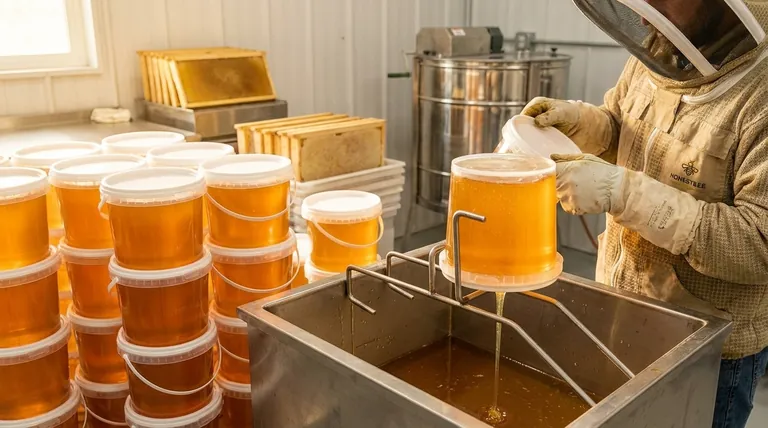
Honey is deceptively heavy, weighing about 12 pounds per gallon (1.4 kg per liter). A standard 5-gallon container will hold 60 pounds of it.
A generic bucket is not designed for this sustained, dense load. Its handle attachments can fail, its walls can warp, and the base can crack under the stress of being moved. A proper honey pail is built with reinforced walls and secure handle points, engineered specifically to manage this burden without failure, season after season.
The High Cost of a Shortcut
Imagine discovering a 60-pound pool of honey spreading across your storage room floor. The cause? A cracked bucket or a handle that tore free from its housing.
The immediate financial loss of the honey is only the beginning. The cleanup is a sticky, time-consuming nightmare that invites pests. But the most significant risks are often invisible.
- Chemical Contamination: A non-food-grade bucket slowly taints your pure honey with imperceptible chemicals, potentially failing quality tests or altering its delicate flavor profile.
- Fermentation: A poor seal allows moisture in, turning a shelf-stable product into a fermenting, unsellable liability.
- Loss of Trust: A customer receiving a container without a tamper-evident seal has no way of knowing its journey. Doubt is planted.
These aren't just operational hassles; they are systemic failures caused by choosing the wrong tool for a critical job.
An Investment in Certainty
The choice of a container is not an expense to be minimized, but an investment in quality control. The slightly higher cost of a proper honey pail buys you certainty.
| Feature | Purpose | Benefit for Commercial Beekeepers |
|---|---|---|
| Food-Grade PET Plastic | Prevents chemical leaching | Guarantees honey purity, safety, and flavor |
| Tamper-Evident Seal | Shows if the container has been opened | Builds customer trust; ensures supply chain integrity |
| Robust Construction | Handles the heavy weight of honey | Prevents catastrophic spills; allows for reusability |
For commercial apiaries and wholesale distributors, these benefits aren't just about protecting a single bucket; they're about protecting the integrity of an entire operation. Consistency, reliability, and safety are the pillars of a professional brand.
At HONESTBEE, we exclusively supply beekeeping equipment that meets these professional standards. We understand that for wholesale operations, equipment is not just a tool—it's part of your quality assurance system. Our honey pails are selected for their durability, safety, and reliability, ensuring your hard work is protected from the hive to the market.
Protecting your harvest is the final, critical step in honoring your craft. Contact Our Experts
Visual Guide
Related Products
- Food Grade Plastic Honey Bucket Pail for Beekeeping
- Premium Stainless Steel Honey Tank Bucket Pail with Reinforced Handle and Polished Finish
- Plastic Honey Gate Spout with Wing Nut for Beekeeping Honey Bucket
- Honeycomb Style Drip Free Honey Dispenser
- Stainless Steel Pail Perch Bucket Bench
Related Articles
- Why Honey Buckets Are So Hard to Open—And the Right Way to Do It
- The Last Mile: Why Your Honey Bucket Defines Your Harvest's Quality
- More Than a Bucket: Why Your Choice of Honey Pail is a Critical Business Decision
- Containing Liquid Gold: The Silent Engineering Inside Every Honey Jar
- How to Choose Honey Storage Containers That Prevent Spoilage and Extend Shelf Life