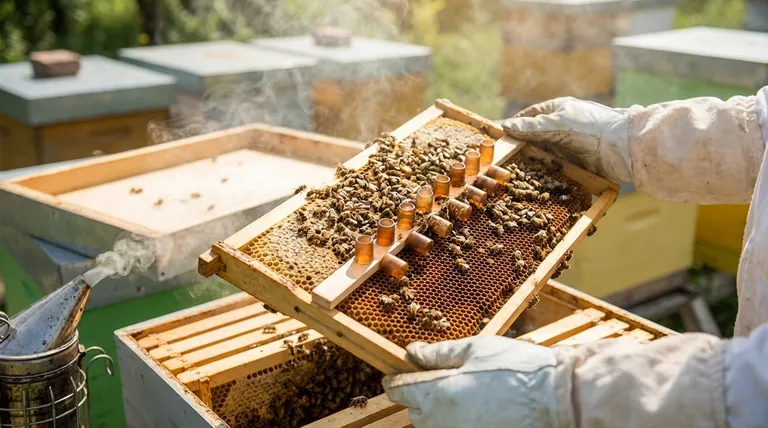
Beekeepers know brood box rearrangement can boost queen-rearing efficiency—but only when done with precision. Missteps risk chilled cells, weakened colonies, and lost productivity. This guide distills field-tested methods to maintain cell viability while streamlining labor, drawing from proven frameworks like the Ben Harden Method and thermal dynamics research.
Maximizing Cell Viability in Queen Rearing
Thermal Dynamics of Brood Nesting
Honeybee larvae thrive within a narrow thermal range (approximately 32–36°C). Disrupting the brood nest’s insulation during rearrangement exposes cells to temperature fluctuations that impair development.
Key tactics:
- Time manipulations during peak foraging (10 AM–2 PM), when ambient temperatures are stable and bees can quickly regroup around exposed brood.
- Buffer frames (1–2 honey/pollen frames) placed adjacent to queen cells act as thermal barriers.
Did you know? Research shows colonies can recover from brief chilling (under 2 hours) if humidity remains above 50%.
The Ben Harden Method Decoded
This protocol prioritizes minimal disturbance by:
- Pre-warming boxes to near-nest temperatures before rearrangement.
- Layered shuffling: Moving no more than two frames per 10-minute interval to allow bees to re-cluster.
Colony Strength Assessment
Bee Population Thresholds for Safe Rearrangement
Weak colonies lack the worker density to thermoregulate rearranged brood. Use these indicators:
- Minimum coverage: 6–8 frames densely covered by bees (≥80% coverage per frame).
- Nurse bee ratio: At least 30% of the population should be young (1–2 week-old) bees capable of rapid brood care.
Seasonal Considerations in Stocking Density
- Spring: Higher tolerance for rearrangement due to natural population growth cycles.
- Summer: Limit to overcast days to avoid heat stress.
- Fall: Avoid late-season manipulations; prep for winter clustering takes priority.
Implementation Protocols
Step-by-Step Box Rearrangement Workflow
- Pre-check: Verify ambient temperature is between 18–30°C.
- Smoke lightly to calm bees without dispersing nurse clusters.
- Work vertically: Shift entire boxes rather than individual frames when possible to preserve nest structure.
- Re-center brood within 1 hour, ensuring queen cells face inward.
Post-Rearrangement Monitoring Checklist
- Hour 1: Confirm bees are fanning around queen cells.
- Day 1: Check for rejected cells (peeled wax or worker aggression).
- Day 3: Assess larval development under a loupe for milky-white, plump appearance.
Risk Mitigation Strategies
Common Errors in Premature Rearrangement
- Overcrowding: Adding too many empty frames dilutes thermoregulation. Stick to a 1:4 ratio of new to established brood frames.
- Timing mismatches: Avoid manipulations during nectar flows when foragers are absent.
Salvaging Chilled Cells: Recovery Techniques
If cells cool below critical thresholds:
- Immediate insulation: Wrap the frame in a bee-safe heating pad (set to 34°C) for 20 minutes.
- Nurse bee boost: Brush 100–200 young bees from another frame onto affected cells.
Upgrade Your Apiary’s Efficiency
HONESTBEE’s insulated brood boxes and frame warmers help commercial beekeepers implement these protocols with precision. Designed for high-volume operations, our equipment minimizes thermal shock during large-scale rearrangements. Contact our wholesale team to outfit your apiary with tools that protect cell viability while cutting labor time.
Pro Tip: Pair rearrangement with HONESTBEE’s pollen substitute patties to accelerate nurse bee recovery post-manipulation.
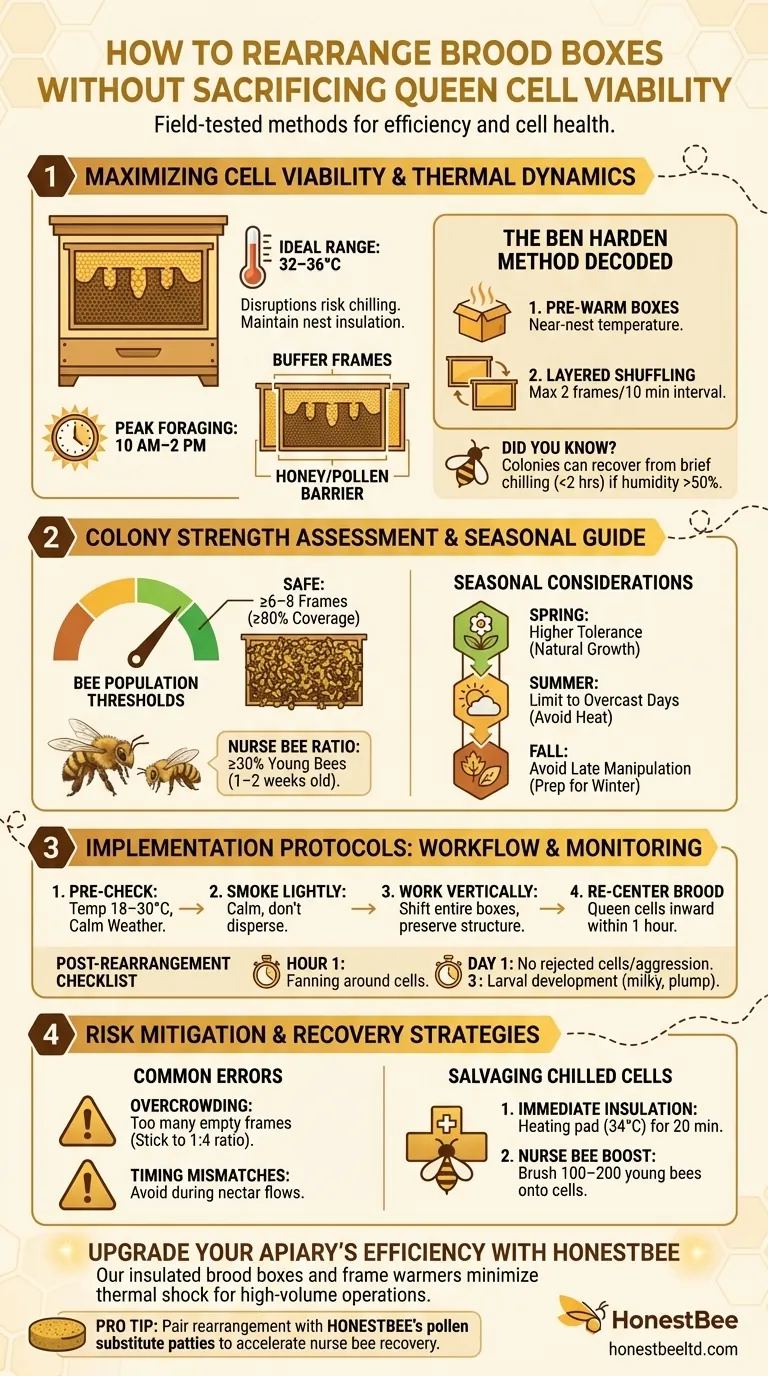
Visual Guide
Related Products
- Langstroth Honey Bee Box Hive Boxes for Different Depths
- Australian Langstroth Beehive Boxes for Beekeeping Wholesales
- High-Performance Langstroth Bee Hives for Global Professional Beekeeping
- Plastic Transporting Bee Packages and Nuc Boxes for Beekeeping
Related Articles
- Flow Hive vs. Langstroth: When Does the Premium Price Deliver Real Savings?
- How to Choose Between 8-Frame and 10-Frame Langstroth Boxes for Optimal Beekeeping
- Why Langstroth Hives Are the Best Choice for Beginner Beekeepers
- How Langstroth Hive Design Optimizes Bee Colony Growth and Honey Production
- How the Langstroth Hive Solves Modern Beekeeping’s Biggest Challenges



