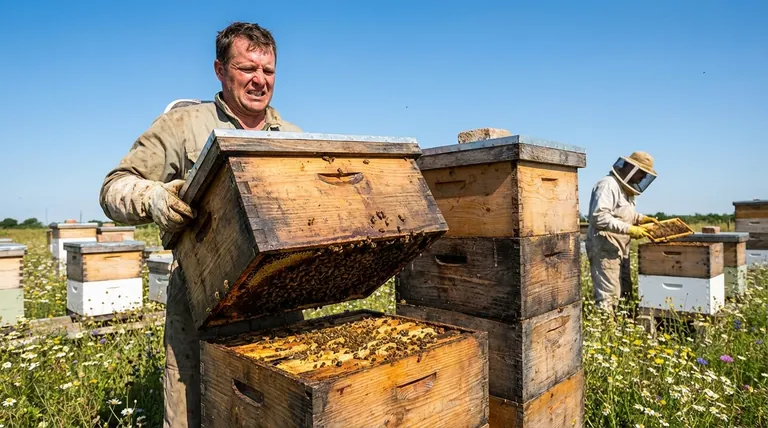
It’s the middle of the season. The sun is high, the air is thick with the hum of bees, and your crew has hundreds of hives to get through. A worker groans as he hoists another deep brood box off a stack. That’s 90 pounds of wood, bees, and brood—and it’s the fifth one he’s lifted in the last 30 minutes. The pace is slow, the work is exhausting, and you can already see the fatigue setting in. You know this isn't sustainable, but what’s the alternative?
The Hidden Costs of a "Heavy Lifting" Strategy
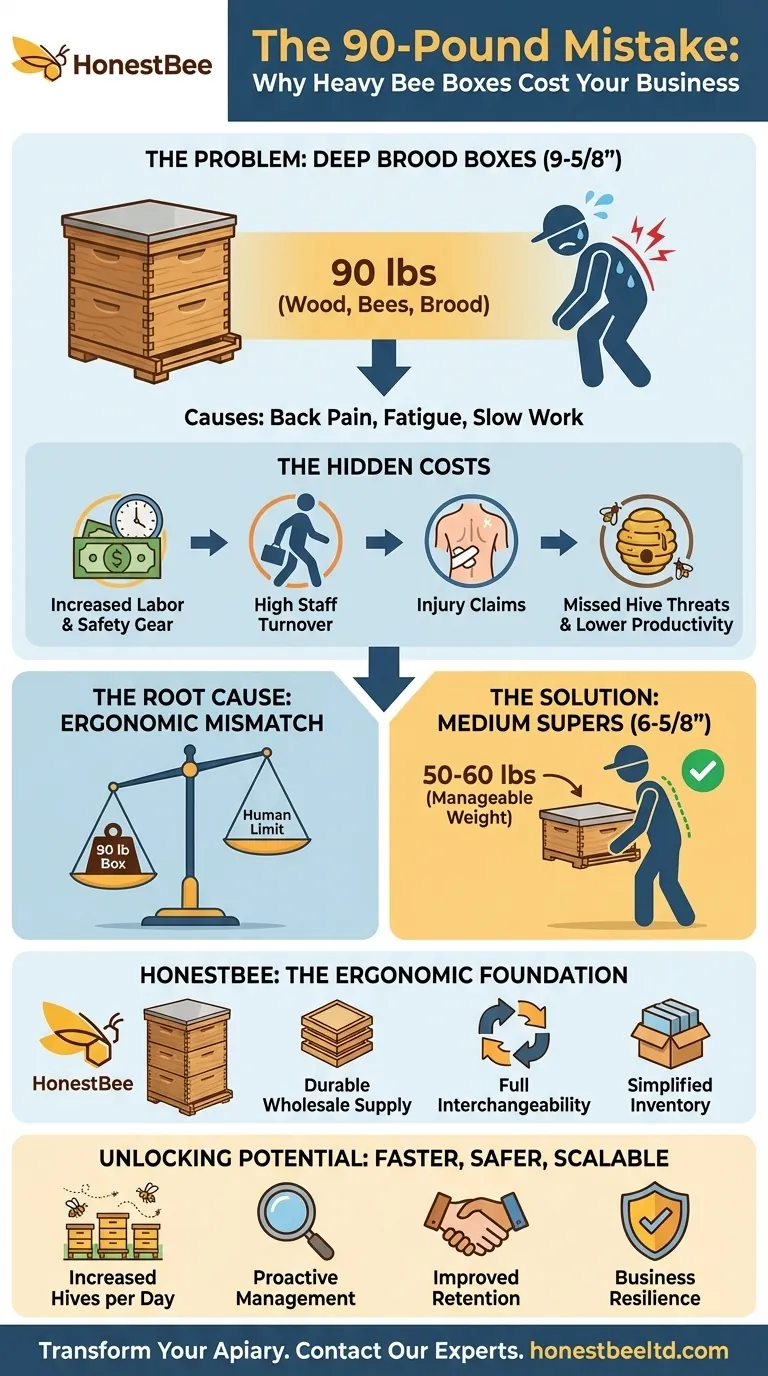
For commercial apiaries, the logic of using deep supers (9-5/8") for brood chambers seems sound on paper: maximize space, consolidate the brood nest, and maybe, just maybe, be more "efficient." Many beekeepers simply accept the back-breaking work as "part of the job."
This acceptance leads to a predictable cycle of struggle:
- Hiring more labor just to keep up with inspections, which inflates payroll.
- Buying back braces and other safety gear, which are temporary patches, not solutions.
- Experiencing high staff turnover as workers burn out or get injured from the repetitive strain of lifting 80-90 pound boxes all day.
These aren't just operational headaches; they are significant business liabilities. A single back injury can lead to costly workers' compensation claims, lost time, and a halt in productivity. Slower, more draining inspections mean your team can service fewer hives per day, capping your operational capacity. When inspections are rushed or postponed due to fatigue, you risk missing early signs of pests, disease, or swarm preparation—threats that can decimate your colonies and your profits.
The Real Bottleneck Isn't Box Size—It's Ergonomics
Here is the turn: The core problem isn't your team's strength or your workflow. It's a fundamental mismatch between the equipment and the human body. The pursuit of "maximum capacity per box" has created an ergonomic trap.
The simple truth is that a 90-pound object is far above the safe lifting limit recommended by occupational health experts for repetitive tasks. While a deep box offers more volume, that advantage is completely erased when:
- It takes two people to safely lift it, doubling your labor for a single task.
- It slows down every single inspection, creating a cumulative drag on your entire operation.
- It directly leads to the physical wear-and-tear that drives your most experienced employees away.
The "common solutions" fail because they dance around this central issue. Back braces don't make 90 pounds lighter. More staff just means you're paying more people to perform an inefficient and unsafe task. You're treating the symptoms, not the underlying cause.
The Solution: Build a System Around a Smarter Standard
To truly solve this problem, you don't need stronger workers; you need a smarter, more manageable system. The goal should be to optimize the entire workflow, not just the capacity of a single box. This requires a system built around two principles: a manageable weight and complete interchangeability.
This is where standardizing your entire operation on medium supers (6-5/8") becomes a game-changing strategy. A full medium super weighs around 50-60 pounds—a significant, immediately noticeable reduction. It’s a weight that one person can handle safely and efficiently, hour after hour.
HONESTBEE: The Foundation for an Ergonomic Apiary
This strategic shift isn't just about choosing a different size; it's about investing in a more profitable operational model. HONESTBEE is your partner in this transition. Our wholesale supply of high-quality, durable, and precisely manufactured medium supers provides the foundation for this smarter system.
Our products are designed for the rigors of commercial use. By choosing HONESTBEE, you're not just buying boxes; you're acquiring the reliable, standardized tools needed to:
- Directly solve the root cause of over-exertion and inefficiency.
- Create a fully interchangeable system where any frame of honey, pollen, or brood can be moved to any box in your apiary. This simplifies countless management tasks, from balancing colony strength to making splits.
- Streamline your inventory, a crucial benefit for both large-scale apiaries and the distributors who supply them. Stocking one box size is simpler and more cost-effective than managing three.
Beyond the Fix: Unlocking a Faster, Safer, More Scalable Apiary
When you eliminate the 90-pound problem, you don't just reduce back pain. You unlock a new level of operational potential.
Imagine your bee yard where inspections are faster and less fatiguing. Your crew moves with purpose, not pain. They can service more hives per day, giving them more time to perform thorough checks and proactive management. This newfound flexibility allows you to easily make splits, create nucs, and equalize colonies to maximize honey production across the entire operation.
Your business becomes more resilient. Employee retention improves because the work is safer and more sustainable. Your risk of costly injury claims plummets. Most importantly, your apiary is now built on a scalable model, ready for growth without being constrained by the physical limits of your team.
Switching your equipment is more than a purchase; it's a strategic investment in the future of your business. But we know every operation has unique challenges and goals. Let our team of experts help you design a system that boosts your efficiency and protects your bottom line. We can work with you to plan a transition that makes sense for your scale, budget, and long-term vision. To explore how this strategy can be tailored to your apiary's specific needs, Contact Our Experts.
Visual Guide
Related Products
- Plastic Transporting Bee Packages and Nuc Boxes for Beekeeping
- Metal Bee Hive Stand Bee Box Stand for Beekeeping
- High-Performance Langstroth Bee Hives for Global Professional Beekeeping
- Australian Langstroth Beehive Boxes for Beekeeping Wholesales
- Langstroth Honey Bee Box Hive Boxes for Different Depths
Related Articles
- Why Your Bee Boxes Don't Match: The Secret to Flawless Apiary Scaling
- The Architect's Dilemma: How a Nuc Box Solves a Honeybee Swarm's Housing Crisis
- The Nuc Box Is Not a Home, It's a Tool: A Strategic Guide to Apiary Fleet Management
- Designing for Instinct: Why the Nuc Box is the Perfect Swarm Trap
- The Lid as a Lever: How Nuc Box Design Drives Colony Success















