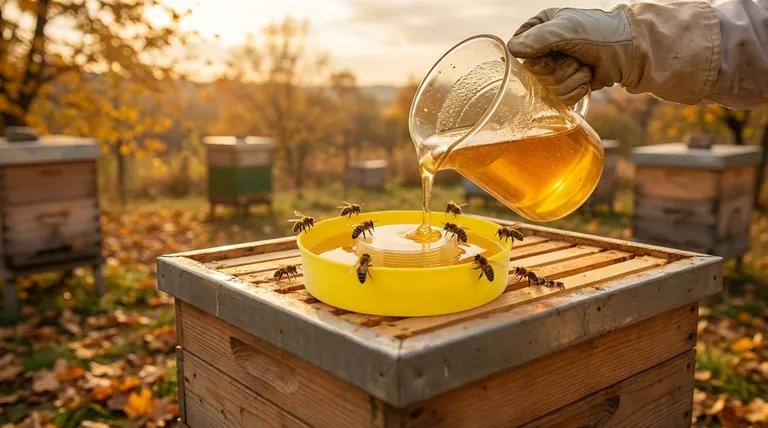
The Beekeepers' Dilemma
The air cools. The last of the goldenrod fades. For a beekeeper, this seasonal shift brings a quiet anxiety. You look at your hives and ask a simple, yet profound question: "Have they stored enough?"
This isn't just about food. It's about energy. It's about surviving the long, cold void until the first maples bloom. Hope is not a strategy. The survival of the colony through winter depends on precise, timely, and intelligent intervention. It begins with understanding the hive's internal monologue.
A Shift in Collective Consciousness
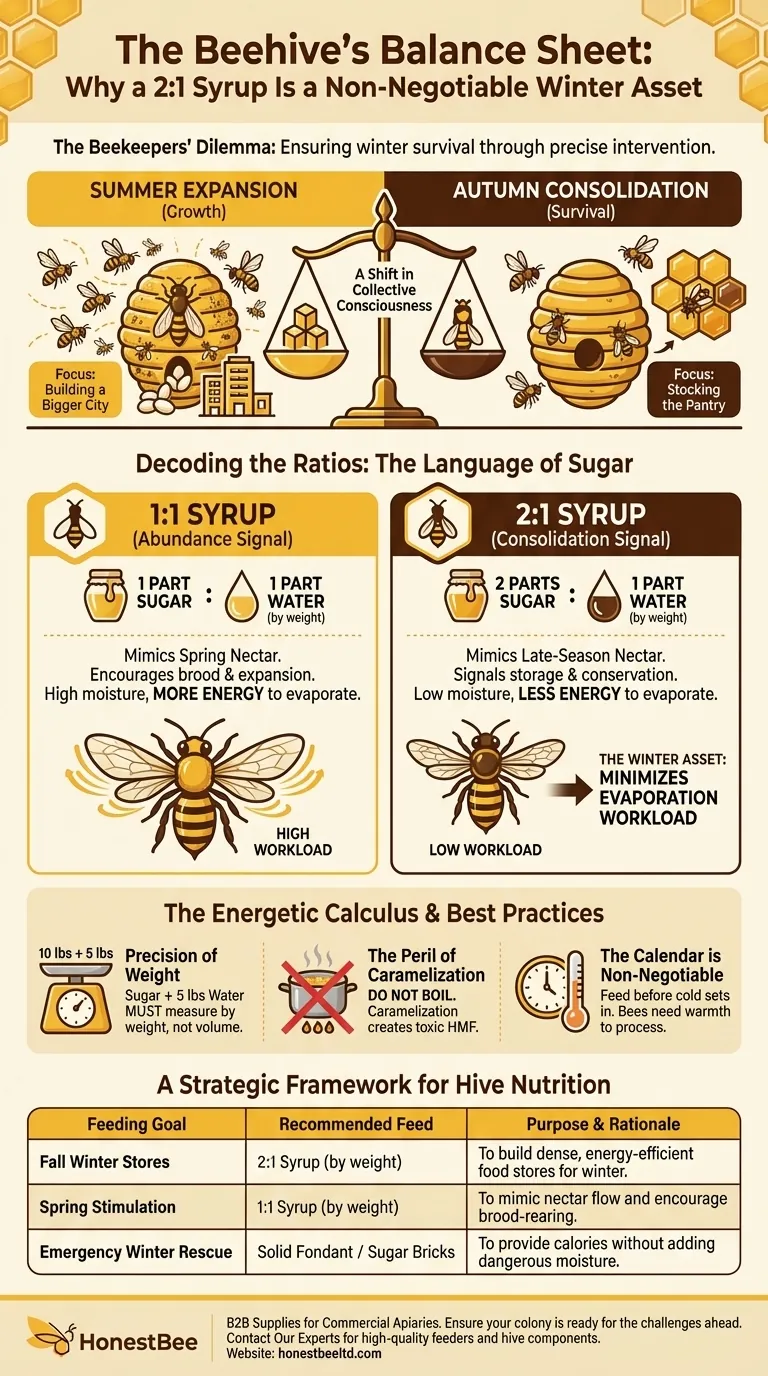
As autumn deepens, a profound change occurs within the colony. The frantic expansion of summer gives way to a singular focus on consolidation and survival. The queen's laying rate plummets. The hive's "personality" shifts from growth to conservation.
They are no longer building a bigger city; they are stocking the pantry and reinforcing the fortress walls. Our feeding strategy must align with this primal, seasonal instinct. To ignore it is to work against the hive, sending confusing signals that can have devastating consequences.
The most effective beekeeping works with the colony's natural rhythms, not against them. Our job is to provide the right resources that reinforce the right seasonal behavior.
Decoding the Ratios: The Language of Sugar
Syrup is not just food; it's a signal. The concentration of sugar in a solution is a message that the bees interpret with millions of years of evolutionary instinct.
1:1 Syrup: A Signal for Abundance
A thin, 1:1 syrup (one part sugar to one part water, by weight) mimics the light nectar flow of early spring. It screams "abundance!" to the colony. This signal stimulates the queen to lay eggs, encourages wax production, and fuels rapid population growth. It is a directive to spend energy and expand. Using this in the fall is like telling a household to start major renovations just as their winter income is cut off.
2:1 Syrup: A Signal for Consolidation
A heavy, 2:1 syrup (two parts sugar to one part water, by weight) mimics the rich, concentrated nectar of a late-season flow. This is a fundamentally different message. It signals that the season of plenty is over and the time for storing is now. It discourages brood rearing and focuses the hive's entire workforce on a single task: processing and capping this dense energy source for the winter ahead. It is a directive to save energy.
The Energetic Calculus of Feeding
The difference between these ratios goes beyond signaling. It taps into the fundamental physics of the hive.
Minimizing the Evaporation Workload
Syrup is not honey. To make it so, bees must dehydrate it, fanning their wings to evaporate excess water until the moisture content drops to around 18%. This is an incredibly energy-intensive task.
A 2:1 syrup contains significantly less water than a 1:1 syrup. By providing a thicker solution, we are drastically reducing the colony's workload. They expend far less energy on dehydration, a critical conservation of resources as the nights grow colder and their ability to work outside the cluster diminishes.
The Precision of Weight Over Volume
The 2:1 ratio is a precise chemical and energetic formula. It must be measured by weight. A pound of granulated sugar occupies far more space than a pound of water. Measuring by volume will result in a much thinner, less effective syrup.
The correct method is simple: use a scale. For example, combine 10 lbs of sugar with 5 lbs of water (approximately 2.3 liters or 0.6 gallons).
The Peril of Caramelization
A common mistake is to boil the syrup to dissolve the sugar faster. Never do this. Boiling can caramelize the sugars, creating hydroxymethylfurfural (HMF) and other compounds that are toxic to bees.
Use very hot (but not boiling) water and stir until the solution is completely clear. Patience here prevents poisoning your colony.
The Calendar is Non-Negotiable
The when is as critical as the what. Fall feeding is a race against the calendar. Bees need time—and warmth—to take down the syrup, process it, and cap the cells.
This work must be completed before temperatures consistently drop and the bees form their tight winter cluster. Once clustered, they cannot effectively process liquid feed. Furthermore, adding large amounts of liquid to a cold hive introduces excess moisture, which can lead to condensation and disease—a fatal combination in winter.
A Strategic Framework for Hive Nutrition
Your choice of feed should be a deliberate, goal-oriented decision.
| Feeding Goal | Recommended Feed | Purpose & Rationale |
|---|---|---|
| Fall Winter Stores | 2:1 Syrup (by weight) | To build dense, energy-efficient food stores for winter. |
| Spring Stimulation | 1:1 Syrup (by weight) | To mimic nectar flow and encourage brood-rearing. |
| Emergency Winter Rescue | Solid Fondant / Sugar Bricks | To provide calories without adding dangerous moisture. |
Managing this delicate balance requires precision, knowledge, and reliable equipment. From heavy-duty feeders that can handle thick syrup without leaking to the hive components that ensure a dry, secure winter home, the right tools are essential for implementing the right strategy. HONESTBEE specializes in providing commercial apiaries and distributors with the high-quality, wholesale supplies needed to ensure every colony is prepared for the challenges ahead.
To ensure your operation is ready for the season, Contact Our Experts.
Visual Guide
Related Products
- Professional Plastic Honey Dipper for Easy Honey Drizzling
- Professional Hive Front Entrance Bee Feeder
- Precision Honey Refractometer Instrument for Quality Assessment
- Solar Beeswax Melter Easy Solar Wax Melter for Beeswax
- Heavy Duty 304 Stainless Steel Honey Dipper
Related Articles
- How Honey Processing Affects Nutrition: Science-Backed Insights for Healthier Choices
- Why Honey Crystallizes Differently—And How to Manage It Naturally
- How to Safely Restore Crystallized Honey Without Losing Nutrients
- How to Control Honey Crystallization: Science-Backed Methods for Beekeepers
- The Unseen Battle in Every Honey Bucket: Heat, Time, and Quality