The Beginner’s Instinct
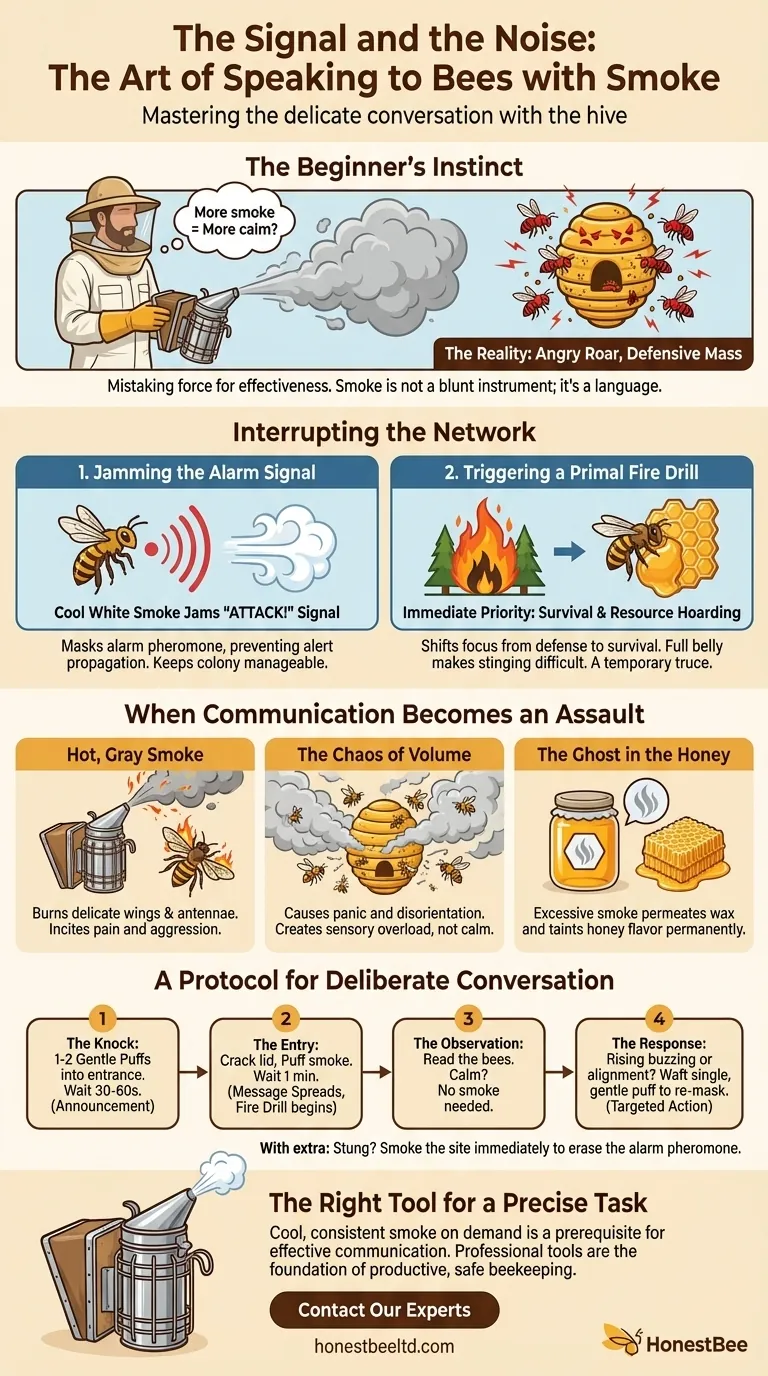
A new beekeeper feels a surge of adrenaline as the hive's hum intensifies. Their first instinct, born of uncertainty, is to pump the smoker. More smoke, they reason, must mean more calm. But the hum turns into an angry roar. The bees, far from being subdued, become a chaotic, defensive mass.
This scene plays out in apiaries everywhere. It stems from a fundamental misunderstanding of our tools and the creatures we manage.
We mistake force for effectiveness. We believe that if a little is good, a lot must be better. But in the delicate system of a beehive, smoke is not a blunt instrument. It's a language. And shouting rarely leads to a productive conversation.
Interrupting the Network
To use smoke effectively, we must first understand what we are actually doing. We are not sedating the bees. We are temporarily disrupting their two most critical communication and survival systems.
1. Jamming the Alarm Signal
When a guard bee perceives a threat, it releases an alarm pheromone. Think of it as a high-speed, biological data packet that screams "ATTACK!" to every bee in the vicinity. This signal is incredibly efficient and can put a colony of 60,000 on high alert in seconds.
Cool, white smoke acts as a signal jammer. It doesn't erase the message, but it floods the channel with "noise," masking the pheromone and preventing the alarm from propagating through the hive. The bees can no longer "hear" the call to arms, keeping the colony in a state of manageable calm.
2. Triggering a Primal Fire Drill
Smoke also triggers a deeper, evolutionary instinct: the threat of a forest fire. To a bee, smoke means their home is about to be destroyed, and they may need to flee.
Their immediate priority shifts from defense to survival. They rush to the honey stores and engorge themselves, hoarding resources for a potential journey to a new home. This has a convenient side effect: a bee with a full belly finds it physically difficult to flex its abdomen to sting. We are hijacking a survival protocol to create a temporary truce.
When Communication Becomes an Assault
The line between a calming signal and a violent attack is thinner than most realize. The beekeeper's technique determines whether the smoke is interpreted as a whisper or a physical blow.
The Error of Hot Smoke
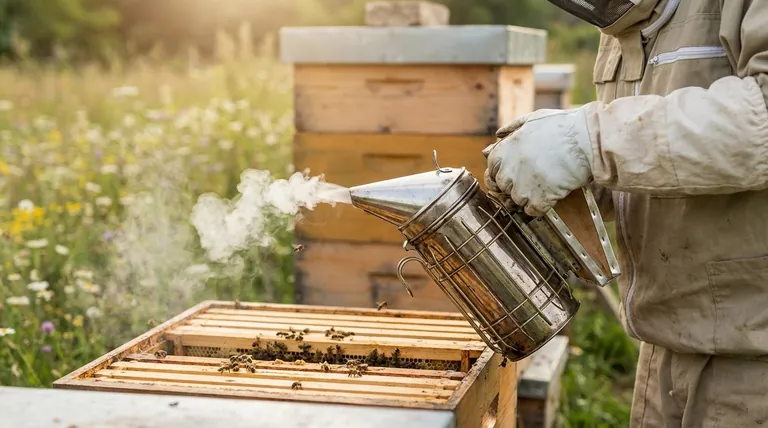
Your smoker should produce cool, gentle, white smoke. If it's puffing out hot air, gray smoke, or sparks, you are no longer communicating. You are attacking. Hot smoke burns their delicate wings and antennae, causing pain and injury. The colony’s response will be swift, defensive, and entirely justified.
The Chaos of Volume
Blasting a hive with continuous clouds of smoke is the equivalent of setting off a fire alarm and a fog machine in an office. It causes panic and disorientation. The goal is to temporarily interrupt communication, not to create a sensory overload that leads to chaos. Their sensitivity returns within 10-20 minutes anyway; over-smoking serves no purpose but to stress the colony.
The Ghost in the Honey
Beeswax is a lipid; it is incredibly effective at absorbing aromas. Excessive smoke, especially during a honey harvest, will permeate the wax cappings and, eventually, the honey itself. This leaves a permanent, smoky taint on a product that should taste of nectar and flowers, a lasting monument to a moment of impatience.
A Protocol for Deliberate Conversation
Effective smoking is a series of deliberate, minimal actions. It’s a dialogue where you must listen as much as you speak.
- The Knock: Before opening the hive, send one or two gentle puffs into the entrance. This is your announcement. Wait 30-60 seconds.
- The Entry: Crack the lid just enough for your hive tool. Puff a little smoke into the gap. Wait another minute. Let the message spread. Let the bees begin their fire drill.
- The Observation: As you inspect, read the bees. If they are calm on the frame, leave them be. No more smoke is needed.
- The Response: If the pitch of the buzzing rises, or if bees start aligning to face you, that is your cue. Waft a single, gentle puff across the top of the frames to re-mask any new alarm signals.
If you are stung, the bee releases a potent alarm pheromone right on the site. Smoke that specific spot on your suit or glove immediately. You are not punishing the bees; you are erasing the "X" that marks the target.
The Right Tool for a Precise Task
This level of control—the ability to produce cool, consistent smoke on demand—is not a luxury. It’s a prerequisite for speaking the language of bees effectively. An unreliable or poorly designed smoker turns a delicate conversation into a clumsy, frustrating struggle. It encourages the very mistakes we seek to avoid.
For commercial apiaries and equipment distributors, providing beekeepers with professional-grade tools is the foundation of productive, safe, and humane beekeeping. The quality of the smoker directly impacts the quality of the beekeeper's interaction with their hives.
| Mistake | Consequence | Correct Practice |
|---|---|---|
| Hot, Gray Smoke | Burns bees, incites aggression | Ensure smoker produces cool, white smoke |
| Excessive Volume | Causes panic and disorientation | Apply minimal puffs only when needed |
| Poor Timing | Taints honey and wax with a smoky flavor | Be exceptionally conservative during harvest |
| Constant Use | Stresses the colony without benefit | "Read the bees" and smoke only in response |
Mastering this language turns beekeeping from a battle of wills into an act of partnership. It requires patience, observation, and equipment you can trust.
Visual Guide
Related Products
- Stainless Steel Honey Bee Smoker Hive and Honeycomb Smoker for Beekeeping
- Professional Bee Smoker with Elongated Spout and Durable Bellows for Beekeeping
- Heavy Duty Manual Bee Smoker Blower for Beekeeping
- Premium Traditional Copper Bee Smoker with Bellows
- European Stainless Steel Bee Smoker for Honey Bee Hive
Related Articles
- The End of 'Hot Hives': Why Your Bee Smoker Is More Important Than Your Suit
- Why Your Bee Smoker Might Be Making Your Hives More Aggressive—And How to Fix It
- Why Your Bee Smoker Keeps Going Out—And the 3-Layer Fix
- How to Operate a Bee Smoker Safely: Expert Techniques for Calmer Hives
- How to Choose the Right Bee Smoker Size for Your Beekeeping Operation