It’s a scene familiar to many successful apiarists: the harvest was excellent, the honey is pure liquid gold, but the packaging room is pure chaos. Jars are piling up faster than your team can seal them. Some lids are cranked on so tight they’ll require pliers to open, while others are just loose enough to create a sticky, unsellable mess on the pallet. You have a premium product, but your bottling process is becoming a major liability.
The Vicious Cycle: Why Common Bottling "Fixes" Fail
This struggle to scale packaging is a classic growing pain. As demand for your honey increases, the manual, hand-tightening process that worked for the farmers market suddenly becomes a massive bottleneck. In an attempt to solve this, many apiaries fall into a few common traps:
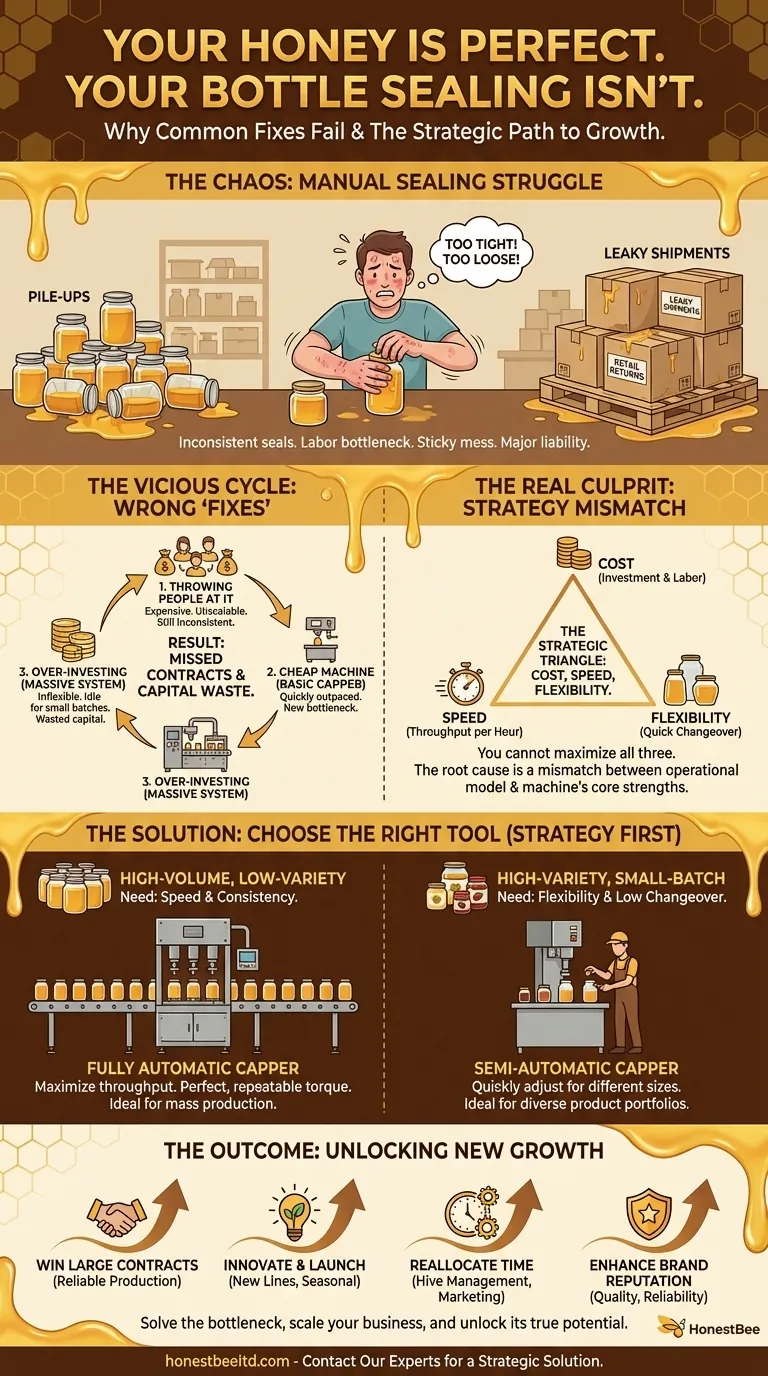
- Throwing More People at the Problem: Hiring more staff to manually twist caps seems like a simple solution. But it doesn't solve the core issues of inconsistent seals (some too tight, some too loose), and labor costs quickly eat into your profit margins. It’s an expensive, unscalable fix.
- Buying the Cheapest Machine: You invest in a basic, semi-automatic capper. It helps for a while, but soon your orders outpace its capacity. The machine that was supposed to be a solution becomes the new bottleneck, and you’re right back where you started, unable to fulfill large wholesale contracts.
- Over-investing in a Massive System: Fearing the previous mistake, you drain your capital on a high-speed, fully automatic line. The problem? It’s designed to run one jar and cap size, thousands of times an hour. It’s inflexible. When you want to run a special batch of small jars for your infused honey, the changeover is so complex and time-consuming that it’s not worth the effort. The expensive machine sits idle.
Each of these "solutions" leads to the same negative business consequences: returned shipments from retailers due to leaks, missed opportunities for large contracts, and capital wasted on equipment that doesn't fit your actual needs.
The Real Culprit: It's Not the Machine, It's the Mismatch
Here is the turn. The problem isn't that capping machines don't work. The problem is choosing a machine without first diagnosing your operational reality. The fundamental mistake is viewing this as an equipment purchase rather than a strategic decision.
Every packaging operation must balance three competing factors: Cost, Speed, and Flexibility.
- Cost: The initial investment and ongoing labor expenses.
- Speed: The number of units you can reliably seal per hour (your throughput).
- Flexibility: The ability to easily switch between different jar sizes, shapes, and cap types.
You cannot maximize all three. A machine that is extremely fast and low-cost will not be flexible. A machine that is highly flexible and low-cost will not be fast. The "common fixes" fail because they focus on solving for only one of these factors, ignoring the others. The root cause of failure is a mismatch between your operational model and the machine's core strengths.
A small apiary with a wide variety of artisanal honeys in different jars has a flexibility-driven model. A large co-op that sells hundreds of thousands of uniform clover honey jars has a speed-driven model. Using the wrong machine for your model is like trying to plow a field with a race car—it's a powerful tool, but completely wrong for the job.
Choosing the Right Tool for the Job: Strategy First, Machine Second
To truly solve the sealing problem, you need to match the equipment to your business strategy. This means you need a tool designed to perform a specific function exceptionally well.
For High-Volume, Low-Variety Operations
If your business depends on producing large quantities of a few core products, your primary need is speed and consistency. Your goal is to maximize throughput and minimize per-unit labor costs.
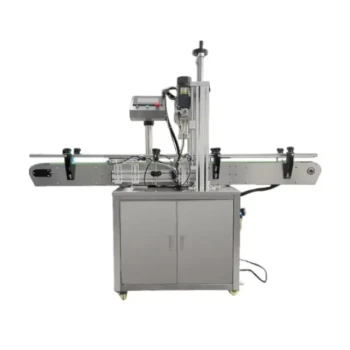
This is where a fully automatic capping machine shines. It is engineered for one purpose: to seal thousands of uniform containers per hour with perfect, repeatable torque. It integrates into a conveyor line, automatically placing and tightening caps without operator intervention. This tool directly solves the root problem of a speed-bottleneck in a high-volume environment.
For High-Variety, Small-to-Medium Batch Operations
If your business thrives on offering a diverse portfolio of products—different honey varietals, infused flavors, and multiple jar sizes—your primary need is flexibility and low changeover time.
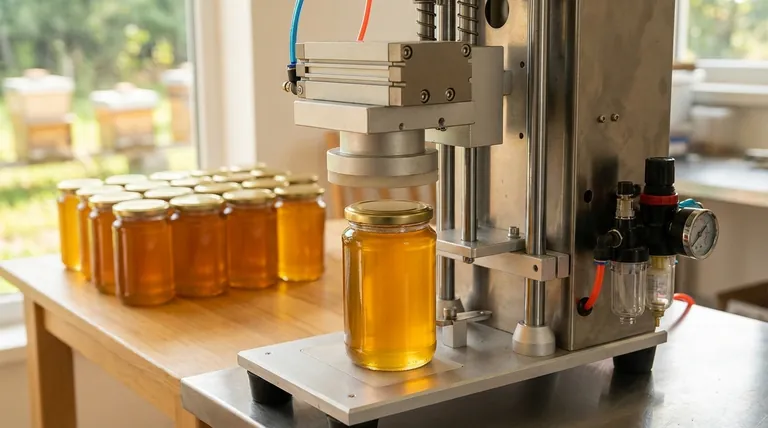
For this model, a semi-automatic capping machine is the ideal instrument. An operator places the cap, but the machine provides the consistent, perfect seal. It can be quickly adjusted for different container heights and cap diameters, allowing you to switch from your 1-pound jars to your 6-ounce gift-set jars in minutes, not hours. It solves the root problem of inflexibility that would cripple a diverse operation using a fully automatic line.
At HONESTBEE, we don’t just sell equipment; we supply solutions based on a deep understanding of apiary operations. Our range of robust semi-automatic and fully automatic cappers are not just machines—they are the embodiment of the right strategy for your specific scale and business model.
Beyond the Bottleneck: Unlocking New Growth for Your Apiary
When you finally install a capping system that is perfectly aligned with your business, something transformative happens. The constant stress of the bottling line vanishes. It's no longer a source of problems, but a source of strength.
With this problem solved, you can now:
- Confidently pursue and win large wholesale contracts, knowing your production can meet the demand with consistent, professional-grade quality.
- Innovate and launch new product lines—like seasonal or specialty honeys—without worrying that your equipment can't handle the new packaging.
- Reallocate your team's valuable time from the tedious task of tightening lids to more value-added activities like hive management, marketing, and product development.
- Enhance your brand's reputation for quality and reliability, from the honey inside the jar to the perfect seal that protects it.
Solving your sealing problem isn't just about fixing leaks. It's about removing the single biggest barrier to scaling your business and unlocking its true potential.
Your operation is unique, and the right solution requires more than a product page. It requires a conversation. Let our team of experts help you analyze your production needs and align your operation with the equipment that will fuel your growth, not hinder it. Contact Our Experts.
Visual Guide
Related Products
- Automatic Inline Spindle Bottle Capping Machine for Honey Production
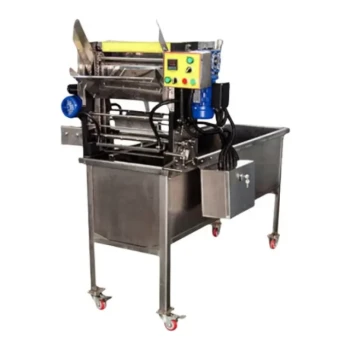
- Automatic Honey Frame Uncapper Machine for Beekeeping
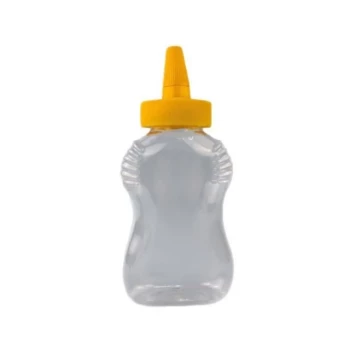
- Ergonomic Squeezable Honey Bottle with Precision Twist Nozzle Cap
- Professional Honey Uncapping Roller for Efficient Harvesting
- Professional Durable Plastic Handle Honey Uncapping Fork