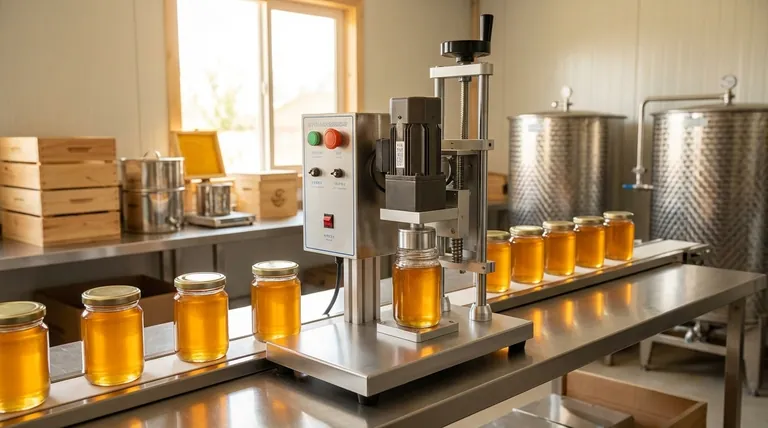
The Last Point of Failure
Imagine a thousand jars of golden honey, perfectly labeled and ready for shipment. Months of hard work, from hive to harvest, are embodied in each one. Yet, the fate of that entire investment rests on a piece of metal or plastic less than a millimeter thick.
The cap is the final handshake with your customer. It’s the last guardian of your product's integrity.
We often fall into a psychological trap. We obsess over the product, the branding, and the container, but we treat the sealing process as an afterthought. This is a critical error. A single leaky cap on a store shelf doesn't just lose one sale; it erodes trust in the entire brand.
The choice of a capping machine, therefore, isn't an operational detail. It's a strategic decision about risk, reputation, and reliability.
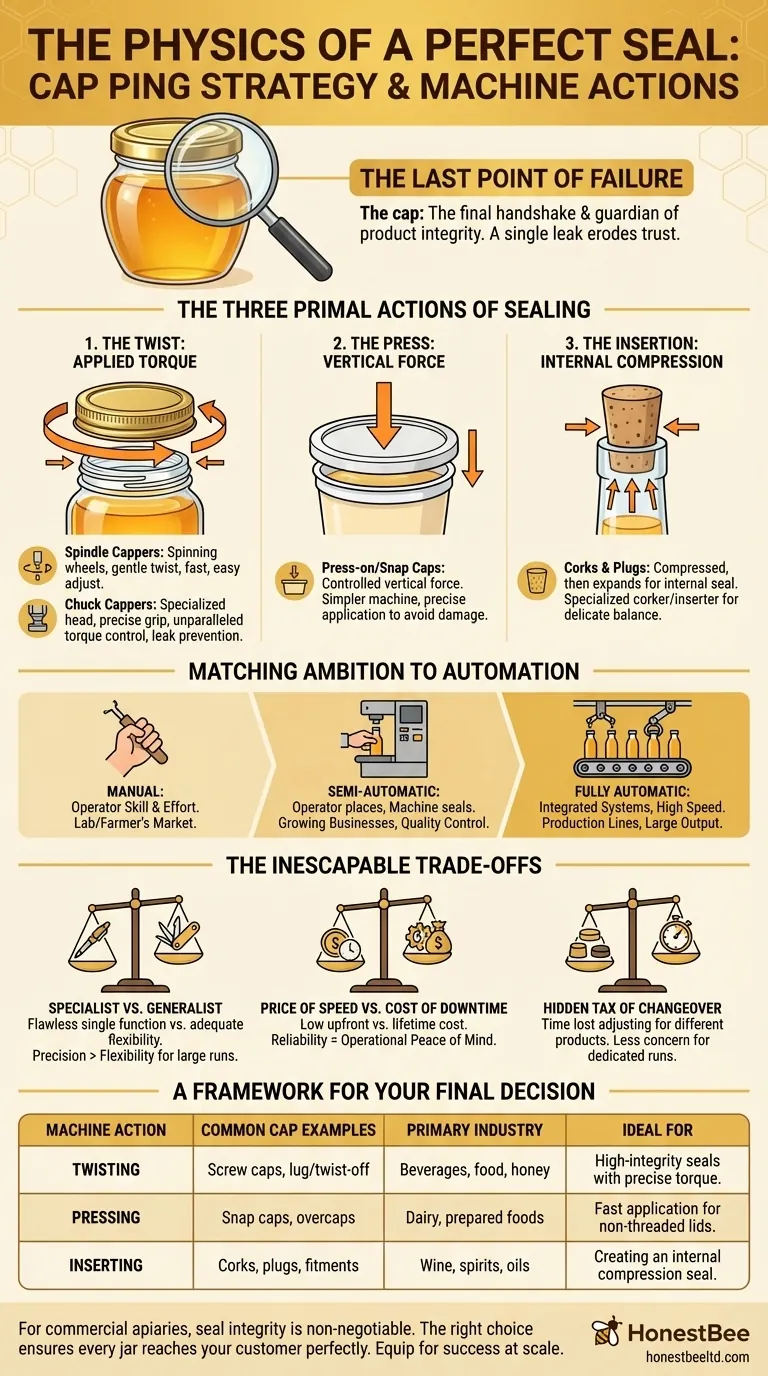
The Three Primal Actions of Sealing
To choose the right machine, you must stop thinking about the dozens of cap types and focus on the three fundamental mechanical actions a machine can perform. This simplifies everything.
Each action is a different physical solution to the same problem: creating a perfect, repeatable seal.
The Twist: The Art of Applied Torque
This is the most common action, governing screw caps and the lug-style "twist-off" lids found on most honey jars. The goal is to apply consistent rotational force, or torque, without stripping the threads or damaging the cap.
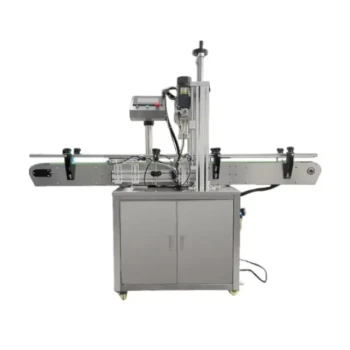
- Spindle Cappers use sets of spinning wheels to gently twist the cap tight as the container moves past on a conveyor. They are fast and relatively easy to adjust.
- Chuck Cappers use a specialized head that descends, grips the cap, and twists it with immense precision. They offer unparalleled torque control, which is critical for preventing leaks and ensuring a consistent customer experience.
The Press: A Matter of Force and Confidence
Press-on or "snap" caps don't require rotation. They need a controlled, vertical force to snap them securely onto the container's rim.
This action is common for deli tubs, dairy products, and some tamper-evident closures. The machine is simpler, but the precision lies in applying just enough force to seal without damaging the container.
The Insertion: A Seal from Within
This is for closures like corks or plugs that seal by being compressed and inserted into the bottle's opening. The seal is created by the closure's attempt to expand back to its original size.
This requires a specialized machine—a corker or inserter—that can handle the delicate balance of compressing the closure without compromising its integrity.
Matching Ambition to Automation
The right mechanical action is only half the equation. The other half is matching the machine's level of automation to the scale of your ambition.
- Manual Cappers are for the lab or the Saturday morning farmer's market. They are simple tools, entirely dependent on operator skill and effort.
- Semi-Automatic Cappers are the workhorse of growing businesses. An operator places the cap, but the machine provides the perfect, repeatable sealing action. This is the first step toward true quality control.
- Fully Automatic Cappers are systems, not just machines. They integrate into a production line, handling everything from sorting caps to sealing containers at high speed. They are built for producers who measure output in pallets, not dozens.
The Inescapable Trade-offs
Choosing equipment is an exercise in navigating trade-offs. Being honest about them is the key to a wise investment.
The Specialist vs. The Generalist
A machine designed to do one thing flawlessly will always outperform a machine designed to do many things adequately. For a commercial apiary sealing thousands of identical honey jars, the precision of a specialized chuck capper is more valuable than the flexibility of a multi-purpose machine.
The Price of Speed vs. The Cost of Downtime
The allure of a low upfront cost is a powerful psychological bias. However, the true cost of a machine is measured over its lifetime. A cheaper machine that produces inconsistent seals or breaks down frequently will cost you far more in lost product, labor, and reputation than a robust, reliable, and more expensive alternative.
Higher speed and reliability aren't just features; they are investments in operational peace of mind.
The Hidden Tax of Changeover
For operations running multiple products, the time spent adjusting a machine between different bottle and cap sizes is a hidden tax on productivity. Spindle cappers are often quicker to change over, while chuck cappers may require swapping parts. For large, dedicated runs of a single product, this is less of a concern.
A Framework for Your Final Decision
Your decision ultimately rests on your primary goal. The table below simplifies the choice based on the mechanical action your product requires.
| Machine Action | Common Cap Examples | Primary Industry | Ideal For |
|---|---|---|---|
| Twisting | Screw caps, lug/twist-off | Beverages, food, honey | High-integrity seals with precise torque. |
| Pressing | Snap caps, overcaps | Dairy, prepared foods | Fast application for non-threaded lids. |
| Inserting | Corks, plugs, fitments | Wine, spirits, oils | Creating an internal compression seal. |
For commercial apiaries, where product value is high and brand reputation is paramount, the integrity of the seal is non-negotiable. The robust and precise twisting action of a dedicated capping machine isn't a luxury; it's the foundation of a scalable, professional operation.
At HONESTBEE, we equip commercial beekeepers and distributors for success at scale. We understand that your equipment must be as hardworking and reliable as you are. Making the right choice ensures every jar reaches your customer as perfectly as you intended. To build a packaging line with that level of integrity, Contact Our Experts.
Visual Guide
Related Products
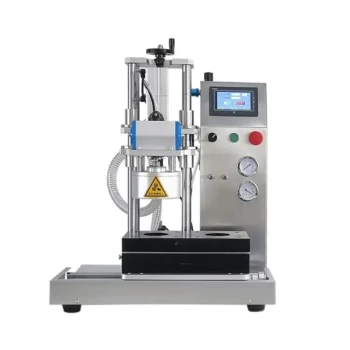
- Semi-Automatic Vacuum Capping Machine with Pneumatic Control for Glass Jars
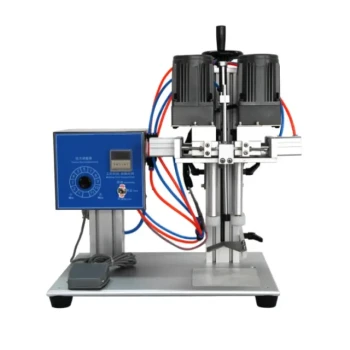
- Semi-Automatic Pneumatic Bottle Capping Machine by HONESTBEE
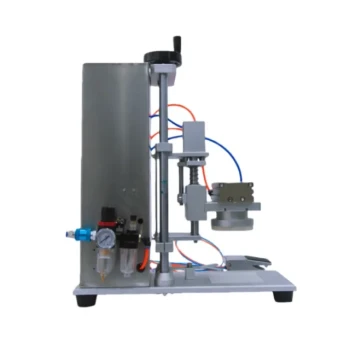
- HONESTBEE Professional Benchtop Pneumatic Bottle Capping Machine Capper
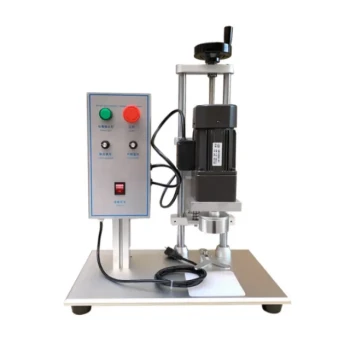
- Semi Automatic Electric Bottle Capping Machine
- Automatic Inline Spindle Bottle Capping Machine for Honey Production