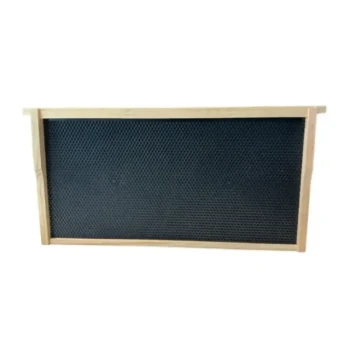
Beehive frames facilitate egg and larval assessments by providing a standardized, removable carrier that allows for direct physical observation without dismantling the colony’s core structure. This organized surface serves as a uniform physical reference, enabling technicians to accurately count larvae—particularly those in the critical 0 to 24-hour window—and assess the colony's reproductive vitality through quantifiable metrics.
Standardized beehive frames are the essential hardware that transforms biological growth into measurable data, allowing commercial beekeepers to quantify brood-rearing capacity and colony biomass. By providing a consistent surface area, frames enable precise health inspections and population forecasting, which are fundamental for professional apiary management.
The Role of Standardization in Population Metrics
Predictable Surface Area for Precise Counting
Standardized frames provide a fixed geometry that serves as a baseline for all biological measurements. A standard double-sided frame typically contains approximately 4,000 brood cells, allowing technicians to estimate egg and larval density by subdividing the frame into quarters or tenths.
Benchmarking Colony Strength
Beyond individual larvae, frames allow for the quantification of the entire adult population. In professional settings, a fully occupied frame is estimated to hold roughly 2,000 adult bees, while the gap between standard frames (such as 435 x 300 mm) represents approximately 250 grams of bee biomass.
Efficient Health Inspections
The removable design of the frame is the primary facilitator of high-speed health assessments. It allows for the identification of young larvae (0-24 hours) and the monitoring of capped and uncapped brood cells without causing significant stress or permanent damage to the hive's internal architecture.
Enhancing Commercial Management Efficiency
Rapid Response to Pathogen Impacts
Using frames as spatial benchmarks allows commercial operators to quickly detect the negative impacts of pathogens like Nosema microsporidians. By observing a reduction in the percentage of brood coverage on a per-frame basis, managers can trigger immediate interventions to protect their investment.
Comparability Across Regional Apiaries
For large-scale distributors and wholesalers, the standardization of frames ensures that data remains comparable across different regions and generations. This uniformity is a technical prerequisite for creating precise feeding plans and evaluating the pollination potential of colonies before they are deployed to the field.
Quantifying Reproductive Capacity
By recording the number of frames fully covered by bees and brood, operators can assess the effectiveness of different nutritional formulas. This data-driven approach to beekeeping relies entirely on the frame as the core tool for monitoring population dynamics and colony growth.
Understanding the Trade-offs and Limitations
The Risk of Thermal Loss
While removing frames is necessary for counting, it exposes the brood to external temperatures. Frequent or prolonged inspections can lead to chilled brood, which may inadvertently lower the larval survival rate you are trying to measure.
Human Error in Estimation
Manual counting is subject to technician bias, especially when estimating "percentage of coverage." While frames provide the benchmark, the accuracy of the assessment depends heavily on the standardization of the training provided to the beekeeping staff.
Hardware Dependency
The utility of these metrics relies entirely on the use of standardized dimensions. If a fleet of hives uses inconsistent frame sizes, the data regarding biomass and reproductive health becomes incomparable, undermining the efficiency of large-scale commercial operations.
Optimizing Your Inventory for Professional Clients
Standardized frames are more than just hive components; they are diagnostic tools that your professional clients rely on for their bottom line. Ensuring a steady supply of high-precision, standard-dimension frames is critical for maintaining your reputation as a premier trading partner.
- If your primary focus is one-stop sourcing: Ensure your portfolio includes standardized frames (like the 435 x 300 mm) to provide clients with the consistent benchmarks required for professional population modeling.
- If your primary focus is supply chain reliability: Leverage ultra-fast delivery and rapid response times to ensure commercial apiaries can replace damaged frames during critical spring build-up phases when larval counts are most frequent.
- If your primary focus is technical expertise: Position your premium frames as essential diagnostic hardware that facilitates the quantification of colony health, biomass, and reproductive success.
By providing standardized, high-quality beehive frames, you empower your clients to transform their apiary management into a precise, data-driven enterprise.
Summary Table:
| Metric/Feature | Value/Function | Commercial Benefit |
|---|---|---|
| Standard Brood Cells | ~4,000 cells per frame | Precise egg/larval density estimation |
| Adult Bee Capacity | ~2,000 bees per full frame | Accurate biomass & colony strength metrics |
| Standard Geometry | 435 x 300 mm (typical) | Data comparability across regional apiaries |
| Inspection Utility | Removable standardized carrier | Rapid health checks & pathogen detection |
Scale Your Bee Provent Operations with HONESTBEE
High-precision hardware is the backbone of data-driven apiary management. HONESTBEE caters to commercial apiaries and distributors with a comprehensive one-stop sourcing solution. From standardized frames that ensure accurate population metrics to advanced honey-filling machinery, our full-spectrum product portfolio is designed to maximize your efficiency and profit margins.
Why Partner with HONESTBEE?
- Comprehensive Wholesale Offering: A wide array of tools, machinery, and industry consumables.
- Expertise & Support: Deep professional insights with OEM/ODM capabilities to suit your specific market.
- Unmatched Fulfillment: Rapid response times and ultra-fast delivery to keep your supply chain moving.
Contact our B2B team today to access premium hardware and exceptional service tailored for industry leaders.
References
- Hafiz Khurram Shurjeel, Nadia Saeed. Impact of Yeast Diet on the Number of Eggs and Larvae Produced in Honey Bee Colonies (Apis Mellifera L.) Apidae: Hymenoptera. DOI: 10.53560/ppasb(60-4)772
This article is also based on technical information from HonestBee Knowledge Base .
Related Products
- Wooden Bee Hive Frames for Beekeeping and Wholesale
- Assembled Wooden Bee Frames with Plastic Foundation for Durability and Convenience by HONESTBEE
- Heavy-Duty Stainless Steel Clip-On Frame Perch
- HONESTBEE Wired and Assembled Wooden Bee Frames Foundation for a Thriving Hive
- Professional Galvanized Steel Frame Rest for Beehives
People Also Ask
- How does balancing the number of frames impact hive productivity? Optimize Your Apiary's Biological Output
- How do wooden and plastic hive frames compare in terms of durability? Wood vs. Plastic Longevity & Repairability
- What are the main considerations when choosing between wooden and plastic bee hive frames? Optimize Your Apiary's Efficiency
- How should beehive frames be maintained to prolong their lifespan? 5 Pro Tips for Durable Beekeeping Equipment
- What are frames and combs used for in beekeeping? The Foundation of Modern Hive Management