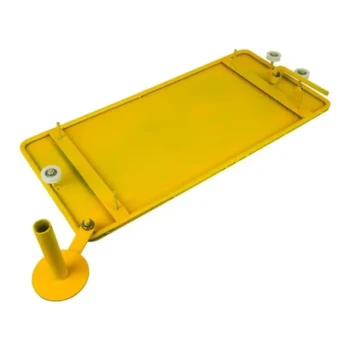
Modified hive bottom boards equipped with sticky liners function as a passive, non-invasive collection system for monitoring Varroa destructor populations. Positioned beneath the brood chamber, these devices capture mites that fall naturally from the comb or are physically removed by worker bees during grooming. By examining the debris accumulated on the liner, technicians can calculate infestation rates and assess the colony's hygienic behavior without disrupting the hive structure.
Core Takeaway: This system provides a quantitative assessment of natural mite drop and colony grooming effectiveness. By analyzing debris and damaged mites collected over a fixed period, beekeepers can determine parasite load and treatment necessity without invasive sampling methods.
The Mechanics of Passive Monitoring
The Collection Interface
The system relies on a modified hive bottom board that accommodates a specialized sticky liner. This setup is designed to serve as a debris trap located directly at the bottom of the brood chamber.
Capturing Natural Mite Drop
The primary function of the liner is to catch mites that dislodge from bees or brood frames. This includes mites that fall due to natural mortality or accidental displacement as they move through the colony.
Assessing Grooming Activity
Crucially, the liner also captures mites that are actively removed by worker bees. This collection mechanism allows for the observation of mites that have been groomed off the bees, providing physical evidence of the colony's defensive behaviors.
Analyzing the Data
Quantitative Assessment
Technicians count the number of mites found on the sticky board after a fixed monitoring period. This count provides a data point for the "natural mite drop," which serves as a proxy for the overall parasite load within the colony.
Inferring Grooming Behavior
Beyond simple counts, the debris allows for a qualitative analysis of the mites themselves. By calculating the proportion of damaged mites found on the liner, observers can infer the effectiveness of the colony's grooming behavior.
Determining Treatment Needs
The data gathered from these liners allows beekeepers to scientifically quantify infestation levels. This information is essential for deciding if chemical or physical control interventions are necessary to ensure winter survival.
Understanding the Trade-offs
Nature of the Data
This method measures fallen mites, not the number of mites currently attached to bees. While it indicates infestation levels, it relies on inference rather than a direct count of mites per bee, which is achieved through other standardized volume sampling methods.
Requirement for Analysis
The effectiveness of this tool depends entirely on the post-collection analysis. Technicians must accurately differentiate between mite debris and other hive waste to ensure the statistics regarding infestation rates and grooming behavior are valid.
Making the Right Choice for Your Goal
This monitoring tool is best utilized when you need to assess colony health without disrupting the hive's internal environment.
- If your primary focus is routine infestation monitoring: Use sticky liners to track natural mite drop trends over time to determine when treatment thresholds are reached.
- If your primary focus is breeding for resistance: Analyze the liners specifically for the proportion of damaged mites to identify colonies with superior hygienic and grooming traits.
By systematically recording natural mite drop and debris composition, you convert raw physical data into actionable insights for colony survival.
Summary Table:
| Feature | Description | Key Benefit |
|---|---|---|
| Mechanism | Passive collection via sticky liners under the brood chamber | Non-invasive monitoring without disrupting bees |
| Data Point 1 | Natural Mite Drop (Daily counts) | Quantitative proxy for total parasite load |
| Data Point 2 | Debris/Mite Damage Analysis | Qualitative measure of colony grooming effectiveness |
| Application | Threshold-based treatment & resistance breeding | Data-driven hive management and winter survival |
Elevate Your Beekeeping Operations with HONESTBEE
At HONESTBEE, we specialize in empowering commercial apiaries and distributors with the high-performance tools needed to combat Varroa destructor and optimize colony health. From precision-engineered modified bottom boards and hive-making machinery to professional-grade honey-filling equipment, we provide the full spectrum of wholesale beekeeping solutions.
Whether you are scaling your commercial production or supplying the next generation of professional beekeepers, our comprehensive portfolio of hardware and essential consumables ensures your success.
Ready to scale your business with industry-leading equipment?
Contact HONESTBEE Today to discuss our wholesale offerings and how we can support your growth.
References
- Ernesto Guzmán‐Novoa, Matías Maggi. Honey bee populations surviving Varroa destructor parasitism in Latin America and their mechanisms of resistance. DOI: 10.3389/fevo.2024.1434490
This article is also based on technical information from HonestBee Knowledge Base .
Related Products
- Solid Bottom Board Australian Pine Wood Langstroth Bottom Board for Wholesale
- Langstroth Solid Bottom Board for Beekeeping
- Langstroth Screen Bottom Board for Beekeeping Wholesale
- Australian Pine Wood Langstroth Screen Bottom Board for Wholesale
- HONESTBEE Durable Frame Wiring Board with Integrated Tensioner
People Also Ask
- In what conditions is a solid bottom board preferred over a screened bottom board? Maximize Hive Heat and Treatment
- What are the characteristics of a solid bottom board? A Guide to Hive Foundation & Climate Control
- What is the primary function of a solid bottom board on a beehive? Key Benefits for Hive Stability and Insulation
- What is the purpose of a solid bottom board in a hive? Essential for Winter Survival & Insulation
- What are the benefits of a solid bottom board? Boost Hive Health with Superior Insulation & Defense