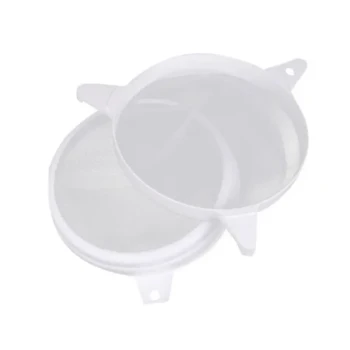
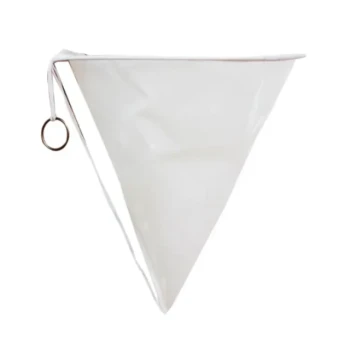
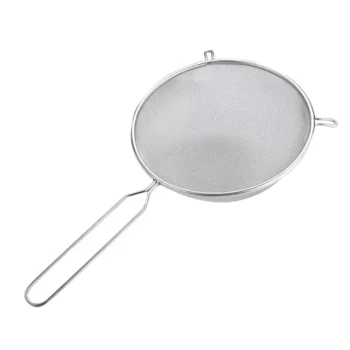
Perforated plastic strainers serve as the critical mechanism for fine filtration within the honey refining workflow. They function by employing a series of barriers with progressively decreasing pore sizes to systematically capture particulate matter. This step-wise removal process effectively isolates fine debris and wax residues, ensuring the honey achieves the high clarity and purity required for refined commercial standards.
The core value of perforated plastic strainers lies in their ability to perform step-wise refinement. By filtering honey through multiple stages of decreasing pore size, you prevent clogging and ensure the final product is free of the microscopic wax and debris that compromise quality.
The Mechanics of Sequential Filtration
The Principle of Decreasing Pore Sizes
Perforated plastic strainers are rarely used as a standalone solution for raw input. Instead, they function most effectively when arranged in a series.
The process begins with strainers featuring larger pores to catch significant particulate matter. Subsequent strainers utilize increasingly smaller perforations to capture finer materials.
Step-Wise Debris Removal
This sequential approach is designed to prevent the system from becoming overwhelmed.
If honey were immediately forced through the finest strainer, larger particles would instantly block the flow. By stepping down the size, the strainers remove contaminants in layers, specifically targeting fine debris and wax residues.
Achieving Refined Quality Standards
Ensuring Visual Clarity
The primary function of these strainers during the refining stage is to polish the final product.
Consumers associate visual clarity with quality. Perforated plastic strainers remove the turbidity caused by suspended wax particles, resulting in the translucent, clean look expected of refined honey.
Meeting Commercial Purity Requirements
Beyond aesthetics, this filtration method ensures the honey meets strict purity standards.
By mechanically removing foreign particles, beekeepers can guarantee a consistent product. This level of refinement is essential for honey intended for high-end retail markets rather than "raw" or unprocessed classifications.
Understanding the Trade-offs
Flow Rate vs. Filtration Quality
While perforated plastic strainers are excellent for clarity, they inherently impact processing speed.
As you decrease the pore size to catch finer debris, the viscosity of the honey becomes a significant factor, potentially slowing down throughput. A higher level of purity requires more time or pressure to move the honey through the finer plastic meshes.
Maintenance and Cleaning Cycles
Plastic strainers act as a physical barrier, meaning they retain the debris they remove.
To maintain functionality, these strainers require regular monitoring and cleaning. If the perforations become blocked with wax, the filtration process halts, requiring downtime to clear the obstruction and restore flow.
Optimizing Your Filtration Strategy
To get the most out of perforated plastic strainers, align their use with your specific production targets:
- If your primary focus is Maximum Clarity: Utilize the full range of strainers, finishing with the smallest available pore size to eliminate all visible micro-particles.
- If your primary focus is Processing Speed: Use a graduated approach with moderate pore sizes to balance reasonable clarity with a faster flow rate, avoiding the finest mesh that causes bottlenecks.
By correctly implementing these strainers, you transform raw harvest into a polished, market-ready product.
Summary Table:
| Filtration Stage | Pore Size Strategy | Target Contaminants | Primary Benefit |
|---|---|---|---|
| Initial Stage | Large Perforations | Large wax chunks & hive debris | Prevents system clogging |
| Intermediate Stage | Medium Perforations | Smaller particles & pollen clusters | Ensures consistent flow |
| Polishing Stage | Fine Perforations | Micro-debris & wax residues | Maximum visual clarity |
| Post-Filtration | N/A | Suspended turbidity | High-end retail standard |
Elevate Your Honey Production with HONESTBEE
At HONESTBEE, we specialize in empowering commercial apiaries and distributors with high-performance beekeeping tools and machinery. Whether you need specialized honey-filling machines to speed up production or high-quality honey filtration equipment to achieve that perfect translucent finish, our comprehensive wholesale catalog has you covered.
From industrial hardware to honey-themed cultural merchandise, we provide the essential consumables you need to scale your business. Contact us today to discuss how our tailored equipment solutions can optimize your workflow and bring your refined honey products to the global market.
References
- Miriti Lydiah, Maina Immaculate. GENDER GAPS IN THE LEVELS OF PARTICIPATION IN IMPROVED BEE KEEPING: CASE OF THE MAASAI COMMUNITY IN TRANS MARA, NAROK COUNTY, KENYA. DOI: 10.47604/jlp.v1i1.846
This article is also based on technical information from HonestBee Knowledge Base .
Related Products
- Two-Stage Plastic Honey Filter for Buckets
- Nylon Honey Strainer Square Filter Cloth for Honey Filters
- Conical Nylon Honey Strainer Filter Bag for Beekeeping and Honey Filtration
- Professional Cone-Shaped Honey Filter with Reinforced Steel Ring
- Stainless Steel Triangle Support Honey Strainer and Filters
People Also Ask
- What are the benefits of using honey filters? Achieve Purity, Efficiency, and Market Appeal
- How do you filter raw honey at home? A Beekeeper's Guide to Clean, Pure Honey
- Should I filter my honey? A Guide to Clarity, Crystallization & Quality
- What are the types of honey filters? Choose the Right System for Your Honey's Clarity & Quality
- Why do people filter honey? For Clarity, Stability, and Consumer Appeal