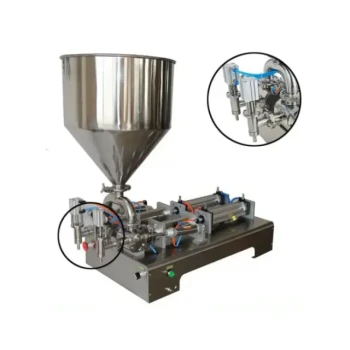
Pine honeydew honey is easier to store and keep liquid than many floral honeys, but its high viscosity demands careful equipment configuration. Its relatively low glucose and fructose concentrations reduce crystallization, allowing continuous transfer and filling with fewer decrystallization cycles. However, accurate dosing still depends on controlled temperature, high-torque positive-displacement pumping, and anti-drip filling technology that manages its dense, stringy flow without introducing air.
Pine honeydew honey reduces crystallization-related downtime, but it does not eliminate processing challenges. The key requirement is to preserve its naturally stable liquid state while controlling viscosity closely enough for accurate, clean, and repeatable filling.
Why Pine Honeydew Honey Behaves Differently
Lower Sugar Concentrations Reduce Crystallization
Pine honeydew honey generally contains less glucose and fructose than traditional polyfloral flower honey. Because glucose concentration strongly influences spontaneous glucose monohydrate crystal formation, pine honeydew honey tends to remain liquid for longer.
This stability simplifies bulk storage and line scheduling. Processors can often move inventory into continuous bottling without repeatedly heating tanks to dissolve newly formed crystals.
Honeydew Origin Affects Composition
Unlike floral honey, pine honeydew honey originates primarily from insect secretions collected from pine and other plant surfaces. Its composition is typically rich in minerals, enzymes, and amino acids, while its pollen content is relatively low.
These characteristics contribute to its dark appearance, distinctive flavor, and low tendency to granulate. They also make pine honeydew honey a distinct product stream that should be stored, blended, and packaged according to its own specifications rather than treated identically to light floral varieties.
High Viscosity Controls Flow
Pine honeydew honey remains dense even when it is liquid. Its viscosity profile can vary with temperature and composition, so a filling line that handles lighter honey reliably may still produce inconsistent dosing with pine honeydew honey.
The practical result is slower or less predictable flow through undersized pumps, valves, hoses, and nozzles. Equipment must be selected for high-viscosity food products and configured to maintain stable flow throughout the filling cycle.
How These Properties Affect Processing Equipment
Use Positive-Displacement Pumping
Piston and rotor pump systems are well suited to dense honey because they deliver a controlled volume under relatively consistent pressure. High-torque designs are especially important when transferring honey from storage or blending tanks through long pipe runs.
Pump capacity should be matched to the honey's viscosity, target throughput, pipe diameter, and operating temperature. An unsuitable pump can cause erratic flow, extended transfer times, or excessive mechanical stress on the line.
Control Temperature During Transfer
Moderate, consistent heating reduces viscosity and helps pine honeydew honey move through pumps and filling heads. The objective is to improve flow without applying unnecessary heat or creating repeated temperature fluctuations.
Overheating can damage quality-sensitive compounds, including natural enzymes such as invertase and glucose oxidase. A properly configured system therefore uses temperature-controlled storage, transfer lines, and filling components rather than relying on uncontrolled high-temperature treatment.
Select Anti-Drip Filling Heads
Honey's dense, stringy behavior can cause trailing, nozzle drips, and contamination around the bottle mouth. Anti-drip nozzles help create a clean cut-off after each dose and improve the appearance and seal of the finished package.
This is particularly important for premium pine honeydew products, where residue on the container can undermine presentation and increase cleaning requirements on the packaging line.
Maintain Accurate Volumetric Dosing
High viscosity can cause filling errors when flow does not stop consistently or when the machine's settings are designed for a thinner product. Piston-based or other adjustable volumetric systems provide better control than equipment that depends only on unrestricted gravity flow.
Calibration should be performed at the actual operating temperature and with the intended container format. A machine that is accurate during a warm test may underdose or overrun when product temperature changes during production.
Chemical Characteristics That Matter to the Line
Acidity Requires Food-Grade Contact Materials
Honey is naturally acidic, with typical pH values in the approximate range of 3.2 to 4.5. Pine honeydew honey's mineral and organic-acid content reinforces the need for hygienic, corrosion-resistant contact surfaces.
High-grade stainless steel is the appropriate baseline for tanks, pumps, pipework, valves, and filling heads. Material selection should cover every wetted component, including seals and fittings, because localized compatibility problems can cause contamination, corrosion, or premature maintenance issues.
Enzymes Favor Gentle Processing
Pine honeydew honey contains active enzymes that contribute to its natural chemical profile. Excessive heat and prolonged thermal exposure can reduce enzyme activity and diminish some of the product's valued nutritional and antibacterial characteristics.
Processing lines should prioritize short, controlled heating periods, accurate temperature sensors, and insulated equipment. Continuous monitoring is more dependable than setting a high general temperature to compensate for variable flow.
Moisture and Water Activity Still Require Control
Low crystallization does not mean the honey is protected from fermentation. Commercial inventory should generally remain below 20% moisture, with water activity managed within a range suitable for stable storage, commonly cited around 0.49 to 0.65.
Moisture testing should occur during receiving, blending, and before filling when product lots or storage conditions vary. A filling machine cannot correct excessive moisture; storage and release controls must address that risk upstream.
Designing a Reliable Filling Workflow
Keep Product Identity Separate
Pine honeydew honey has a dark color and strong sensory profile that can affect lighter products if residues remain in shared equipment. Facilities handling multiple varietals should use dedicated circuits where practical or apply validated cleaning procedures between product runs.
Separate tanks, hoses, or filling paths may be justified for premium grades, allergen-sensitive operations, or products with sharply different color and flavor requirements. The decision should be based on product portfolio, changeover frequency, and quality specifications.
Use Temperature-Controlled Holding Tanks
Holding tanks should maintain a stable, product-appropriate temperature while avoiding unnecessary residence time under heat. Gentle agitation can help maintain uniformity, but excessive mechanical action may increase air incorporation.
The tank outlet, pump inlet, and pipework should be designed to minimize dead zones and sudden restrictions. Consistent conditions at the filler are more valuable than simply raising the tank temperature.
Minimize Air Entrapment
Dense honey can carry air into the filling system when tanks are poorly vented, pumps operate near their limits, or suction lines draw inconsistently. Air pockets can produce foaming, underfilled containers, and unstable cut-off behavior.
Use appropriate inlet geometry, steady pump loading, and filling settings that allow air to escape before final dosing. Nozzle position and filling speed should be validated with the actual bottle and closure system.
Schedule Around Storage Stability
Because pine honeydew honey crystallizes slowly, processors gain more flexibility in production planning. Bulk inventory can remain liquid for longer periods, reducing the urgency of frequent heating cycles before every bottling run.
That advantage should be used to improve order fulfillment and reduce equipment downtime, while still monitoring viscosity, moisture, temperature, and container performance for every production lot.
Understanding the Trade-offs
Lower Crystallization Does Not Mean Easy Flow
Pine honeydew honey's resistance to crystallization simplifies storage, but its density can still restrict flow. A line optimized only for crystallization control may remain poorly suited to high-viscosity dosing.
The correct machinery strategy addresses both properties: preserve the liquid state with moderate temperature control and manage the remaining viscosity with positive-displacement pumping and precise filling heads.
Heating Saves Flow but Can Reduce Quality
Heating can improve transfer efficiency and filling accuracy, but excessive or prolonged heat may reduce enzyme activity and alter the product's natural quality. Repeated thermal treatment also increases energy use and can complicate production scheduling.
Processors should establish a narrow operating window based on actual viscosity and filling performance. The lowest effective temperature is generally the most defensible starting point.
Stable Storage Does Not Remove Quality Controls
Low crystallization may reduce rework, but it does not replace moisture testing, sanitation, lot traceability, or corrosion control. Incorrect storage conditions can still create fermentation, contamination, or quality problems.
Distributors and wholesalers should request consistent technical specifications for moisture, water activity, viscosity, and packaging performance before committing to high-volume supply.
One Machine Setting Will Not Fit Every Lot
Natural honey composition varies between harvests, apiaries, and geographic sources. Changes in mineral content, moisture, temperature, or viscosity can affect pump load and filling accuracy.
Commercial lines should support adjustable pump speed, temperature set points, fill volumes, and anti-drip timing. Flexible equipment is more valuable than a nominally high-speed machine that performs well only under one set of conditions.
How to Apply This to Your Processing Operation
Pine honeydew honey should be sourced and packaged through a supply program that combines product expertise with responsive technical support and dependable fulfillment.
- If your primary focus is long-term storage: Use pine honeydew honey's low crystallization tendency to reduce decrystallization cycles, while continuing to control moisture and water activity.
- If your primary focus is filling accuracy: Specify adjustable positive-displacement pumps, controlled operating temperatures, and anti-drip volumetric nozzles calibrated with the actual product.
- If your primary focus is preserving premium quality: Limit thermal exposure, use corrosion-resistant food-grade contact materials, and protect enzyme activity through gentle handling.
- If your primary focus is high-throughput distribution: Choose equipment and suppliers that can respond to viscosity variation, support efficient changeovers, and maintain rapid order fulfillment.
- If your primary focus is product-line separation: Use dedicated or thoroughly validated cleaning circuits to prevent dark, strongly flavored honeydew honey from affecting lighter varietal products.
With the right temperature control, pumping system, materials, and filling technology, pine honeydew honey can be processed efficiently while retaining the qualities that distinguish it in the market.
Summary Table:
| Property | Impact on Handling/Processing | Equipment Consideration |
|---|---|---|
| Low glucose/fructose → low crystallization | Longer liquid storage, less decrystallization | Reduced heating cycles, flexible scheduling |
| High viscosity | Slow flow, inconsistent dosing | Positive-displacement pumps, temperature control, anti-drip nozzles |
| Acidity (pH 3.2-4.5) | Corrosion risk | Stainless steel contact parts |
| Enzyme sensitivity | Quality degradation with heat | Controlled low-temperature processing |
| Moisture/water activity | Fermentation risk | Moisture testing, proper storage |
Optimize your honey filling line for pine honeydew's unique properties. HONESTBEE offers a full spectrum of beekeeping machinery and equipment, including high-viscosity filling machines, temperature-controlled tanks, and anti-drip nozzles. Our team provides dedicated support, rapid response, and ultra-fast delivery to keep your production running smoothly. Contact us today to discuss your specific requirements and get a tailored solution.
Related Products
- Precision Durable Efficient HONESTBEE Rotary Honey Filling Machine
- Economy Small Honey Filling Machine Honey Bottle Filler Packaging Machine
- Semi Automatic Small Honey Bottle Filling Machine Honey Filler
- Fully Automatic Honey Filling Packaging Machine for Processing Line
- Automatic Honey Filling and Filtering Machine for Beekeeping Bottle Filling
People Also Ask
- What is a key feature of the new generation of the honey filling machine? The Advanced Electronic Control Unit
- How do honey filling machines work? Achieve Precision & Speed for Your Apiary
- How do honey filling and processing machines aid native bee product conservation? Boost Value with HONESTBEE Technology
- What are the common types of bottling machines used for honey? Choosing the Right Solution for Your Apiary
- How do high-precision honey filling machines ensure quality? Optimize Your Commercial Production with HONESTBEE