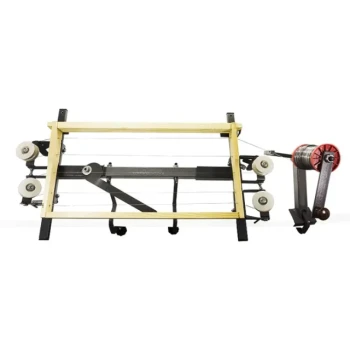
To wire a beekeeping frame in a parallel pattern, you begin by nailing a single piece of wire to one end of the frame. This wire is threaded horizontally across the frame to the opposite hole, then run down the side bar to the next hole, and passed back across in the other direction. This repeating "S" or ladder motion continues until the wire is nailed off at the end, creating a series of equally spaced horizontal lines.
Core Takeaway Parallel wiring creates a stable, ladder-like structure using a single continuous wire that helps maintain the integrity of the honeycomb. This method secures the wax foundation against sagging and prevents the comb from breaking under the centrifugal force of honey extraction.
The Step-by-Step Wiring Process
Anchoring the Wire
The process begins by securing the wire to the wooden frame.
A single piece of wire is nailed firmly to the frame at one end to establish the starting tension point.
Creating the Ladder Pattern
Once anchored, the wire is passed through the first hole and pulled straight across to the directly opposite hole.
From there, the wire is led down along the side bar to reach the next hole below it.
It is then passed through and led straight across the frame in the opposite direction.
Determining Wire Density
This back-and-forth process is repeated for every pair of holes present on the side bars.
The total number of wire strands depends on the frame's depth, with two, three, or four pairs being standard configurations.
Finalizing the Assembly
When the wiring pattern is complete, the remaining end of the wire is nailed to the frame.
This final step locks the tension in place, completing the parallel structure.
The Purpose of Wiring
Preventing Foundation Collapse
The primary goal of wiring is to support the beeswax foundation.
Without these wires, the foundation is prone to collapsing or sagging before the bees have successfully drawn out the comb.
Resisting Extraction Forces
Wiring provides essential reinforcement during the honey harvest.
It prevents the honeycomb from breaking out of the frame when it is subjected to the intense centrifugal force inside a honey extractor.
Structural Longevity
Beyond holding the wax, wiring serves a mechanical function for the wood itself.
The tension of the wire helps hold the frame's wooden components together as the wood ages over time.
Understanding the Trade-offs
Parallel vs. Crisscross Patterns
While parallel wiring is effective, it provides support primarily in the horizontal plane.
An alternative method is the crisscross pattern, where wires are run diagonally from upper left to lower right.
Complexity of Assembly
The parallel method is generally straightforward, following a linear path down the frame.
The crisscross method involves a more complex path, running up the outside of the side bar and crossing back in the opposite direction.
Making the Right Choice for Your Goal
When assembling your frames, consider the level of support required for your specific equipment.
- If your primary focus is standard stability: Use the parallel pattern to create equally spaced horizontal supports that prevent sagging and hold the frame components together.
- If your primary focus is multi-directional support: Consider the crisscross method to run wires diagonally, offering a different style of reinforcement across the frame face.
Correctly wiring your frames today ensures your comb remains intact during the harvest tomorrow.
Summary Table:
| Feature | Parallel Wiring Details |
|---|---|
| Pattern Type | Horizontal "S" or Ladder motion |
| Wire Type | Single continuous stainless steel or galvanized wire |
| Strand Count | Typically 2 to 4 strands (depending on frame depth) |
| Primary Function | Supports wax foundation and prevents collapse during extraction |
| Key Benefit | High horizontal stability and easier assembly process |
Scale Your Apiary Operations with HONESTBEE
Maintaining structural integrity in your hives is essential for high-yield honey production. At HONESTBEE, we specialize in supporting commercial apiaries and distributors with premium-grade beekeeping tools and machinery. Whether you need high-tensile wiring supplies, hive-making machines, or advanced honey-filling equipment, our comprehensive wholesale portfolio is designed to enhance your efficiency.
Ready to upgrade your equipment? Contact us today to discover how our professional-grade solutions can streamline your honey production and protect your investment.
Related Products
- Professional Wooden Requeening Frame for Beekeeping
- Wooden Bee Hive Frames for Beekeeping and Wholesale
- Ergonomic Plastic Frame Spacer Tool for Rapid Hive Management Beekeeping
- JZBZ Langstroth Queen Rearing Frame for Beekeeping
- Durable Rubberized Comfort Handle Frame Grip
People Also Ask
- What are the primary functions of beekeeping frames? Boost Efficiency with Professional Hive Management
- What are the best practices for assembling beekeeping frames? Pro Tips for Maximum Durability & Efficiency
- How are deep, medium, and shallow frames typically used in beekeeping? Optimize Your Hive Setup
- What are the characteristics of wooden frames in beekeeping? Unlock Natural Flexibility & Cost-Effectiveness
- What are the common specifications for wooden beekeeping frames used in colony expansion? Your Complete Guide