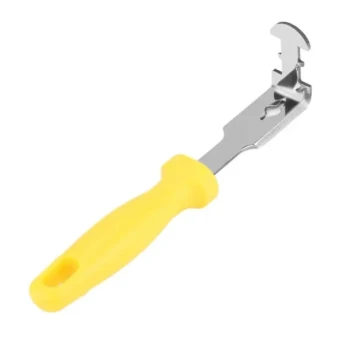
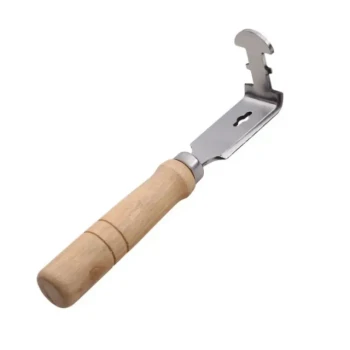
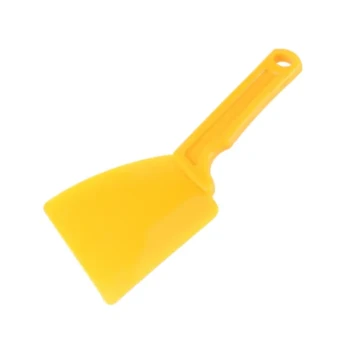
During the recovery phase, a specialized scraper is strictly employed to peel dehydrated bee venom crystals from glass collection plates. Because the venom dries into an exceptionally thin layer that adheres tightly to the surface, this tool applies precise tangential force to harvest the powder completely without introducing contaminants.
Converting raw bee venom into commercial-grade powder requires navigating the tension between strong surface adhesion and material fragility. The specialized scraper resolves this by maximizing yield through precise physical force while maintaining strict purity standards.
The Mechanics of Crystal Recovery
To understand the necessity of a specialized scraper, one must first understand the physical state of the processed venom.
Overcoming Surface Adhesion
Once the collection cycle is complete, the venom dehydrates on the glass plate. This results in a layer of crystals that are extremely thin and bond aggressively to the substrate. Standard tools often fail to separate this delicate layer effectively.
Applying Tangential Force
The specialized scraper operates by applying precise tangential force. This specific angle of mechanical action shears the crystal layer off the glass. It ensures the material lifts away cleanly rather than being crushed or remaining stuck to the plate.
Ensuring Product Integrity
The scraping process is not merely about removal; it is a critical quality control step in the production pipeline.
Preventing Contamination
Bee venom is a high-value biological product where purity is paramount. The industrial-grade design of the scraper ensures that the collection process does not introduce impurities. It allows for the harvesting of the venom alone, excluding potential debris from the tool or environment.
Commercial Standardization
This physical processing step serves as the bridge between raw collection and a market-ready product. By peeling the crystals cleanly and completely, the scraper facilitates the conversion of raw venom into a standardized, commercial-grade powder.
Critical Operational Trade-offs
While the specialized scraper is the correct tool for the job, improper usage carries specific risks that can degrade the final product.
Force vs. Purity
The primary trade-off involves the application of force. Inadequate force results in low yields, leaving valuable crystals on the glass. However, excessive or imprecise force risks damaging the collection plate or the tool itself, which would immediately contaminate the sample.
Tool Material Limitations
The scraper must be of distinct industrial quality. Using a generic or distinct material scraper increases the risk of the tool degrading during use. This would introduce foreign micro-particles into the venom powder, rendering it unfit for pharmaceutical or cosmetic use.
Optimizing Your Extraction Process
Successful recovery depends on aligning your technique with your production goals.
- If your primary focus is Maximum Yield: Ensure the scraper applies uniform tangential force across the entire surface area to prevent leaving thin crystal residues behind.
- If your primary focus is Product Purity: Utilize only industrial-grade scrapers designed specifically for chemical or biological recovery to eliminate the risk of introducing tool-derived impurities.
Mastering the mechanical recovery phase is the final, defining step in securing a high-value, standardized bee venom yield.
Summary Table:
| Feature | Function in Recovery Phase | Impact on Quality |
|---|---|---|
| Tangential Force | Shears crystal layer from glass substrate | Prevents crushing and ensures complete yield |
| Industrial-Grade Material | Resists wear and chemical degradation | Eliminates foreign micro-particle contamination |
| Precision Edge | Peels exceptionally thin dehydrated layers | Converts raw venom into standardized powder |
| Mechanical Action | Overcomes aggressive surface adhesion | Maintains biological integrity of the crystals |
Maximize Your Bee Venom Value with HONESTBEE
At HONESTBEE, we understand that the difference between raw collection and premium commercial-grade bee venom lies in the precision of your equipment. As a leading provider for commercial apiaries and distributors, we offer the full spectrum of specialized beekeeping machinery—from advanced venom collection systems to high-precision recovery tools.
Why choose HONESTBEE?
- Wholesale Excellence: Comprehensive inventory of beekeeping tools and industrial-grade machinery.
- Targeted Solutions: Specialized hardware designed to maximize yield and maintain strict purity standards.
- Industry Expertise: We cater specifically to large-scale operations and distributors seeking reliable, standardized results.
Ready to elevate your production efficiency and product purity? Contact us today to explore our wholesale equipment solutions!
References
- Ximena Araneda Durán, Daniza Morales Ulloa. Evaluación de dos frecuencias de colecta de apitoxina extraída de colmenas de Apis mellifera L. durante la época estival en la Región de La Araucanía. DOI: 10.4067/s0718-34292011000200019
This article is also based on technical information from HonestBee Knowledge Base .
Related Products
- Full Set Beekeeping Electronic Bee Venom Collector Machine Device for Bee Venom Collecting
- Professional Dual Action Queen Excluder Scraper for Beekeeping
- Stainless Steel Scraper for Metal Queen Bee Excluders
- Professional Long-Handled Silicone Honey Scraper for Beekeeping
- Professional Wide Blade Honey Scraper for Beekeeping and Honey Processing
People Also Ask
- How does the glass plate integrated into a bee venom collector contribute to maintaining quality and purity?
- What is the function of specialized collection equipment in the production process of bee venom? Expert Guide
- What is the significance of using specialized bee venom collection devices in commercial beekeeping operations?
- Why are bee venom collection devices typically mounted on specialized wooden carrier boards? Maximize Yield & Purity.
- How does a dedicated bee venom collection device operate? Extract Pure Venom Safely Without Harming Your Bees