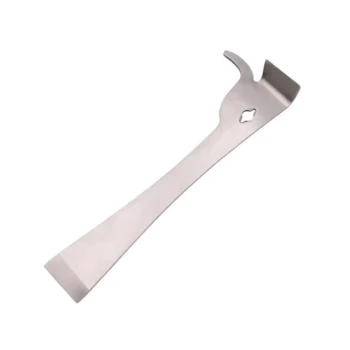
The most effective method to minimize the loss of hive tools is to alter their visual appearance to create high contrast against the apiary environment. Specifically, painting your hive tool a bright, distinct color—such as a vivid blue—drastically increases the likelihood of recovery when it is inevitably dropped in grass or dense foliage.
Standard steel tools tend to blend seamlessly into natural backgrounds, acting as unintended camouflage. By applying high-visibility paint, you break this visual pattern, ensuring that a dropped tool remains distinct and easily retrievable.
The Mechanics of Visual Detection
Overcoming Natural Camouflage
Apiaries are typically situated in environments dominated by organic textures and earth tones. Standard hive tools are usually made of unpainted steel or have dark wooden handles.
These materials share a similar tonal value with soil, dry grass, and shadows. When dropped, the tool lacks the visual contrast necessary for the eye to register it, causing it to effectively "disappear" into the ground cover.
The Advantage of Unnatural Colors
To counteract this, you must introduce a color that does not occur naturally in your immediate environment. This creates a visual anomaly that the human eye can detect quickly.
While various bright colors work, blue is specifically recommended. It offers a sharp contrast against both the green chlorophyll of vegetation and the brown hues of soil and dead leaves.
Practical Application
Strategic Painting
You do not need to paint the entire tool to gain the benefit of visibility. Focusing on the handle or the upper shaft is usually sufficient to catch the eye.
Using a durable, outdoor-rated spray paint or dipping the handle in liquid rubber (like Plasti Dip) can provide both visibility and improved grip.
Maintenance Considerations
Be aware that hive tools are subjected to significant friction and leverage. The paint will eventually wear down, scratch, or fade after repeated exposure to the elements and propolis.
To maintain effectiveness, inspect your tools at the start of every season. Re-apply the bright coating as soon as the steel begins to show through significantly.
Common Pitfalls and Limitations
Risk of Hive Contamination
A common mistake is painting the working edge (the blade or scraper) of the tool. As you scrape frames or pry boxes apart, paint chips can flake off into the hive.
To avoid contaminating the honey or the wax, keep the paint restricted to the handle and non-contact areas of the tool.
Visuals Are Not a Tether
Bright paint acts as a recovery aid, not a preventative measure against dropping the tool. It solves the problem of finding the tool, but not the problem of dropping it.
It does not replace the necessity of developing the muscle memory to return the tool to a pocket, belt magnet, or bucket immediately after use.
Implementing a Tool Retention Strategy
To solve the problem of lost equipment effectively, apply these principles based on your specific priorities:
- If your primary focus is maximum visibility: paint the handle of your tool a high-gloss, neon blue to create the strongest possible contrast against grass and dirt.
- If your primary focus is product purity: apply the bright color only to the upper third of the tool, ensuring no paint is near the scraping edge to prevent chips from entering the hive.
By converting your tools from camouflaged steel to high-visibility assets, you turn a frustrating search into a momentary pause.
Summary Table:
| Strategy | Benefit | Application Tip |
|---|---|---|
| High-Contrast Paint | Increases visual detection against soil/grass | Use vivid blue or neon colors |
| Strategic Painting | Prevents contamination of hive products | Paint handles only; avoid the scraper edge |
| Material Choice | Enhances grip and visibility simultaneously | Use liquid rubber dip or outdoor-rated spray |
| Seasonal Audit | Ensures long-term tool recovery | Re-apply coating when steel shows through |
Maximize Your Apiary Efficiency with HONESTBEE
Don't let lost tools slow down your operations. At HONESTBEE, we understand the demands of commercial beekeeping and the importance of reliable equipment. We cater specifically to commercial apiaries and distributors, providing a comprehensive wholesale selection that ranges from specialized hive-making and honey-filling machinery to high-quality beekeeping tools and consumables.
Whether you are scaling your honey production or stocking your distribution network, our portfolio offers the durability and precision you need. Contact us today to discover how our premium hardware and industry-leading expertise can streamline your business and boost your yield.
Related Products
- HONESTBEE Professional Long Handled Hive Tool with Precision Cutting Blade
- Professional Multi-Function Stainless Steel Hive Tool
- HONESTBEE Premium Italian Style Hive Tool with Hardwood Handle
- Ergonomic Plastic Frame Spacer Tool for Rapid Hive Management Beekeeping
- Professional Grade Foldable Beehive Handles
People Also Ask
- Why are professional hive tools considered indispensable? Master Beekeeping Maintenance with Precision Leverage
- What is the role of professional hive tools in routine apiary maintenance? Expert Tips for Hive Health and Longevity
- What is a bee hive tool? Discover Why It’s the Most Essential Hand Tool for Every Beekeeper
- How do hive tools and queen rearing equipment facilitate the bee colony splitting process? Restore Your Apiary Faster
- Why are professional hive tools & observation equipment necessary for queen rearing evaluation? Master Your Quality