Commercial queen mating success is judged primarily by the sperm stored in the queen’s spermatheca. A queen with fewer than 3 million stored sperm is generally considered inadequately mated, while strong commercial targets are commonly above 3–5 million sperm after receiving approximately 10–20 μL of semen. Specialized rearing and artificial insemination equipment helps breeders reach these reproductive targets while controlling genetic parentage at commercial scale.
The key measure is not simply whether a queen has mated, but whether she has stored enough viable sperm for sustained egg production. Professional equipment improves both mating reliability and the breeder’s ability to produce queens with predictable genetic and reproductive performance.
How Commercial Queen Mating Success Is Evaluated
Spermathecal sperm count is the primary measure
After mating, sperm is stored in the queen’s spermatheca, a specialized reproductive organ. Commercial reproductive quality is primarily evaluated by measuring the quantity of stored sperm.
Queens carrying fewer than 3 million sperm face a greater risk of premature sperm depletion. Stronger commercial performance is generally associated with stored sperm counts above 3–5 million.
Inadequate mating is commercially significant
Research summarized in the reference indicates that approximately 13.6% to 19.0% of commercially produced queens may fall below the 3-million-sperm threshold. These queens can require early supersedure, creating replacement costs and disrupting colony productivity.
For a commercial apiary, this makes reproductive evaluation more than a laboratory concern. It is a quality-control issue affecting queen longevity, colony continuity, and customer satisfaction.
Mating quantity supports long-term egg production
A queen may lay up to 1,500 eggs per day, so her stored sperm supply must support sustained fertilization over a productive lifespan. If sperm reserves are inadequate, the colony may receive fewer fertilized eggs or the queen may be replaced prematurely.
Stored sperm quantity is therefore a practical indicator of whether a queen is likely to remain productive, rather than merely an indicator that mating occurred.
Why Multiple Mating Matters
Polyandry increases colony-level genetic diversity
Honey bee queens naturally mate with multiple drones, a behavior known as polyandry. The resulting mixture of patrilines increases genetic diversity among worker bees within the same colony.
This diversity supports more effective division of labor and can improve brood-nest temperature stability, disease resistance, and colony survival.
Artificial control must preserve breeding objectives
Natural multiple mating can provide useful diversity, but open-yard mating does not reliably control which drones contribute genetically. Queens may mate with drones from unknown colonies or with males carrying undesirable traits.
Artificial insemination allows breeders to select drone material deliberately. This is especially important when maintaining defined lines, producing hybrids, or operating closed-population breeding programs.
The Role of Specialized Queen-Rearing Equipment
Rearing equipment protects the queen-development process
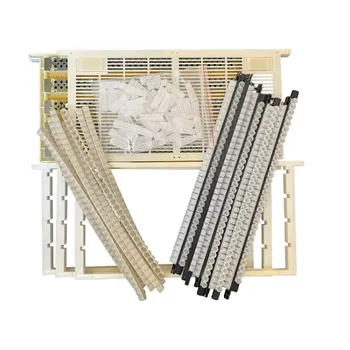
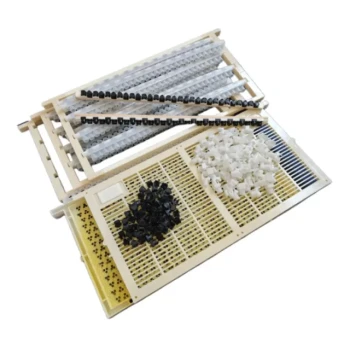
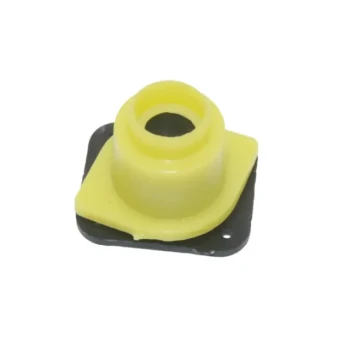
Commercial queen production depends on tools such as grafting instruments, queen-cell cups, queen frames, and mating nuclei. These supplies help breeders transfer larvae and manage queen cells under controlled conditions.
Standardized equipment reduces handling variation and supports more consistent larval survival and queen development across production batches.
Mating nuclei provide a controlled finishing environment
Mating nuclei, or mating nucs, supply a compact colony environment in which virgin queens can mature and complete the mating process. They are essential for managing queen acceptance, mating opportunities, and post-mating performance.
For commercial operations, reliable mating-nucleus systems also make it easier to organize production schedules and evaluate queens before distribution.
Standardization supports scalable supply
A breeder supplying dozens or thousands of queens cannot depend entirely on improvised tools or inconsistent colony setups. Uniform frames, cell cups, grafting tools, and related consumables create a repeatable production workflow.
For distributors and resellers, this creates demand for a complete product portfolio rather than a single tool: rearing supplies, mating equipment, handling tools, and insemination systems must work together.
Why Artificial Insemination Equipment Is Important
It enables precise genetic pairing
Artificial insemination gives the breeder direct control over the queen and drone genetic pairing. Selected semen can be collected and introduced using precision instrumental insemination equipment.
This makes it possible to develop or maintain lines selected for traits such as disease resistance, honey productivity, gentleness, and environmental adaptation.
It reduces the uncertainty of open mating
Because honey bees mate in flight, open-yard mating cannot reliably guarantee parentage. Neighboring colonies and unrelated drones may influence the resulting queen line.
Instrumental insemination removes much of this uncertainty. It is particularly valuable when breeders need to maintain line purity, make planned crosses, or avoid unwanted drone competition.
It accelerates structured genetic improvement
Controlled breeding programs can combine selected drone lines, maintain genetic diversity, and support hybrid or closed-population breeding. Artificial insemination is therefore a tool for systematic selection rather than simply a substitute for natural mating.
When used with appropriate records and breeding objectives, it helps propagate desirable traits across successive generations.
It supports reproductive consistency
The reference identifies a typical semen volume of approximately 10–20 μL for instrumental insemination. Precision equipment helps breeders deliver the intended semen volume and improve the likelihood of achieving high stored-sperm counts.
Equipment alone does not guarantee success. Operator skill, semen quality, queen maturity, handling, and post-insemination management remain decisive factors.
Understanding the Trade-offs
Artificial insemination requires skill and process control
Instrumental insemination is more technically demanding than allowing queens to mate naturally. Breeders need trained personnel, suitable microscopes or insemination systems, careful semen handling, and repeatable operating procedures.
This creates a higher initial investment, but it may be justified where genetic control, line purity, or reproductive consistency has significant commercial value.
Controlled breeding can reduce diversity if poorly managed
Artificial insemination can improve genetic control, but excessive restriction of parentage may increase inbreeding risk. Breeding programs must manage drone selection and maintain adequate genetic diversity, including attention to sex-allele diversity.
The objective is not maximum uniformity at any cost. The objective is a balanced combination of performance, vigor, adaptability, and genetic stability.
Equipment does not replace reproductive evaluation
A queen can be inseminated without achieving the desired long-term reproductive result. Breeders should still verify outcomes through appropriate assessment of stored sperm and colony performance.
Similarly, high sperm counts do not remove the need to monitor brood viability, queen acceptance, temperament, disease status, and productivity.
Natural mating remains useful in some operations
Natural mating is simpler and may be appropriate for beekeepers prioritizing lower cost, local adaptation, or broad genetic diversity. Artificial insemination becomes more valuable when the operation requires predictable parentage and repeatable genetic outcomes.
The right approach depends on the apiary’s breeding goals, technical capacity, production volume, and budget.
How to Apply This to a Commercial Apiary
Specialized equipment should be selected as an integrated production system rather than as isolated products.
- If your primary focus is queen quality: Prioritize standardized grafting tools, cell cups, queen frames, mating nuclei, and procedures that support high stored-sperm counts and consistent queen development.
- If your primary focus is genetic improvement: Invest in precision instrumental insemination equipment and breeding records that enable deliberate queen–drone pairings and controlled hybridization.
- If your primary focus is production scale: Build a complete, standardized equipment portfolio with reliable consumable replenishment, fast order fulfillment, and compatible components across the workflow.
- If your primary focus is biosecurity and line preservation: Use controlled mating systems and artificial insemination to limit unknown drone influence and maintain defined genetic lines.
- If your primary focus is distribution or resale: Source rearing supplies, mating equipment, and insemination systems from a supplier able to provide one-stop purchasing, technical expertise, rapid response, and dependable delivery.
A well-designed queen-breeding system combines reproductive measurement, skilled management, specialized equipment, and disciplined genetic planning to produce queens that support stronger and more productive apiaries.
Summary Table:
| Metric | Commercial Benchmark | Why It Matters |
|---|---|---|
| Stored sperm in spermatheca | ≥3–5 million | Ensures long-term egg production and colony viability |
| Semen volume for insemination | 10–20 μL | Precision delivery supports high sperm storage |
| Inadequate mating rate | 13.6–19.0% | Indicates need for quality control in queen production |
| Egg-laying rate | Up to 1,500 eggs/day | Demands sufficient sperm reserves for sustained productivity |
Ready to elevate your queen-rearing operation? HONESTBEE offers a complete range of specialized beekeeping tools and machinery, from grafting instruments to artificial insemination systems. As a one-stop supplier for commercial apiaries and distributors, we provide fast delivery, OEM/ODM support, and expert guidance to maximize your breeding success and profitability. Contact us today to discuss your wholesale needs and receive a tailored quote!
Related Products
- Queen Bee Artificial Insemination Instrument Equipment for Instrumental Insemination
- HONESTBEE Improved No Grafting Queen Rearing Kit For Queen Rearing and Royal Jelly Production
- No Grafting Queen Rearing Kit: System for Royal Jelly Production and Queen Rearing
- Retractable Chinese Queen Rearing Grafting Tools Equipment
- Nicot Queen Rearing Kit for Beekeeping and Grafting in Nicot System
People Also Ask
- Why is maintaining sanitary conditions important during artificial insemination? Protect Your Queen from Fatal Infections
- Why are artificial insemination instruments critical in bee hybridization? Master Genetic Control & Pure Breeding
- What is the core value of bee artificial insemination instruments in breed improvement? Achieve Precise Genetic Control
- Why is professional bee artificial insemination equipment considered a core tool for genetic control in honeybee breeding? Ensure 100% Purity
- Why is high-purity CO2 used for queen bee artificial insemination? Unlock Precision Breeding & Faster Egg-Laying