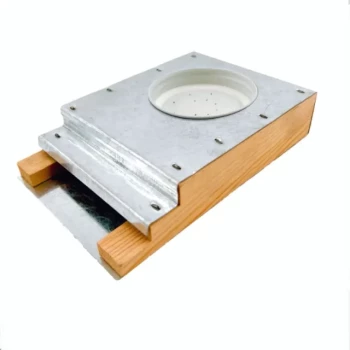
Artificial feeders are precision instruments designed to create a controlled foraging environment outside the hive. They function as mobile food sources that researchers can place at exact coordinates, usually containing odorless syrup to eliminate olfactory variables from the experiment.
By neutralizing scent cues and fixing the food source's location, artificial feeders force honeybees to rely solely on spatial information. This allows researchers to accurately decode how distance and direction are communicated through the waggle dance.
Establishing Experimental Control
To understand honeybee communication, researchers must differentiate between environmental cues and actual communication. Artificial feeders provide the necessary rigor to make this distinction.
Precision Positioning
The primary function of an artificial feeder is to act as a controlled food source.
Unlike natural flowers, which are distributed randomly, these feeders can be precisely positioned at specific distances and angles relative to the hive.
Isolation of Variables
In a natural setting, bees use a combination of sun compass navigation, visual landmarks, and scent to find food.
Artificial feeders allow researchers to strip away these layers. By placing the feeder at a known location, the researcher dictates the exact flight vector the bee must travel.
Decoupling Recruitment Signals
The core scientific value of these feeders lies in their ability to manipulate the inputs of the waggle dance.
The Role of Odorless Syrup
Standard floral sources produce strong scents that bees bring back to the hive. This scent adheres to the bee's cuticle and provides a "cheat sheet" for other recruits.
Artificial feeders utilize odorless syrup to remove this variable.
Testing Encoding and Decoding
When the scent is removed, the recruiting bee cannot rely on olfactory cues to guide her nestmates.
She is forced to communicate using only the distance and direction information encoded in her waggle dance. This allows scientists to observe exactly how spatial data is transferred and interpreted without chemical interference.
Critical Constraints and Requirements
While artificial feeders are powerful, their effectiveness relies entirely on the rigorous exclusion of external factors.
The Necessity of Odor Control
The experiment relies on the assumption that the bees are navigating solely by the dance's vector instructions.
If the syrup or the feeder itself possesses a distinct odor, it contaminates the data. The recruits may simply follow a scent trail rather than decoding the spatial instructions of the dance, rendering the recruitment test invalid.
Designing Your Recruitment Experiment
When setting up a study on honeybee navigation, use the feeder to target specific behavioral mechanisms.
- If your primary focus is Spatial Encoding: Ensure your feeder uses strictly odorless syrup to force bees to rely on the waggle dance's vector information.
- If your primary focus is Distance Calibration: distinct placement of the feeder allows you to measure how the duration of the waggle run correlates with specific flight distances.
By controlling the food source, you transform the chaotic natural world into a measurable laboratory.
Summary Table:
| Core Function | Description | Scientific Objective |
|---|---|---|
| Precision Positioning | Fixed coordinates at specific flight vectors | Control distance and direction variables |
| Odor Neutralization | Use of odorless syrup for foraging | Eliminates scent-tracking cues |
| Signal Decoupling | Forced reliance on spatial encoding | Validates accuracy of the waggle dance |
| Behavioral Calibration | Measurable feeder-to-hive distance | Measures waggle run duration vs. distance |
Elevate Your Apiary Operations with HONESTBEE
At HONESTBEE, we understand the precision required for both advanced bee research and commercial honey production. As a leading global supplier, we provide commercial apiaries and distributors with high-quality, professional-grade beekeeping tools, machinery, and essential consumables.
Whether you need specialized hive-making equipment, industrial honey-filling machines, or innovative beekeeping hardware, our comprehensive wholesale portfolio is designed to maximize your efficiency and scale.
Ready to optimize your production? Contact us today to discover how HONESTBEE’s specialized equipment and cultural merchandise can drive your business forward.
References
- Songkun Su, Shenglu Chen. East Learns from West: Asiatic Honeybees Can Understand Dance Language of European Honeybees. DOI: 10.1371/journal.pone.0002365
This article is also based on technical information from HonestBee Knowledge Base .
Related Products
- HONESTBEE Entrance Bee Feeder Efficient Hive Front Liquid Feeding Solution for Beekeeping
- Rapid Bee Feeder White Plastic 2L Round Top Feeder for 8 or 10-Frame Bee Hives
- Professional Hive Top Bee Feeder for Beekeeping
- 3.5L Plastic Beehive Frame Feeder Deep Frame Water Feeder for In Hive Use
- HONESTBEE Square Top Hive Bee Feeder Top Bee Feeder
People Also Ask
- What types of bee feeders are available for beginners? Start with the Simple Entrance Feeder
- What are the advantages and disadvantages of using an entrance feeder for bees? Balance Convenience and Hive Security.
- What is a bee entrance feeder and what are its drawbacks? Essential Guide to Hive Security and Feeding Efficiency
- How does a bee entrance feeder work? A Simple Guide to Convenient Hive Feeding
- How to make an entrance feeder for bees? A DIY Guide for Safe & Effective Feeding