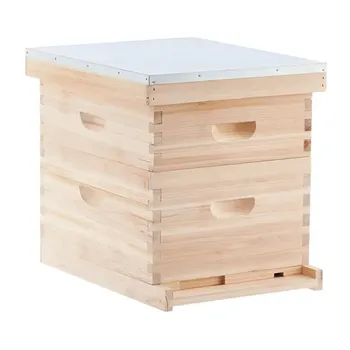
Langstroth hive bodies are commonly supplied in four depth configurations: deep at 9 5/8 inches, medium at 6 5/8 inches, intermediate at 7 5/8 inches, and shallow or ultra-shallow at approximately 5 11/16–5 7/8 inches. For commercial beekeepers, the practical decision is usually between deep brood bodies, medium honey supers, and shallow equipment where minimizing lifting weight is more important than maximizing handling efficiency.
Commercial default: Use deep bodies for brood, medium bodies for honey storage, and shallow or ultra-shallow bodies when low lifting weight is the priority. Before purchasing, match box depth, frame depth, width, and supplier specifications across the entire operation.
Langstroth Hive Body Depths Explained
Deep bodies: 9 5/8 inches
Deep boxes provide the greatest internal volume and are the conventional choice for brood production. Their larger comb area supports substantial egg-laying, brood rearing, pollen storage, and reserve feed.
A deep box is typically used as the lower brood chamber, although some operations use two or more deep bodies depending on climate, colony strength, and management system.
Intermediate bodies: 7 5/8 inches
Intermediate boxes sit between deep and medium equipment in height. They can provide a useful compromise for operations that want more capacity than a medium without the full weight of a deep.
However, intermediate equipment is less universally standardized than deep and medium equipment. Commercial buyers should confirm frame availability, supplier compatibility, and resale demand before making it a core inventory item.
Medium bodies: 6 5/8 inches
Medium boxes are widely used for honey supers because they offer a practical balance between capacity, lumber use, and filled-box weight.
They are also suitable for brood chambers in systems designed around uniform medium equipment. The key advantage is operational flexibility: the same box and frame format can potentially be used for brood, honey, and replacement inventory.
Shallow or ultra-shallow bodies: approximately 5 11/16–5 7/8 inches
Shallow equipment is the lightest of the main configurations. A full shallow super may weigh roughly 35 pounds, according to the primary reference, although actual weight depends on wood, moisture, comb, and honey content.
Manufacturers and catalogs may identify this size as shallow, ultra shallow, or list slightly different nominal dimensions. The approximately 5 11/16-inch specification and the commonly cited 5 7/8-inch specification should therefore be treated as related but not automatically interchangeable.
What the Depth Determines
Depth determines frame compatibility
Hive-body depth and frame depth must match. Typical frame dimensions are approximately:
- Deep frame: 9 1/8 inches or 230 mm
- Medium frame: 6 1/4 inches or 160 mm
- Shallow frame: 5 3/8 inches or 140 mm
These frame dimensions are not identical to the outside depth of the box. The difference accounts for the box structure, frame clearance, and required bee space.
Length is more standardized than depth
Traditional Langstroth boxes generally use an outside length of approximately 19 7/8 inches, while the width depends on the frame configuration.
The principal purchasing variables are therefore depth, which determines the frame type, and width, which determines whether the box accommodates eight or ten frames.
Different depths can be stacked
Langstroth equipment permits different box depths within the same hive. For example, a beekeeper may use deep brood bodies below and medium honey supers above.
This flexibility is useful, but it also creates an inventory and workflow obligation. Every depth requires compatible frames, foundations, covers, storage space, and replacement parts.
How Commercial Beekeepers Should Choose
Choose deep bodies for brood capacity
Deep boxes are the strongest general choice when the priority is maintaining a large brood nest and supporting vigorous colonies.
They provide maximum volume for brood rearing, but the trade-off is substantial filled weight. A deep box can become difficult to lift during inspections, migration, harvest, or pallet handling.
Choose medium bodies for honey production
Medium boxes are generally the most balanced option for commercial honey supers. They reduce lifting demands compared with deeps while retaining useful honey-storage capacity.
They are particularly suitable for operations seeking efficient handling without moving to a large number of smaller boxes and frames.
Choose shallow bodies for ergonomic handling
Shallow or ultra-shallow supers are appropriate when worker safety, reduced lifting strain, or frequent manual handling is the primary concern.
Their lower filled weight can improve ergonomics, but more boxes and frames are needed to provide the same comb area as deeper equipment. That increases assembly, inspection, storage, and transport requirements.
Consider a uniform-medium system
Some commercial operations may prefer using medium equipment throughout the hive. This simplifies frame interchangeability, box handling, procurement, and staff training.
The compromise is that more medium boxes may be required to provide the brood volume of a deep system. The best choice depends on the operation’s labor model, equipment fleet, and colony-management method.
What Distributors and Commercial Buyers Should Standardize
Standardize the dominant system first
For most commercial inventories, deep and medium equipment should receive priority because they serve the broadest range of brood and honey applications.
Intermediate and ultra-shallow products can be valuable additions, but they should be stocked according to verified customer demand rather than treated as universally interchangeable standards.
Verify dimensions by manufacturer
Small dimensional differences can occur between manufacturers. Confirm the actual outside depth, frame dimensions, rabbet configuration, wall thickness, and bee-space tolerances before combining products from different suppliers.
This is especially important for shallow equipment, where catalog terminology and nominal dimensions vary more noticeably.
Match all related components
A box purchase is not complete without compatible frames and foundations. Commercial buyers should also verify compatibility with inner covers, queen excluders, bottom boards, pallets, lids, and extracting equipment.
A full-spectrum product portfolio is more valuable when the components are genuinely interoperable rather than merely available under similar names.
Plan for replenishment and delivery
Commercial beekeepers need reliable replacement stock during the active season. Distributors should therefore evaluate not only unit price but also production consistency, response time, packaging quality, and fulfillment speed.
Maintaining a dependable supply of the selected depth can be more important than obtaining a small initial discount on a mixed or incompatible equipment package.
Understanding the Trade-offs
Deep equipment maximizes capacity but increases weight
Deep boxes support large brood areas and reduce the number of boxes needed for a given volume. Once filled, however, they can become exceptionally heavy and difficult to lift safely.
This makes them less attractive for honey supers when the operation relies heavily on manual harvesting or frequent movement.
Shallow equipment reduces strain but increases complexity
Shallow supers are easier to handle, but matching the capacity of a deep or medium system requires more boxes and frames.
That can increase assembly investment, storage requirements, inspection time, transport volume, and the number of components that must remain in circulation.
Mixed-depth systems improve flexibility but complicate inventory
Using deep brood bodies with medium or shallow supers is a practical and common arrangement. The drawback is that each depth requires its own compatible frame inventory and management procedures.
For large operations, the labor and procurement simplicity of a more uniform system may outweigh the theoretical flexibility of using every available depth.
Do not confuse nominal compatibility
A box that is described as “medium” by one supplier may not match every other medium component without verification. The same caution applies to “shallow” and “ultra shallow” terminology.
Commercial buyers should compare measured specifications and confirm compatibility rather than relying on names alone.
How to Apply This to Your Operation
Select the equipment depth according to the job it must perform, then build procurement and inventory around that decision.
- If your primary focus is brood capacity: Choose 9 5/8-inch deep bodies and accept the higher filled weight in exchange for maximum brood-nest volume.
- If your primary focus is balanced honey production: Choose 6 5/8-inch medium bodies for a practical compromise between capacity, handling, and equipment efficiency.
- If your primary focus is reducing lifting strain: Choose approximately 5 11/16–5 7/8-inch shallow or ultra-shallow supers, while budgeting for additional boxes and frames.
- If your primary focus is simplified commercial inventory: Consider a predominantly medium system, provided the additional box count meets your brood and honey-storage requirements.
- If your primary focus is supplying multiple customer segments: Stock deep and medium equipment as core lines, then add intermediate and shallow products after confirming regional demand and component compatibility.
The right Langstroth depth is the one that balances colony needs, labor capacity, equipment compatibility, and dependable long-term supply.
Summary Table:
| Depth Type | Outside Depth | Common Use | Weight Consideration |
|---|---|---|---|
| Deep | 9 5/8 in | Brood | Heavy |
| Intermediate | 7 5/8 in | Compromise | Medium |
| Medium | 6 5/8 in | Honey | Moderate |
| Shallow | ~5 11/16–5 7/8 in | Light | Light (~35 lbs filled) |
Ready to optimize your beekeeping operation? At HONESTBEE, we offer a comprehensive range of Langstroth hive bodies in all standard depths, tailored for commercial apiaries and distributors. Our one-stop sourcing ensures you get reliable supply, fast delivery, and expert support. Contact us now to discuss your bulk needs and discover how we can boost your efficiency and profitability. Contact us today!
Related Products
- Langstroth Honey Bee Box Hive Boxes for Different Depths
- Australian Langstroth Beehive Boxes for Beekeeping Wholesales
- Langstroth Solid Bottom Board for Beekeeping
- Solid Bottom Board Australian Pine Wood Langstroth Bottom Board for Wholesale
- Long Langstroth Style Horizontal Top Bar Hive for Wholesale
People Also Ask
- What role do standardized Langstroth boxes play in commercial apiary management and honey bee research? | HONESTBEE Guide
- What are the differences between the three standard depths of Langstroth boxes? Choose the Best Size for Your Apiary
- What are the primary advantages of using standardized Langstroth boxes? Scale Your Commercial Beekeeping Operation
- What are the typical uses for the different box sizes in a Langstroth hive? Master Hive Management & Efficiency
- What features of Langstroth hive boxes contribute to expandability and honey yield? Maximize Your Apiary Production