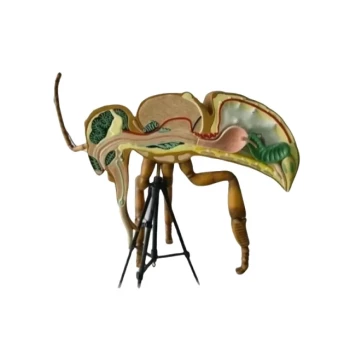
Stereo microscopes are the definitive tool for macroscopic observation and fine dissection in bee pathology. They provide high-precision, three-dimensional images with significant depth of field, typically operating at low magnifications between 7x and 35x. This specific optical configuration allows researchers to effectively identify external parasites, examine internal organ distribution, and perform delicate abdominal dissections with spatial accuracy.
While standard microscopes flatten images to view cellular details, stereo microscopes preserve 3D spatial structure. This depth perception is the critical requirement for physically manipulating bee specimens, identifying external threats, and teaching complex dissection techniques.
Precision in Anatomical Dissection
To successfully dissect a honeybee, you must be able to gauge depth and distance accurately.
The Importance of 3D Visualization
Stereo microscopes are distinct because they produce a three-dimensional image.
This allows the user to perceive the specimen with significant depth, which is impossible with standard high-power compound microscopes.
Facilitating Fine Abdominal Work
The primary reference highlights the device's suitability for fine abdominal dissection.
Because the user can see the relative position of tissues in 3D, they can separate delicate structures without accidental damage.
Diagnostic Applications in Pathology
Beyond dissection, the stereo microscope acts as a high-precision diagnostic tool for general health assessment.
Identifying External Parasites
The magnification range of 7x to 35x is ideal for spotting external bee parasites.
It provides enough power to identify the pest while keeping enough of the bee in the field of view to understand the context of the infestation.
Examining Internal Organ Distribution
Pathology often requires understanding how organs are arranged within the body cavity.
These microscopes allow for the clear visualization of internal organ distribution, helping researchers spot gross anatomical anomalies.
The Role in Education and Training
The stereo microscope is not just a research tool; it is an essential instructional device.
Teaching Fine Dissection Techniques
Mastering the motor skills required for bee dissection takes practice.
The clarity of the 3D spatial structures makes these microscopes the preferred tool for teaching fine dissection techniques to students and new researchers.
Understanding the Optical Limits
While invaluable for anatomy, it is important to understand where the utility of a stereo microscope ends.
Macroscopic vs. Microscopic
Stereo microscopes are designed for macroscopic morphological observation.
They operate at low magnifications (7x to 35x).
If your goal is to view individual bacteria, viruses, or cellular structures, this magnification level will be insufficient.
Making the Right Choice for Your Goal
Selecting the correct optical tool depends entirely on the level of detail required for your specific task.
- If your primary focus is physical manipulation: Rely on the stereo microscope's depth of field to guide scalps and forceps during fine abdominal dissection.
- If your primary focus is general health inspection: Use the 7x-35x magnification range to quickly screen for external parasites and observe organ placement.
By matching the tool's 3D capabilities to the task, you ensure precision in both diagnosis and anatomical study.
Summary Table:
| Feature | Application in Bee Study | Key Benefit |
|---|---|---|
| 3D Visualization | Fine Abdominal Dissection | Ensures spatial accuracy and prevents tissue damage |
| 7x - 35x Magnification | Parasite Identification | Ideal power for spotting external pests like Varroa |
| High Depth of Field | Internal Organ Analysis | Clear view of macroscopic anatomical distribution |
| Low Mag. Optics | Training & Education | Simplifies teaching of complex dissection techniques |
Elevate Your Apiary Operations with HONESTBEE
At HONESTBEE, we empower commercial apiaries and distributors with high-performance solutions designed for the modern beekeeping industry. Our comprehensive wholesale portfolio includes everything from specialized hive-making and honey-filling machinery to essential industry consumables and honey-themed cultural merchandise.
Whether you are scaling your production or outfitting a professional laboratory, we provide the full spectrum of tools and equipment needed for success. Contact us today to explore our wholesale offerings and professional equipment—let HONESTBEE be your partner in precision beekeeping.
References
- Daniel Basterfield. The Future Of Beekeeping?. DOI: 10.1080/0005772x.2011.11417399
This article is also based on technical information from HonestBee Knowledge Base .
Related Products
- Heavy-Duty Ergonomic Grip Galvanized Pollen Shovel
- HONESTBEE AC Powered Wire Embedder with Alligator Clips
- Solar Beeswax Melter Easy Solar Wax Melter for Beeswax
- Honey Bee Lifecycle Model: A Detailed Honeycomb Display of Bee Development
- Professional Dual Action Queen Excluder Scraper for Beekeeping
People Also Ask
- For what reasons do beekeepers collect bee pollen? Boost Hive Health and Unlock New Revenue Streams
- Why should commercial apiaries focus on the collection of diversified bee products? Maximize Your Hive’s Profit Potential
- How do bee pollen collection tools affect the quality of bee pollen used in functional dairy ice cream production?
- How does a specialized pollen collector facilitate the harvesting of diverse bee products? Automate High-Value Yields
- What is the impact of pollen collectors and associated equipment on the cost structure of pollen production? Maximize ROI