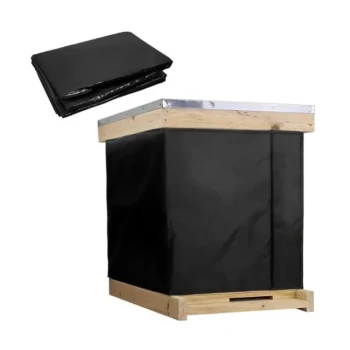
The hive inner cover is a critical structural component placed directly between the top honey super and the outer telescoping lid. It functions primarily as a protective barrier that prevents bees from cementing the heavy outer cover to the hive body with wax and propolis, while also creating a "dead air" space for essential insulation.
By acting as a buffer between the colony and the external elements, the inner cover solves the logistical problem of stuck lids while stabilizing the hive's internal climate.
The Mechanics of Hive Protection
Preventing Structural Adhesion
Bees have a natural instinct to seal gaps and secure their home using propolis (bee glue) and wax. Without an inner cover, the bees would attach their honeycomb and propolis directly to the heavy outer telescoping cover.
This makes the outer cover extremely difficult to remove during inspections without jarring the hive or damaging equipment. The inner cover sacrifices itself to this "gluing" process. Because it is lightweight and sits flush with the box edges, it is much easier to pry loose with a hive tool than the main lid.
Thermal Regulation through "Dead Air"
The inner cover is engineered to create a trapped layer of air between the living colony and the roof. This dead air space acts as a buffer against external temperature fluctuations.
In the summer, this space shields the colony from the direct heat beating down on the outer lid. It prevents the top of the hive from becoming an oven, reducing the stress on the bees to cool the brood.
Managing Moisture and Condensation
In the winter, the insulation provided by the inner cover is vital for moisture control. It prevents the warm, moist air generated by the cluster from hitting the freezing cold surface of the outer cover.
Without this buffer, condensation would form on the lid and drip back down onto the bees, which can be fatal in cold weather.
Operational Utility
The Function of the Center Hole
Most inner covers feature an oblong or oval hole in the center. While this allows for ventilation and bee movement, it serves a specific mechanical purpose during harvest.
Beekeepers can fit a bee escape into this hole. This one-way mechanism allows bees to leave the honey supers but prevents them from returning, clearing the box for easier honey harvesting.
Understanding the Trade-offs
The Necessity of Maintenance
While the inner cover prevents the outer lid from getting stuck, the inner cover itself will eventually become heavily propolized. It is not a "set and forget" item; it requires regular scraping and cleaning to maintain the proper "bee space."
If the propolis buildup becomes too thick, it can alter the spacing between frames and the cover. This may encourage bees to build "burr comb" (unwanted bridge comb) in the gap, defeating the purpose of the clean separation the inner cover provides.
Making the Right Choice for Your Goal
To maximize the utility of your hive components, consider your immediate objective:
- If your primary focus is Ease of Inspection: Ensure the inner cover is placed rim-side up (depending on design) to minimize the surface area the bees can glue down, ensuring the outer lid lifts off effortlessly.
- If your primary focus is Overwintering: Rely on the inner cover to separate the moist colony air from the freezing outer lid, preventing dangerous condensation drips.
- If your primary focus is Harvesting: Utilize the center hole of the inner cover to install a bee escape, allowing you to clear bees from supers without using chemical fumes.
The inner cover is not merely a lid; it is the hive's primary climate control and access management system.
Summary Table:
| Feature | Primary Function | Practical Benefit |
|---|---|---|
| Structural Barrier | Prevents bees from gluing the outer lid | Easier inspections; less equipment damage |
| Dead Air Space | Thermal insulation & buffer layer | Stabilizes internal hive temperature |
| Moisture Control | Reduces condensation buildup | Prevents cold water from dripping on bees |
| Center Hole | Accommodates bee escapes/feeders | Simplified honey harvesting & feeding |
| Rim Design | Maintains proper bee space | Reduces unwanted burr comb construction |
Scale Your Apiary Efficiency with HONESTBEE
Maximize your productivity and hive health with premium equipment designed for professional success. HONESTBEE serves commercial apiaries and global distributors with a complete wholesale range of beekeeping solutions. From high-quality inner covers and specialized hardware to advanced honey-filling and hive-making machinery, we provide the tools you need to thrive.
Ready to elevate your operation? Contact us today to access our comprehensive catalog of tools, machinery, and honey-themed merchandise. Let HONESTBEE be your partner in industrial-grade beekeeping excellence.
Related Products
- Inner Beehive Cover for Beekeeping Bee Hive Inner Cover
- Professional Insulated Winter Hive Wrap for Beekeeping
- Telescopic Beehive Outer Cover Lid Roof with Galvanised Sheeting for Langstroth Hive and Beehive Outer Cover
- Professional Insulated Plastic Bee Hives
- Professional Galvanized Steel Frame Rest for Beehives
People Also Ask
- What is the purpose of the inner cover in a beehive? A Key to Hive Health & Easy Management
- What is the function and placement of an inner cover in a beehive? Essential Hive Management Guide
- What is the purpose of the inner and outer covers in a beehive? Essential for Hive Health & Management
- What is a beehive's inner cover and how is it used? Essential Guide for Hive Insulation and Ventilation
- What are the functions of the inner and outer covers on a beehive? Essential Guide for Hive Protection and Management