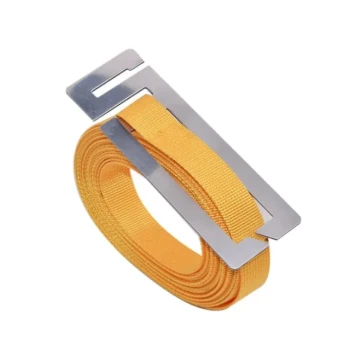
The mechanical principle relies entirely on physical contact and social transmission. The process uses wood strips impregnated with synthetic chemicals, such as fluvalinate, which are suspended directly between hive frames. As bees naturally move through the hive and brush against these strips, they physically pick up the active medicinal ingredients and transfer them throughout the colony.
The efficacy of medicated wood strips is fundamentally driven by the hive's natural traffic; the wood acts as a passive carrier for chemicals that are distributed solely through the bees' physical interactions with the strips and each other.
The Mechanics of Delivery
The Carrier System
The core of this method involves impregnating wood carriers with a synthetic chemical agent. By soaking the active ingredient (e.g., fluvalinate) into the wood, the strip becomes a stable reservoir for the miticide.
Strategic Placement
To ensure effectiveness, these strips are suspended between the hive frames. This placement is calculated to interrupt the highest traffic areas within the hive, ensuring maximum exposure to the bee population.
The Distribution Cycle
Initial Contact Action
The method leverages the frequent activity of bees within the hive. The primary mechanism is "contact action," meaning the chemical does not vaporize into the air but resides on the surface of the wood.
Uniform Dispersal
As bees come into direct contact with the wood surface, the chemical transfers to their bodies. Through natural social behaviors and movement, the bees then spread these ingredients amongst themselves.
This results in the active ingredients being uniformly distributed throughout the colony, rapidly reducing the population of Varroa mites.
Operational Dependencies
Reliance on Hive Movement
It is critical to note that this is a passive delivery system requiring an active host. The strips do not actively pump or spray the chemical; they rely entirely on the bees' movement to scour the surface.
Therefore, the mechanical principle fails if the bees are dormant or avoiding the area where the strips are hung. The success of the treatment is inextricably linked to the frequency of bee activity.
Application for Effective Mite Control
To ensure the mechanical principles described above function correctly for your hive, consider the following:
- If your primary focus is treatment placement: Ensure strips are hung centrally between frames where bee traffic and density are highest to maximize contact.
- If your primary focus is treatment timing: Apply the strips during periods of active hive movement to guarantee the chemical is distributed uniformly.
By understanding that the bee is the vehicle for the chemical, you can ensure the wood strip is placed where it will be most effective.
Summary Table:
| Feature | Mechanical Principle Detail |
|---|---|
| Carrier Method | Wood strip impregnated with synthetic chemicals (e.g., Fluvalinate) |
| Distribution | Passive transfer via physical contact and social grooming |
| Placement | Central hive frames (high-traffic zones) |
| Dependency | High reliance on active bee movement and hive density |
| Primary Goal | Uniform dispersal to eliminate Varroa mite populations |
Partner with HONESTBEE for Superior Apiary Solutions
Maximize your colony's health and productivity with high-quality chemical control tools. HONESTBEE is dedicated to supporting commercial apiaries and distributors with a comprehensive wholesale portfolio. We offer the full spectrum of beekeeping equipment, from essential consumables like medicated strips to advanced machinery, including hive-making and honey-filling systems.
Whether you are scaling a commercial operation or supplying the industry, our expertise ensures you have the most effective tools at your disposal. Contact us today to explore our wholesale offerings and industrial solutions.
References
- Yuxin Chen. Research progress on VARROA DESTRUCTOR. DOI: 10.1051/bioconf/20225501023
This article is also based on technical information from HonestBee Knowledge Base .
Related Products
- Adjustable Formic and Acetic Acid Dispenser for Bee Mite Treatment
- Compact Circular Bee Mite Treatment Dispenser
- Plastic Bee Pollen Trap Strips Comb Catcher Collector
- 12V Bee Mite Removal Evaporator Oxalic Acid Vaporizer for Bee Fumigation Treatment 180W Atomization
- High-Efficiency Diamond Maze Bee Escape for Clearing Supers
People Also Ask
- How is the process regulation function of a Formic Acid Dispenser implemented? Achieve Safe, Effective Varroa Control
- Why is a specialized formic acid evaporator necessary? Ensure Safe & Effective Varroa Mite Treatment
- What role do Formic Acid Dispensers play in the biochemical control of Varroa mites? Precision Mite Management
- What is the primary function of a specialized evaporation dispenser? Master Formic Acid Varroa Control
- What is the function of specialized application devices for Varroa? Precision Control for Healthier Bee Colonies