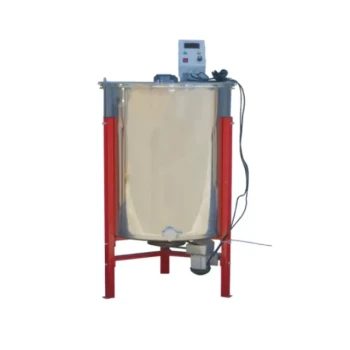
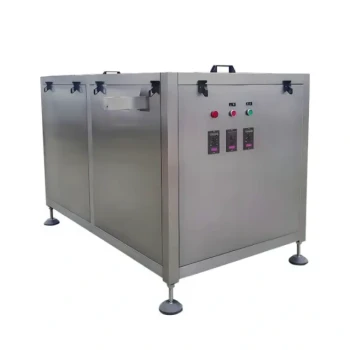
Centrifugal force is the driving mechanism that enables the isolation of microscopic pollen grains from the viscous honey matrix during pretreatment. By utilizing high-speed rotation—typically around 3500 rpm for 10 minutes—the centrifuge generates sufficient force to overcome the buoyancy of the liquid, causing dense pollen particles to settle at the bottom of the container as a concentrated sediment for analysis.
The centrifuge acts as a precision separation tool, transforming a diluted honey solution into a high-concentration precipitate. This physical process is essential for isolating trace pollen grains from sugars and interfering substances, ensuring the sample purity required for professional microscopic examination and botanical origin verification.
The Physics of Centrifugal Separation
Harnessing High-Speed Rotation
At the core of the pretreatment process is the conversion of rotational energy into centrifugal force. As the centrifuge spins, it creates an outward force that acts on every particle within the diluted honey solution.
Density-Driven Sedimentation
Pollen grains possess a higher density than the surrounding diluted honey-water mixture. The centrifugal force accelerates the natural settling process, pushing these dense pollen grains toward the base of the centrifuge tube while the lighter liquid remains above.
Isolation from the Sugar Matrix
Honey is naturally high in sugars, which can interfere with microscopic clarity. Centrifugation allows for solid-liquid separation, effectively "washing" the pollen grains as they are pulled away from the dissolved sugar matrix and concentrated into a clean pellet.
Critical Operational Parameters for Professionals
Optimal Speed and Duration
To achieve consistent results in pollen extraction (APC analysis), technical precision is vital. Primary industry standards suggest a speed of 3500 rpm for a duration of 10 minutes to ensure that even the smallest pollen particles are successfully enriched.
The Necessity of Sample Dilution
Raw honey is too viscous for efficient particle movement. Pretreatment requires the honey to be diluted with water or a solvent; this reduces the resistance of the liquid, allowing the centrifugal force to move the pollen grains through the medium more effectively.
Preserving Sample Integrity
Unlike thermal extraction methods, mechanical centrifugation is a physical separation. It preserves the original physicochemical properties and heat-sensitive nutritional components, such as proteins and enzymes, which are critical for accurate quality testing.
Understanding the Trade-offs and Pitfalls
Risks of Improper Parameter Settings
Setting the centrifuge at a speed that is too low or for an insufficient duration will lead to incomplete sedimentation. This results in an inaccurate pollen count, which can lead to the misclassification of honey origin or purity.
Equipment Maintenance and Calibration
Inconsistent rotation speeds due to poorly maintained equipment can result in "loose" sediment. For high-volume B2B operations, using industrial-grade laboratory centrifuges is necessary to ensure the repeatability of results across different batches.
Managing Sample Overheating
While the process is physical, prolonged high-speed rotation can generate friction heat in some centrifuge models. It is critical to use equipment that maintains a stable temperature to avoid damaging the delicate pollen morphology required for microscopic identification.
How to Leverage This Expertise for Your Business
Making the Right Choice for Your Goal
- If your primary focus is botanical origin verification: Ensure your sourcing partners utilize standardized centrifugation protocols (e.g., 3500 rpm) to provide accurate APC (Annual Pollen Count) data.
- If your primary focus is high-volume quality assurance: Invest in or partner with facilities that offer rapid-response laboratory services and efficient order fulfillment through automated centrifugal pretreatment.
- If your primary focus is premium product positioning: Highlight the use of physical, non-thermal separation methods in your marketing to emphasize the preservation of the honey’s natural enzymatic profile.
Utilizing professional centrifugal pretreatment ensures the transparency and purity required to thrive in the competitive global honey trade.
Summary Table:
| Feature | Technical Detail |
|---|---|
| Core Mechanism | Centrifugal Force & Density-Driven Sedimentation |
| Standard Protocol | 3500 RPM for 10 Minutes |
| Primary Goal | Isolation of microscopic pollen from the sugar matrix |
| Key Advantage | Non-thermal separation preserves enzymatic integrity |
| Essential Step | Sample dilution to reduce honey viscosity |
Scale Your Honey Business with HONESTBEE
Precise extraction is critical for honey quality, and having the right equipment is vital for your success. HONESTBEE caters to commercial apiaries and B2B distributors with a comprehensive one-stop sourcing model.
Whether you need specialized honey-filling machines, hive-making hardware, or high-quality beekeeping consumables, we provide a full-spectrum product portfolio designed for high profit margins and supply reliability. Benefit from our ultra-fast delivery, deep industry expertise, and dedicated OEM/ODM support.
Contact HONESTBEE today to streamline your supply chain and access premium wholesale offerings.
References
- Alinne Costa Cavalcante Rezende, Otilene dos Anjos Santos. Pollen of honey from <i>Melipona seminigra merrillae</i> Cockerell, 1919, <i>Scaptotrigona nigrohirta</i> Moure, 1968 and <i>Scaptotrigona</i> sp. Moure, 1942 (Apidae: Meliponini) reared in Sataré Mawé indigenous communities, Amazon, Brazil. DOI: 10.1080/01916122.2018.1458664
This article is also based on technical information from HonestBee Knowledge Base .
Related Products
- electric honey extractor honey centrifuge 3 frame honey extractor stainless steel honey frame extractor
- Professional 4 Frame Self Reversing Electric Honey Extractor for Beekeeping
- Fully Automatic High Speed Centrifugal Bottle Unscrambler
People Also Ask
- What are the characteristics of electric honey extractors? Boost Your Apiary Efficiency with Automated Technology
- What are the disadvantages of using an electric honey extractor? Weighing Cost, Power, and Comb Safety
- What are the advantages of an electric honey extractor? Boost Efficiency and Scale Your Honey Production
- What are the technical advantages of electric honey extractors? Maximize Yield and Protect Your Bee Colony
- How does an electric honey extractor affect the quality of honey? Preserve Flavor & Purity with Precision Extraction