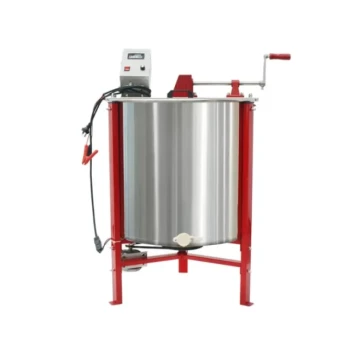
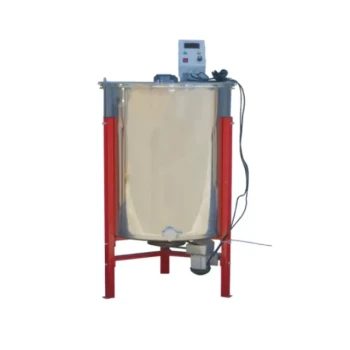
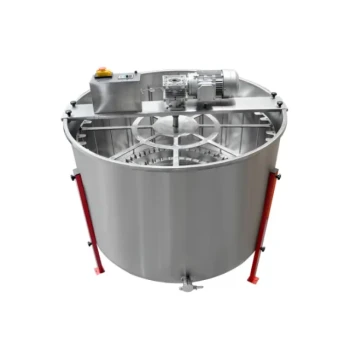
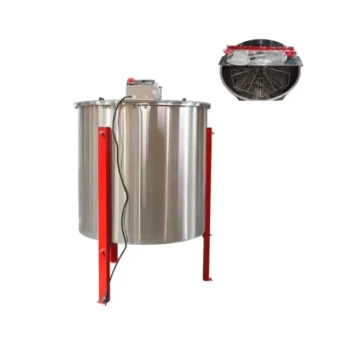
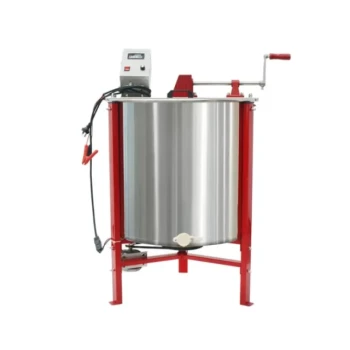
The primary advantages of an electric honey extractor are speed, volume capacity, and the elimination of manual labor. These machines are designed for efficiency, with the ability to handle high capacities—up to 100 frames in some models—while requiring significantly less physical effort than hand-cranked alternatives. Because the motor handles the spinning, the operator is free to monitor the process or focus on other tasks.
By automating the mechanical work of spinning, electric extractors shift the beekeeper's role from "laborer" to "manager." The defining value is not just that it spins faster, but that it decouples the extraction time from your physical exertion.
Transforming the Extraction Workflow
Elimination of Physical Fatigue
The most immediate benefit is the removal of repetitive manual labor. Manual extraction requires continuous cranking, which becomes exhausting even with small frame counts.
Electric models utilize a motor to generate centrifugal force. This allows you to process batch after batch without the physical burnout associated with manual gearing.
Multitasking Capability
Because the machine runs automatically, you do not need to stand over it constantly. The primary reference highlights that operators can simply monitor the process while it spins.
This freedom allows for a continuous workflow. You can uncap the next set of frames while the current batch is extracting, drastically reducing total time in the honey house.
Handling Volume and Speed
High-Volume Capacity
Electric extractors are essential for scaling operations. While manual extractors often hold 2 to 4 frames, electric units are built for volume.
According to the primary data, these units can accommodate a high capacity of up to 100 frames. This makes them the standard choice for commercial operations or large-scale hobbyists.
Precision Speed Control
Electric motors offer variable speed controls. This allows for a slow start to balance the load and a high-speed finish to extract the remaining honey.
This control leads to a faster extraction process overall. You can achieve maximum centrifugal force to ensure a higher honey yield without the inconsistency of hand-cranking.
Preserving Equipment and Product
Protecting the Honeycomb
Despite their power, electric extractors can be gentler on the comb than manual operation. The consistent rotation minimizes the "wobble" that often occurs when a human arm gets tired.
This smoothness preserves the integrity of the wax comb. Intact combs can be returned to the hive for immediate reuse, which is a massive energy saver for the bee colony.
Cleaner Honey Yield
The sustained centrifugal force pulls honey out more effectively. This results in a drier comb and more honey in the bucket.
Furthermore, consistent spinning forces often result in honey with less debris, as the process is controlled and steady rather than erratic.
Understanding the Trade-offs
While the advantages are clear, there are objective limitations to consider. The primary trade-off is cost; electric models represent a significantly higher financial investment than manual counterparts.
Additionally, they introduce a dependency on electricity. This limits placement options, as you must be near a reliable power source, and it adds a small operational cost to the harvest.
Making the Right Choice for Your Apiary
The decision to invest in an electric extractor depends largely on your current scale and future goals.
- If your primary focus is Commercial or Large-Scale Production: The ability to process up to 100 frames at once makes an electric model mandatory for efficient time management.
- If your primary focus is Workflow Optimization: The ability to uncap frames while the extractor spins allows you to double your productivity per hour.
- If your primary focus is Comb Preservation: The consistent, controlled speed of an electric motor protects your drawn comb for future seasons better than manual cranking.
An electric extractor is an investment in time, allowing you to move from simply harvesting honey to managing a production line.
Summary Table:
| Feature | Advantage | Impact on Apiary Operations |
|---|---|---|
| Capacity | Handles up to 100 frames | Dramatically increases volume and processing speed. |
| Automation | Eliminates manual cranking | Reduces physical fatigue and allows for multitasking. |
| Speed Control | Variable motor speeds | Ensures maximum honey yield while protecting delicate wax combs. |
| Consistency | Smooth centrifugal force | Preserves drawn comb for immediate reuse by bee colonies. |
Maximize Your Harvest with HONESTBEE Commercial Solutions
Transition from laborer to manager with HONESTBEE. As a leading provider for commercial apiaries and distributors, we offer a comprehensive wholesale range of high-capacity electric honey extractors, honey-filling machines, and hive-making equipment. Whether you are scaling your production or supplying the industry with essential consumables and honey-themed merchandise, we deliver the specialized hardware you need to succeed.
Ready to elevate your beekeeping efficiency?
Contact HONESTBEE today for wholesale pricing and expert equipment guidance!
Related Products
- HONESTBEE 72 Frame Industrial Electric Honey Extractor for Beekeeping
- Electric 4 Frame Tangential Honey Extractor
- 32 Frame Commercial Electric Honey Extractor for Beekeeping and Honey Production
- HONESTBEE 6 Frame Self Reversing Electric Honey Extractor for Beekeeping
- electric honey extractor honey centrifuge 3 frame honey extractor stainless steel honey frame extractor
People Also Ask
- What is the importance of balancing honeycomb frames within a honey extractor? Ensure Stability and Protect Machinery
- How is honey separated from the frames after they are uncapped? Efficient Extraction Methods for High Yields
- What are the main benefits of using a honey extractor? Maximize Yields and Protect Your Honeycomb
- What are the recommended methods for removing honey from the honeycomb? Top Extraction Techniques for Maximum Efficiency
- How do manual honey extractors compare to electric honey extractors? Choosing the Right Tool for Your Apiary Growth