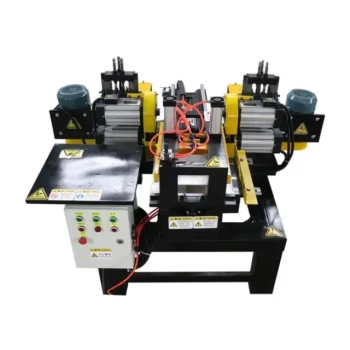
The double-roller extrusion system functions as the central processing unit for beeswax foundation manufacturing, simultaneously managing material density and surface geometry. Its primary role is to compress raw beeswax blocks into sheets of uniform thickness while imprinting the critical hexagonal pattern required for hive construction. By utilizing two counter-rotating rollers with an adjustable gap, the system transforms irregular wax inputs into standardized sheets ranging typically from 1 to 3 mm thick.
The double-roller system is not merely a flattening device; it is a synchronization tool that marries high-pressure compression with precise biological formatting. It ensures the resulting sheet provides a structurally sound and biologically familiar base for honeybees.
The Mechanics of Wax Transformation
Controlled Compression
The first critical action of the system is the reduction of raw material. Beeswax blocks are fed into the machine, where the physical force of the rollers compresses the solid mass.
This process eliminates air pockets and increases the density of the wax. The result is a consistent, durable sheet that can withstand the weight of the hive and the temperature variations within it.
Precision Thickness Adjustment
Achieving a specific gauge is vital for the end product's utility. The system allows operators to fine-tune the output by adjusting the gap between the rollers.
This adjustment capability ensures the sheet meets strict specifications, typically falling within the 1 to 3 mm range. Uniform thickness is essential to prevent structural weak points in the final honeycomb foundation.
The Role of Counter-Rotation
The efficiency of the feed mechanism relies on the counter-rotating motion of the rollers. This opposing movement grabs the raw wax block and pulls it through the gap with consistent force.
This ensures that the material flows evenly through the extrusion point. Without this synchronized rotation, the wax would likely jam or feed unevenly, resulting in warped or unusable sheets.
Creating the Biological Interface
Imprinting the Alveoli
Beyond simple flattening, the rollers serve as a mold. As the wax is compressed, the rollers simultaneously emboss a hexagonal foundation pattern, known as alveoli, onto the surface.
This is not a decorative step; it is functional engineering. The rollers transfer the exact geometric template onto the wax sheet, defining the starting points for the bees' cell construction.
Standardization for Efficiency
The pattern provided by the rollers acts as a guide for the colony. By providing a standardized physical base, the system reduces the energy and time bees must expend to build the comb.
A precisely imprinted foundation encourages rapid and uniform comb building. This optimization allows the colony to focus resources on honey production and brood rearing rather than foundational architecture.
Understanding the Operational Trade-offs
Balancing Pressure and Integrity
While high compression creates dense sheets, excessive pressure can damage the wax structure. If the gap is set too narrow for the volume of input material, the wax may tear or become brittle.
Conversely, insufficient pressure results in a "soft" sheet where the hexagonal pattern is ill-defined. Finding the mechanical "sweet spot" is necessary to ensure the pattern is deep enough to be recognized by the bees without compromising the sheet's flexibility.
Material Consistency Requirements
The double-roller system relies heavily on the quality of the input block. Because the system is designed for uniform extrusion, irregularities in the raw block's temperature or composition can lead to inconsistencies.
If the wax block is too cold, it may damage the roller alignment; if too hot, it may stick to the embossing surface. Operators must maintain strict control over the raw material state before it enters the extrusion gap.
Making the Right Choice for Your Goal
To get the most out of a beeswax sheet processing setup, consider how you calibrate the extrusion system based on your specific objectives.
- If your primary focus is structural durability: Prioritize the compression settings to achieve a density near the 3 mm limit, ensuring a thicker, more robust foundation that resists sagging.
- If your primary focus is rapid colony acceptance: Focus on the precision of the gap adjustment to ensure the hexagonal imprinting is sharp and deep, providing the clearest possible guide for the bees.
Success in beeswax processing lies in the precise balance between mechanical force and delicate patterning.
Summary Table:
| Feature | Primary Function | Technical Specification |
|---|---|---|
| Material Compression | Increases density and eliminates air pockets | High-pressure mechanical force |
| Thickness Control | Maintains uniform sheet gauge | Adjustable gap (1 - 3 mm) |
| Hexagonal Imprinting | Embosses alveoli patterns as a biological guide | Precision-machined roller molds |
| Feed Mechanism | Ensures consistent material flow | Synchronized counter-rotating motion |
| Structural Integrity | Prevents sagging and provides durability | Balanced pressure/temperature control |
Elevate Your Beekeeping Production with HONESTBEE
As a premier partner for commercial apiaries and global distributors, HONESTBEE provides the industry-leading technology you need to scale. Our professional beeswax sheet processing machinery ensures perfect cell geometry and material density every time. Beyond extrusion systems, we offer a full spectrum of beekeeping tools, hive-making machines, and honey-filling equipment designed for maximum efficiency.
Ready to optimize your wholesale operations? Contact us today to discover how our comprehensive equipment solutions and honey-themed cultural merchandise can drive your business growth.
References
- Lider Yoel Castillo Laban, Raisa Marina Cedeño Loor. Diseño y construcción de un prototipo de una máquina de laminadora de cera de abeja. DOI: 10.18779/ingenio.v8i1.866
This article is also based on technical information from HonestBee Knowledge Base .
Related Products
- Manual Beeswax Flat Sheet Machine for Beeswax Processing
- Electric Beeswax Flat Sheet Machine with Operating Tray for Wax Processing
- Electric Flatting and Embossing Machine with Tray for Beekeeping
- Fully Automatic Beeswax Embossing Machine Foundation Mill
- Manual Beeswax Comb Foundation Machine Wax Foundation Mill Embossing Machine
People Also Ask
- How do cultural merchandise processing machines contribute to the economic value chain? Boosting Apiary Profitability
- What are some practical tips for managing equipment and workspace when processing beeswax? Essential Studio Setup Tips
- How do specialized beeswax processing machines maximize the value of beekeeping by-products? Boost Your Apiary's ROI
- What role does beeswax processing equipment play in development of by-products? Turn Apiary Waste into High-Value Profit
- What is the economic and operational value of beeswax processing? Maximize Profits and Hive Health with Refining