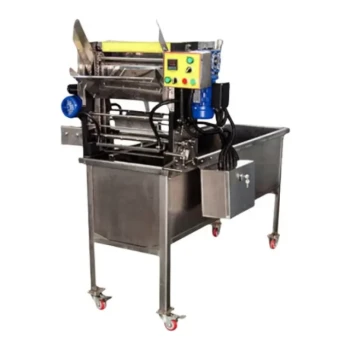
Automated Honey-filling Machines serve as the critical bridge between raw harvest and commercial retail, functioning primarily to standardize the final product. Their core role is to enhance packaging efficiency and guarantee product consistency through high-precision measurement and dosing technologies. By operating within a sealed environment, these machines minimize external contamination, ensuring strict compliance with food safety standards and supporting the commercial branding of the product.
The transition to automated filling represents the shift from traditional manual methods to large-scale commercial operations. It transforms honey from a raw agricultural variable into a consistent, safe, and market-competitive consumer good.
Mastering the Physical Challenges of Honey
Managing High Viscosity
Honey is naturally thick and difficult to handle manually. Industrial-grade filling machines utilize high-precision metering pumps to manage this viscosity effectively.
Many systems also integrate thermal pre-processing to optimize the flow of the honey. This ensures rapid bottling without compromising the chemical integrity of the product.
Precision Volumetric Control
Manual bottling often leads to over-filling or under-filling. Automated machines provide precise quantitative control, ensuring every bottle meets exact weight specifications.
This precision significantly reduces material waste. It ensures that the producer maximizes the revenue from every batch of harvested honey.
Elevating Food Safety Standards
The Closed-Loop Defense
The most critical role of these machines is creating a hygienic, closed packaging environment. This sealed process acts as a hardware defense against environmental contaminants.
By isolating the honey during bottling, the machinery significantly reduces the probability of airborne molds and yeasts entering the finished product.
Eliminating Secondary Contamination
Manual handling carries a high risk of introducing bacteria or foreign particles. Automated filling removes the need for direct human contact during the most vulnerable stage of processing.
This reduction in human handling is essential for meeting high-level food hygiene standards. It ensures the final product is safe for long-term storage and consumption.
Strategic Commercial Advantages
Enabling Large-Scale Throughput
Automation allows for a volume of production that is impossible with manual labor. These machines increase production line throughput, enabling producers to meet larger market demands.
Enhancing Brand Consistency
Market competitiveness relies on visual uniformity. Automated filling ensures consistent fill levels across all units, which improves the visual quality of the product on retail shelves.
This consistency supports commercial branding. It signals professionalism and quality control to the consumer.
Understanding the Trade-offs
Equipment Dependency and Maintenance
While automation increases speed, it introduces mechanical complexity. Producers must maintain metering pumps and thermal systems to prevent breakdowns that could halt the entire production line.
Upstream Quality Requirements
A filling machine cannot improve the quality of the honey itself; it preserves it. If the honey has not been properly filtered of micro-impurities or suspended particles before reaching the filler, the machine will simply package those impurities efficiently.
The filling machine must be viewed as the final step in a system that includes centrifugal extractors and high-precision filtration. It relies on these upstream processes to deliver clean, clear honey for packaging.
Making the Right Choice for Your Goal
To maximize the value of an automated filling system, align your equipment choice with your primary operational objective:
- If your primary focus is Regulatory Compliance: Prioritize machines with enclosed sterile operating environments to minimize mold and yeast risks.
- If your primary focus is Profit Margins: Focus on systems with the highest rated volumetric precision to eliminate product over-fill and waste.
- If your primary focus is Scalability: ensure the machine features advanced viscosity management (thermal processing) to maintain high throughput speeds regardless of honey thickness.
Automating the filling process is the definitive step that secures the hygiene, consistency, and profitability required for a successful commercial honey brand.
Summary Table:
| Core Role | Key Mechanism | Operational Benefit |
|---|---|---|
| Standardization | High-precision metering pumps | Ensures consistent bottle weight and branding |
| Viscosity Control | Thermal pre-processing | Rapid bottling of thick honey without quality loss |
| Food Safety | Closed-loop sealed environment | Eliminates contamination and airborne molds |
| Efficiency | Automated high-speed throughput | Enables large-scale commercial market entry |
| Waste Reduction | Volumetric quantitative control | Minimizes product over-fill and maximizes revenue |
Elevate Your Honey Production with HONESTBEE
Ready to transition from manual processing to industrial-scale excellence? HONESTBEE specializes in supporting commercial apiaries and distributors with a comprehensive wholesale portfolio.
We provide everything from high-precision honey-filling machines and hive-making hardware to professional-grade beekeeping tools and essential industry consumables. Partner with us to enhance your production efficiency, ensure regulatory compliance, and boost your brand's market competitiveness.
Contact us today to optimize your honey processing line!
References
- Soresa Shuma. The Challenges and Opportunities of Honey Production Systems in Jimma Horro District Kellem Wollega Zone, Oromia, Ethiopia. DOI: 10.26717/bjstr.2020.29.004779
This article is also based on technical information from HonestBee Knowledge Base .
Related Products
- Fully Automatic Honey Filling Packaging Machine for Processing Line
- Automatic Honey Filling and Filtering Machine for Beekeeping Bottle Filling
- Precision Durable Efficient HONESTBEE Rotary Honey Filling Machine
- Semi Automatic Small Honey Bottle Filling Machine Honey Filler
- Precision Automated Packaging Turntable Honey Spoon Filling Sealing Packing Machine
People Also Ask
- Why are fully automatic honey filling and packaging lines essential? Boost Your Honey's Market Value and Quality
- What is a fully-automatic honey filler? Streamline Your Production with High-Precision Automation
- How do automated honey filling and packaging machines affect profitability? Boost Margins with HONESTBEE Technology
- How do automated honey filling and packaging machines contribute to the market value of honey products? Maximize Your ROI
- How do industrial-grade automated honey filling and packaging machines mitigate the risk of physical contamination?