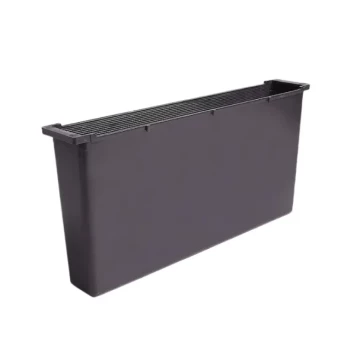
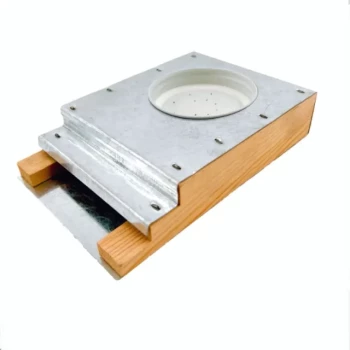
Top bar hives primarily utilize internal feeders designed to fit within the hive's unique horizontal geometry. The most standard configuration involves placing an inverted mason jar with a perforated lid behind a follower board, allowing bees to access liquid feed without flooding the main living area.
Core Takeaway Unlike vertical hives that use top-mounted reservoirs, top bar hives manage feeding laterally. The key is using a follower board to partition the hive, creating a separate "kitchen" area for feeders that keeps the colony undisturbed and the food source secure.
The Standard Approach: Internal Gravity Feeders
The Mason Jar Method
The most prevalent feeder for a top bar hive is a simple upside-down mason jar.
Small holes are punched in the lid, allowing the syrup to drip out slowly.
This relies on a vacuum seal and gravity to dispense the liquid only as the bees consume it.
The Role of the Follower Board
Because top bar hives are horizontal, you cannot simply place a feeder on "top" of the frames as you would in a vertical hive.
Instead, the feeder is placed behind a follower board—a movable partition that defines the colony's living space.
This creates a designated feeding zone separated from the brood and honeycomb, minimizing disturbance to the bees during refills.
Seasonal Adaptations: Winter Feeding
The Limitation of Liquid Feed
Liquid syrup is effective for establishing new colonies or during nectar dearths in warm weather.
However, in winter, liquid feed is prone to freezing, rendering it inaccessible to the cluster.
Fondant Feeders
For cold-weather survival, a fondant feeder is the superior choice.
Fondant provides a solid, dense source of carbohydrates that will not freeze.
This ensures the colony has access to emergency food even when internal hive temperatures drop.
Understanding the Trade-offs
Risk of Drowning
Any feeder containing liquid syrup presents a drowning hazard for bees.
While plastic frame feeders often feature roughened inner walls to provide grip, improvised jar feeders must be monitored carefully.
If a feeder leaks or lacks proper surface tension, bees can become trapped in the syrup.
Leakage and Robbing
Gravity feeders (like inverted jars) are sensitive to temperature fluctuations, which can alter the internal pressure and cause the syrup to dump.
Leaked syrup on the bottom of the hive is not just a mess; it can attract pests or trigger robbing behavior from other colonies.
Always ensure the lid holes are sized correctly to maintain the vacuum seal.
Making the Right Choice for Your Goal
Selecting the correct feeder depends largely on the season and the current state of your colony's resources.
- If your primary focus is establishing a new colony: Use a liquid mason jar feeder behind the follower board to simulate a heavy nectar flow and stimulate wax production.
- If your primary focus is winter survival: Switch to a solid fondant feeder to prevent freezing and provide a reliable emergency food source.
The most effective feeding strategy respects the horizontal nature of the top bar hive, keeping the food source accessible but compartmentalized.
Summary Table:
| Feeder Type | Feeding Season | Best Used For | Key Advantage |
|---|---|---|---|
| Mason Jar (Internal) | Spring / Summer | Establishing new colonies | Simple vacuum-seal gravity delivery |
| Fondant Feeder | Winter | Cold weather survival | Solid food source that won't freeze |
| Follower Board Area | All Seasons | Horizontal hive management | Minimizes colony disturbance during refills |
Maximize Your Apiary Productivity with HONESTBEE
At HONESTBEE, we understand that commercial success in beekeeping requires precision tools and reliable equipment. Whether you are managing professional apiaries or operating as a distributor, we provide a comprehensive wholesale range including:
- Beekeeping Machinery: Hive-making and honey-filling machines for high-volume operations.
- Professional Tools: A full spectrum of hardware and essential industry consumables.
- Cultural Merchandise: Honey-themed products to diversify your retail portfolio.
Partner with us to streamline your operations and access premium equipment at scale. Contact HONESTBEE today to discuss your wholesale needs and see how our expertise can support your growth.
Related Products
- HONESTBEE Square Top Hive Bee Feeder Top Bee Feeder
- HONESTBEE Professional Hive Top Bee Feeder Feeding Solution
- Professional Hive Top Bee Feeder for Beekeeping
- HONESTBEE Round Hive Top Bee Feeder for Syrup
- Rapid Bee Feeder White Plastic 2L Round Top Feeder for 8 or 10-Frame Bee Hives
People Also Ask
- How does a bee hive top feeder work? A Guide to Efficient, Protected Feeding
- How to use a top feeder in a beehive? A Guide to Effective Beehive Feeding
- What is the structural design and placement of a beehive top feeder? Optimize Your Apiary's Feeding Efficiency
- What is a top feeder and how is it designed? Maximize Hive Feeding Efficiency
- What are the different types of top feeders for bees? Choosing the Best Feeder for Your Apiary