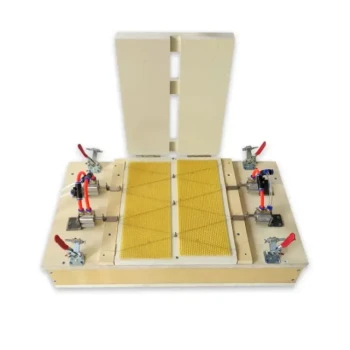
Foundation sheets serve as the fundamental architectural template for commercial hive management. By providing a strict guide, they compel bees to build honeycombs that are consistently straight, flat, and uniform in size. This physical standardization creates a modular system where honeycombs become completely interchangeable assets across different hives and apiaries.
While natural comb construction is variable, commercial operations require predictability. Foundation sheets provide the essential standardization that makes honeycombs interchangeable, acting as the technical prerequisite for mechanized harvesting and large-scale industrial efficiency.
The Mechanics of Standardization
Enforcing Structural Uniformity
In a natural environment, bees may build irregular structures. Foundation sheets override this tendency by providing a regular template.
This forces the colony to construct combs that adhere to specific dimensions. The result is a predictable, flat surface rather than an organic, uneven volume.
Creating Interchangeable Components
The primary value of this uniformity is interchangeability. Because every comb is built on the same template, any frame can fit into any hive within the operation.
This eliminates the logistical nightmare of matching specific frames to specific hive boxes. It transforms the honeycomb from a unique biological creation into a standardized industrial component.
Enabling Industrial Operations
Facilitating Mechanization
Large-scale honey production relies heavily on machinery. Mechanized honey harvesting requires frames that fit precisely into extractors and uncapping machines.
Straight, flat combs created on foundation sheets ensure these machines operate without damaging the equipment or the comb itself. Without this standardization, automated processing would be impossible.
Streamlining Asset Management
For a commercial beekeeper, the hive is an asset that must be managed efficiently. Foundation sheets allow for modular management.
Beekeepers can rotate combs, replace damaged sections, or balance resources between colonies instantly. This fluidity is essential for maintaining the high-tempo workflow required in large commercial apiaries.
Understanding the Trade-offs
The Requirement for Precision
Adopting foundation sheets commits the apiary to a strict standard. The entire operation relies on the consistency of these inputs.
If the foundation sheets themselves are flawed or deviate from the standard, the bees may build irregular comb ("burr comb"), defeating the purpose of the system.
Dependency on Industrial Systems
Using foundation sheets moves the apiary toward an industrialized model. It shifts focus from purely biological observation to asset management.
While this increases efficiency, it requires an adherence to mechanized standards that acts as a prerequisite for growth. You cannot scale to an industrial level while relying on natural, irregular comb structures.
Optimizing Apiary Management Strategy
To leverage foundation sheets effectively, align their use with your specific operational goals:
- If your primary focus is Industrial Scalability: Prioritize foundation sheets to ensure all frames are compatible with automated uncapping and extraction machinery.
- If your primary focus is Asset Efficiency: Use the interchangeability provided by foundation sheets to rapidly balance resources between strong and weak colonies without compatibility constraints.
Standardization through foundation sheets is the bridge between traditional beekeeping and high-efficiency, commercial apiculture.
Summary Table:
| Feature | Standardized Foundation Sheets | Natural Comb Construction |
|---|---|---|
| Structural Form | Flat, uniform, and predictable | Organic, irregular, and variable |
| Interchangeability | High; frames fit any hive box | Low; often custom to specific space |
| Machinery Compatibility | Optimized for extractors & uncappers | High risk of damage to machinery |
| Management Style | Modular asset management | Biological observation focus |
| Scaling Potential | High-efficiency industrial scale | Limited by manual labor constraints |
Scale Your Apiary with HONESTBEE Professional Solutions
Transitioning to a high-efficiency industrial model requires more than just technique—it requires precision equipment. HONESTBEE specializes in supporting commercial apiaries and distributors with a comprehensive wholesale range of beekeeping tools and machinery.
From foundation-aligned hive-making machines to automated honey-filling systems and essential industry consumables, we provide the hardware necessary to turn standardization into profit. Whether you are expanding a large-scale operation or supplying the next generation of beekeepers, our portfolio is designed to maximize your asset efficiency.
Ready to industrialize your honey production? Contact HONESTBEE Today for Wholesale Pricing and Equipment Consultations
References
- Eleanor Andrews. ‘The main objection to numerous small bee keepers’: biosecurity and the professionalization of beekeeping. DOI: 10.1016/j.jhg.2019.10.015
This article is also based on technical information from HonestBee Knowledge Base .
Related Products
- Beeswax Foundation Sheets Beehive Foundation for Wholesale
- Food Grade Plastic bee Foundation for Bee Frames
- Beeswax Machine Press Embosser Wax Foundation Mold Printer Bee Hive Equipment Making Sheet
- Notebook Style Beeswax Foundation Mould Wax Foundation Mold
- Colorful Silicone Beeswax Foundation Mold Mould for Beekeeping
People Also Ask
- What are the technical advantages of beeswax foundations and feeding tools? Optimize Your Bee Breeding Phase
- Why is the regular exchange and replacement of beeswax foundations encouraged? Boost Honey Yield & Hive Biosafety
- What are the negative consequences of using old or contaminated beeswax in foundations? Protect Your Hive Today
- Why is high-purity natural beeswax essential for foundations? Prevent Larval Mortality & Boost Colony Health
- What are the specific advantages of regular comb replacement? Boost Hive Health with New Beeswax Foundations