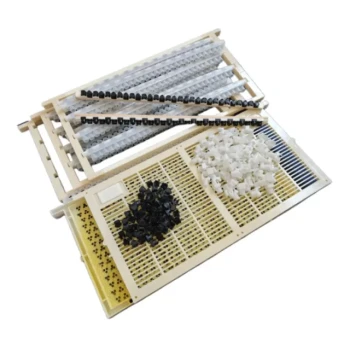
Standardized queen rearing relies on a specific suite of precision equipment designed to scale production while maintaining genetic integrity. To implement a program for high-yield races, you require grafting needles, queen rearing frames, artificial wax cell cups, and mating hives to manage the lifecycle from larvae to reproductive maturity.
The Core Insight Success in rearing high-yield honey bee races is not just about biology, but about process consistency. Specialized tools allow breeders to move from artisanal methods to high-frequency, large-scale selection, ensuring that every queen produced meets specific standards for productivity, disease resistance, and genetic purity.
The Hardware for Larval Transfer and Development
To standardize production, you must first standardize the environment in which the queens develop. This requires moving away from natural cell construction to managed systems.
Precision Grafting Tools
The foundation of the process is the grafting needle. This tool allows for the delicate transfer of larvae from worker cells to queen cups without physical damage.
Artificial Cell Cups
Standardized programs utilize artificial wax or plastic queen cell cups. These provide a uniform geometry for the developing larvae, ensuring consistent acceptance rates by the nurse bees.
Specialized Queen Rearing Frames
The queen rearing frame acts as the primary carrier for mass production. It secures rows of artificial cups, enabling the concentrated placement of large numbers of developing larvae within a single colony.
Beyond holding cells, these frames allow researchers and breeders to accurately record development timelines. By centralizing the larvae, you can track the exact hours from grafting to pupation and emergence, facilitating the management of large experimental or commercial batches.
Tools for Genetic Control and Mating
Once the virgin queens emerge, the focus shifts to ensuring they are mated with drones that carry compatible, high-yield genetics.
Mating Hives (Nuclei)
Mating hives, or nuclei, are smaller, specialized colony units. They provide the isolation necessary for the queen to mature and take her mating flights while minimizing the resource drain on the operation.
Artificial Insemination Equipment
For high-yield races where genetic purity is paramount, relying on open mating is a risk. Artificial insemination tools are essential for controlled breeding, allowing you to bypass natural mating variables.
This equipment supports high-frequency selection procedures, enabling the production of thousands of queens with specific traits—such as gentleness or disease resistance—that might be diluted in open-air mating.
Environmental Control Hardware
Professional setups utilize equipment that offers precise temperature control and isolation. This hardware simulates optimal egg-laying environments to increase larval survival rates and protect rare genetic resources, such as specific Caucasian bee lineages, from environmental stress.
Understanding the Trade-offs
While specialized tools enable scale and quality, they introduce new layers of complexity to your operation.
Equipment Cost vs. ROI
Investing in artificial insemination and precision incubation hardware represents a significant upfront cost. While these tools ensure purity, they require a higher volume of queen production to achieve a positive return on investment.
Technical Proficiency
Tools like grafting needles and insemination devices are not automated; they require high manual dexterity. The "standardization" comes from the process, but the success rate is still heavily dependent on the skill of the operator.
Making the Right Choice for Your Goal
To maximize the effectiveness of your rearing program, align your equipment choices with your specific operational targets.
- If your primary focus is Commercial Scale: Prioritize queen rearing frames and mating nuclei to maximize the volume of queens produced per cycle.
- If your primary focus is Genetic Purity: Invest heavily in artificial insemination tools and isolation hardware to ensure specific high-yield traits are retained without dilution.
Standardization is the bridge between having a good bee stock and building a profitable, resilient apiary industry.
Summary Table:
| Tool Category | Essential Equipment | Core Function | Impact on Yield |
|---|---|---|---|
| Larval Transfer | Grafting Needles & Cell Cups | Precise transfer and uniform development of larvae. | High acceptance rates and consistent queen size. |
| Mass Production | Queen Rearing Frames | Houses multiple cells for centralized management. | Scalable production and accurate timeline tracking. |
| Genetic Control | Artificial Insemination Kit | Controlled breeding for specific genetic traits. | Guaranteed purity and trait stabilization (e.g., disease resistance). |
| Maturation | Mating Hives (Nuclei) | Isolated units for maturation and mating flights. | Reduced resource drain and higher survival rates. |
| Environmental | Precise Incubation Hardware | Simulates optimal temperature and humidity. | Maximizes larval survival and protects rare lineages. |
Elevate Your Breeding Program with HONESTBEE
To achieve true standardization and high-yield results, you need equipment that matches your ambition. HONESTBEE specializes in supporting commercial apiaries and distributors with a comprehensive range of professional beekeeping tools and machinery. From precision queen rearing systems and grafting hardware to high-capacity honey-filling machines and hive-making equipment, we provide the industrial-grade solutions required for large-scale success.
Whether you are expanding a commercial breeding operation or stocking specialized hardware for your distribution network, HONESTBEE delivers the quality and consistency your business demands.
Ready to scale your production? Contact us today to explore our wholesale offerings and equipment solutions!
References
- A. AKEEM. OYERINDE. Assessment of Honey Production Efficiency of Races of Apis mellifera. AdansoniiL. in Nigeria. DOI: 10.36108/nje/6102/23.0140
This article is also based on technical information from HonestBee Knowledge Base .
Related Products
- Retractable Chinese Queen Rearing Grafting Tools Equipment
- Plastic Chinese Queen Grafting Tool for Bee Queen Rearing
- Stainless Steel Beekeeping Queen Grafting Tool for Honey Bee Rearing
- Stainless Steel Queen Grafting Tool for Beekeeping and Bee Queen Grafting
- Plastic Beekeeping Honey Bee Larvae Grafting Tools for Queen Rearing and Chinese Grafting
People Also Ask
- Why are specialized queen rearing tools necessary to mitigate winter hive losses? Boost Apiary Survival and Recovery
- What operational workflows and queen rearing tools are required for implementing instrumental insemination and isolated mating in commercial queen breeding programs?
- How do queen-rearing tools facilitate the sustainability and expansion of a commercial apiary? Drive Scalable Growth
- In what ways do modern queen rearing equipment and grafting tools improve competitiveness? Boost Breeding Success Rate
- What role do specialized queen rearing tools and consumables play in modern large-scale apiculture? Drive Production & Scale