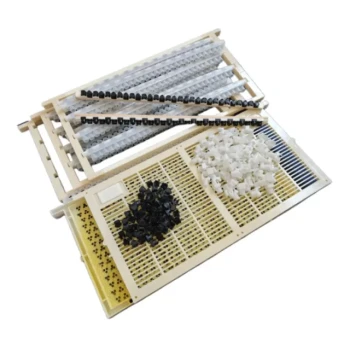
Precise time management is the absolute foundation of successful royal jelly production. Using high-precision timers or recording tools is critical because the harvesting window is strictly limited to 72 hours; missing this mark compromises yield quantity and disrupts the biological order of the hive.
Royal jelly production operates on a non-negotiable 72-hour biological clock. Adhering to this timeline is the only way to maximize extraction volume while simultaneously suppressing natural colony behaviors—like swarming or worker egg-laying—that would otherwise halt production.
The Biology of the 72-Hour Cycle
Maximizing Harvest Volume
The production of royal jelly follows a strict timeline. To achieve the highest possible yield, harvesting must occur exactly three days after grafting.
Tools that track this timeline ensure you extract the product when it is most abundant. Any deviation results in a significant drop in the volume of jelly collected per cycle.
Preventing Larval Over-Development
The larvae grafting process initiates a rapid developmental phase. If the harvest is delayed even slightly beyond the 72-hour mark, the larvae will develop too far.
This advanced development reduces the quality and quantity of the jelly, as the larvae begin to consume the store or change physiologically. Precision timers prevent this by flagging the exact moment for intervention.
Maintaining Colony Stability
Mitigating Swarming Impulses
Beyond yield, timing is a critical control measure for colony behavior. A precise schedule helps suppress the colony's natural impulse to swarm.
When the cycle is tightly managed, the bees remain focused on feeding the grafted larvae. Losing track of time allows swarming instincts to take over, which can lead to the loss of the colony’s workforce.
Preventing Production Disorder
Strict time management is required to maintain hierarchy and order within the hive. Delays in the cycle can trigger worker bees to begin laying eggs.
This phenomenon disrupts the production order, shifting the colony's focus from generating royal jelly to raising unplanned brood. Recording tools ensure the cycle resets before this disorder takes root.
Common Pitfalls in Time Management
The Risk of Manual Estimation
Relying on memory or manual estimation is the most common failure point in harvesting. The biological processes of the hive do not pause for human error.
Without high-precision tools, it is easy to miss the 72-hour window by a few hours. This seemingly minor slip is enough to trigger the biological setbacks mentioned above.
Operational Inflexibility
The strictness of the 72-hour cycle creates a trade-off in operational flexibility. Once grafting occurs, the harvest time is locked in regardless of external factors.
Producers must be prepared to harvest exactly on schedule. Weather conditions or labor shortages cannot be used as excuses to delay, as the biological cost of waiting is too high.
Making the Right Choice for Your Goal
To optimize your production, align your tools with your operational priorities:
- If your primary focus is maximizing yield: Use timers to enforce the 72-hour limit strictly, ensuring you harvest before larvae consume the product.
- If your primary focus is colony health: Use recording tools to monitor long-term cycles, preventing the behavioral disorders (swarming and laying workers) caused by irregular schedules.
Consistency is not just a best practice; it is the biological requirement for high-volume royal jelly production.
Summary Table:
| Factor | Role in Royal Jelly Cycle | Risk of Poor Timing |
|---|---|---|
| 72-Hour Window | Maximizes extraction volume | Drastic yield reduction |
| Larval Development | Controls jelly consumption | Larvae consume jelly stores |
| Swarming Control | Focuses bees on feeding larvae | Loss of colony workforce |
| Hive Order | Prevents laying workers | Shift to unplanned brood |
Scale Your Commercial Production with HONESTBEE
Looking to optimize your royal jelly yield or expand your wholesale distribution? HONESTBEE provides commercial apiaries and distributors with a comprehensive range of professional beekeeping tools, advanced machinery—including hive-making and honey-filling machines—and essential industry consumables.
From specialized hardware to honey-themed cultural merchandise, we offer the industrial-grade solutions you need to maintain a perfect 72-hour cycle and maximize efficiency.
Contact us today to explore our wholesale catalog and elevate your operations!
References
- O. Mishchenko, K. Afara. CПОСОБИ ФОРМУВАННЯ СІМЕЙ-ВИХОВАТЕЛЬОК У ТЕХНОЛОГІЇ ВИРОБНИЦТВА БДЖОЛИНОГО МАТОЧНОГО МОЛОЧКА. DOI: 10.46913/beekeepingjournal.2022.10.04
This article is also based on technical information from HonestBee Knowledge Base .
Related Products
- Plastic Chinese Queen Grafting Tool for Bee Queen Rearing
- No Grafting Queen Rearing Kit: System for Royal Jelly Production and Queen Rearing
People Also Ask
- Why is it necessary for migratory beekeeping enterprises to utilize professional queen bee rearing tools? Boost Resilience
- What specialized tools and frame configurations are needed for larval grafting during queen rearing, and how are queen cells properly spaced? Master the essentials for efficient queen production
- What are the benefits of using a queen grafting tool for queen rearing? Master Precision for Superior Bee Genetics
- What is grafting in queen rearing? Take Control of Your Apiary's Genetics
- What are the steps involved in using a queen grafting tool? A Guide to Successful Queen Rearing