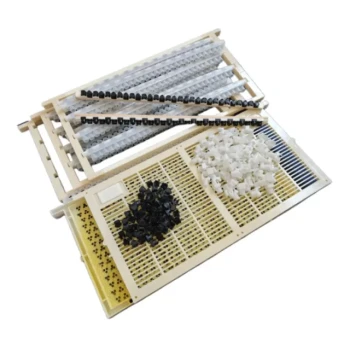
Queen-rearing tools are the foundational mechanism for shifting an apiary from passive maintenance to active, scalable growth. These specialized instruments allow commercial beekeepers to independently control colony reproduction, eliminating the reliance on capturing wild swarms to replenish or expand their stock. By enabling the systematic replacement of failing queens and the splitting of hives, these tools ensure operational continuity and rapid recovery from environmental setbacks.
The strategic value of queen-rearing tools lies in autonomy and genetic control. They transform beekeeping from a game of chance—waiting for nature to provide new colonies—into a predictable industrial process where growth is planned, and stock quality is constantly improved.
Securing Independence and Scalability
Eliminating Reliance on Wild Capture
Traditionally, expanding an apiary required capturing wild swarms, a method plagued by unpredictability and risk.
Queen-rearing tools break this dependency, allowing beekeepers to generate new queens on demand from their own best stock.
This independence is critical for commercial sustainability, as it secures the supply chain of bees regardless of natural swarming seasons.
Enabling Systematic Scale-Up
To expand a commercial operation, you need a reliable method to multiply colony numbers.
Using these tools, a beekeeper can artificially propagate queens to create new splits and nucleus colonies at will.
This capability allows for a linear, planned expansion of the apiary rather than a fluctuating count based on seasonal luck.
Rapid Recovery Mechanisms
Commercial apiaries often face massive losses due to environmental disasters, pests, or disease.
Queen-rearing equipment provides the means for rapid population recovery by allowing the surviving strong colonies to rear queens for re-establishing lost hives.
This resilience reduces the financial shock of colony collapse and ensures business continuity.
Optimizing Genetics for Commercial Viability
Reducing Swarming Tendencies
A major challenge in commercial beekeeping is the natural instinct of bees to swarm, which reduces the workforce and honey yield.
Through selective breeding enabled by these tools, beekeepers can propagate genetics that exhibit a lower tendency to swarm.
This keeps the colony population high and focused on production rather than reproduction during critical honey flows.
Lowering Aggression Levels
Worker safety and ease of management are logistical priorities in large-scale apiaries.
Queen-rearing allows for the selection of docile traits, significantly lowering honeybee aggression.
Easier handling translates to faster hive inspections and reduced labor costs per colony.
Improving Yield and Disease Resistance
The queen is the biological core of the colony, determining its foraging efficiency and immune response.
By rearing queens from high-performing lineage, apiaries can maximize the "per-hive" yield rather than just increasing the total number of hives.
High-quality queens also transmit superior disease resistance, reducing the need for chemical interventions and improving long-term sustainability.
Understanding the Trade-offs
The Requirement of Technical Expertise
While powerful, queen rearing is not a passive activity; it requires a higher tier of biological understanding and technical skill than basic hive management.
Failure to execute the rearing process correctly can lead to weak queens or grafting failures, temporarily setting back production goals.
Resource Allocation
Implementing a queen-rearing program demands a dedication of resources—specifically time and nurse bees—that are diverted from honey production.
Beekeepers must balance the immediate loss of foraging workforce against the long-term gain of genetic superiority and colony expansion.
Making the Right Choice for Your Goal
Whether you are stabilizing a struggling apiary or aggressively capturing market share, the application of these tools differs slightly.
- If your primary focus is Stability and Risk Management: Prioritize using these tools to create a "bank" of replacement queens to immediately swap out failing monarchs and recover from winter losses.
- If your primary focus is Expansion and Yield: Focus your rearing efforts on selective breeding from your top 10% performing hives to propagate genes for disease resistance and high foraging capacity.
Mastering queen-rearing tools ultimately grants you the power to dictate your apiary's future, turning genetic potential into predictable commercial profit.
Summary Table:
| Feature | Impact on Sustainability | Impact on Expansion |
|---|---|---|
| Genetic Selection | Enhances disease resistance and lowers aggression. | Improves honey yield and reduces swarming tendencies. |
| Independent Rearing | Eliminates reliance on unpredictable wild swarms. | Enables predictable, scheduled hive splitting. |
| Queen Banking | Provides immediate replacements for failing queens. | Supplies the biological core for new nucleus colonies. |
| Selective Breeding | Reduces chemical dependency through resilience. | Maximizes per-hive productivity for higher ROI. |
Empower Your Apiary with HONESTBEE Professional Solutions
Transition from passive maintenance to predictable industrial growth with HONESTBEE. As a premier partner for commercial apiaries and distributors, we provide the full spectrum of high-performance beekeeping tools and machinery—from specialized queen-rearing equipment and hive-making machines to industrial honey-filling lines.
Why partner with HONESTBEE?
- Scalability: Our wholesale equipment is designed for rapid operation expansion.
- Efficiency: High-quality tools reduce labor costs and improve genetic management.
- Comprehensive Range: We supply everything from essential consumables to honey-themed cultural merchandise.
Ready to optimize your genetics and maximize your yields? Contact us today to discover how our comprehensive wholesale offerings can secure the future of your beekeeping business.
References
- Jordanna Hinton, David Lloyd. An Overview of Rural Development and Small-Scale Beekeeping in Fiji. DOI: 10.1080/0005772x.2019.1698104
This article is also based on technical information from HonestBee Knowledge Base .
Related Products
- Retractable Chinese Queen Rearing Grafting Tools Equipment
- Plastic Chinese Queen Grafting Tool for Bee Queen Rearing
- Stainless Steel Beekeeping Queen Grafting Tool for Honey Bee Rearing
- Stainless Steel Queen Grafting Tool for Beekeeping and Bee Queen Grafting
- Plastic Beekeeping Honey Bee Larvae Grafting Tools for Queen Rearing and Chinese Grafting
People Also Ask
- Which specialized tools are necessary for implementing standardized queen rearing? Scale Your High-Yield Apiary
- How does selective queen rearing benefit an apiary? Discover Essential Tools for High-Quality Queen Bees
- Why are specialized queen rearing tools necessary to mitigate winter hive losses? Boost Apiary Survival and Recovery
- What operational workflows and queen rearing tools are required for implementing instrumental insemination and isolated mating in commercial queen breeding programs?
- In what ways do modern queen rearing equipment and grafting tools improve competitiveness? Boost Breeding Success Rate