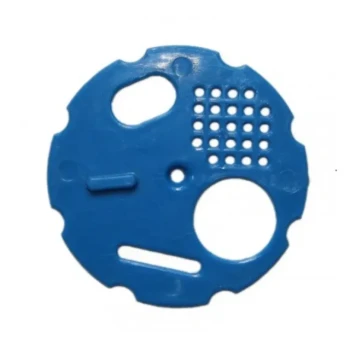
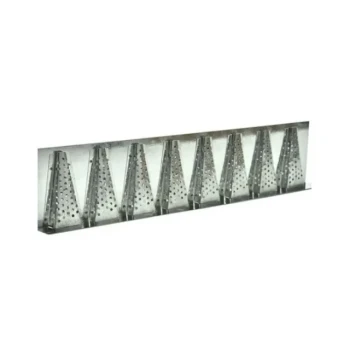
Narrowing the beehive entrance is a fundamental control measure required to maintain data integrity during flight activity observation. By physically restricting the opening, observers force the bees to enter and exit in a single-file line rather than in clusters. This bottleneck eliminates the visual confusion caused by simultaneous movement, allowing researchers to capture an exact count of individual foragers and analyze their specific cargo.
By forcing bees to pass one at a time, you transform a chaotic cloud of movement into a quantifiable stream of data. This physical adjustment is the only way to eliminate counting errors caused by simultaneous crossovers, ensuring precise documentation of foraging activity.
The Mechanics of Accurate Counting
Eliminating Simultaneous Traffic
The primary obstacle to accurate observation is the natural tendency of bees to move in bursts.
Without a narrowed entrance, multiple bees will often enter or exit at the exact same moment. This overlap makes it nearly impossible for the human eye—or even some automated sensors—to distinguish individual insects, leading to significant undercounting.
Creating a Single-File Stream
Narrowing the entrance acts as a physical filter.
By sizing the opening to accommodate only one bee at a time, you create a linear progression of traffic. This allows the observer to focus on a single focal point, ensuring that every transition from inside to outside is logged as a discrete event.
Enhancing Data Resolution
Validating Foraging Success
The goal of observation is often deeper than a simple head count; it is to understand resource gathering.
A single-file constraint allows observers to clearly see what each returning bee is carrying. You can verify the presence of pollen and nectar loads with much higher reliability when you are not distracted by swarming behavior at a wide entrance.
Reducing Observer Fatigue
Tracking a wide, busy entrance requires splitting attention across a broad visual field.
Narrowing the entrance standardizes the observation zone. This reduces cognitive load on the researcher, leading to fewer errors over the duration of the observation period and higher-quality long-term data.
Understanding the Trade-offs
The Risk of Congestion
While narrowing the entrance is necessary for counting, it creates an artificial bottleneck.
In extremely active hives, this restriction can lead to a "traffic jam" at the entrance, where returning bees must queue to enter. This queuing behavior can temporarily delay the deposit of resources, though it is a necessary sacrifice for data accuracy.
Potential for Overheating
Ventilation is often managed through the hive entrance.
Restricting the opening significantly reduces airflow. If observations are conducted during peak heat, the observer must be mindful that the narrowing does not cause the internal temperature of the hive to spike dangerously.
Making the Right Choice for Your Goal
To apply this methodology effectively, consider the specific requirements of your study:
- If your primary focus is absolute numerical accuracy: Narrow the entrance strictly to a one-bee width to prevent any simultaneous passage, regardless of the congestion it may create.
- If your primary focus is general activity trends: You may allow a slightly wider entrance (two bees wide) to reduce hive stress, accepting a small margin of error in the exact count.
Precision in data collection begins with physical control of the environment.
Summary Table:
| Factor | Narrowed Entrance (Single-File) | Wide Entrance (Standard) |
|---|---|---|
| Counting Accuracy | High - Eliminates simultaneous traffic | Low - Visual confusion from clusters |
| Data Resolution | High - Clear view of pollen/nectar loads | Low - Distracted by swarming behavior |
| Observer Fatigue | Reduced - Standardized observation zone | Increased - Broad visual field required |
| Hive Ventilation | Restricted - Requires temperature monitoring | Optimal - Natural airflow maintained |
| Traffic Flow | Bottlenecked - Potential for queuing | Fluid - Natural burst movement |
Elevate Your Commercial Apiary with HONESTBEE Precision Solutions
Maintaining data integrity in large-scale operations requires the right tools. At HONESTBEE, we specialize in supporting commercial apiaries and distributors with a comprehensive wholesale range of professional beekeeping equipment. From high-precision hive-making machinery to essential industry consumables and honey-themed merchandise, our portfolio is designed to enhance your operational efficiency.
Whether you are scaling your honey production or supplying the next generation of beekeepers, our expert team is ready to provide the specialized hardware and tools you need to succeed.
Ready to optimize your production? Contact us today for a wholesale consultation!
References
- Reem Abdel-Galel, Fayez Semida. Foraging rhythm of honeybees Apis mellifera in Ismailia, Egypt. DOI: 10.21608/cat.2021.196712
This article is also based on technical information from HonestBee Knowledge Base .
Related Products
- Steel Round Disc Entrance Reducer for Flexzion Bee Hive Nuc Box Gate
- Beehive Entrance Reducer Guardian Metal Hive Entrance for Bees
- White Plastic 0.5L Beekeeping Entrance Feeder for Bees
- Beehive Entrance Discs Plastic Bee Entrance Disc for Bee Hives
- Professional Hive Front Entrance Bee Feeder
People Also Ask
- What is the purpose of an entrance reducer for a beehive? Strengthen Colony Defense and Prevent Robbery
- Why are entrance reducers used to counter hornet infestations? Protect Your Hive with Strategic Choke Points
- Why is it critical to maintain a smaller entrance for a newly established bee hive? Boost Colony Growth and Security
- What is the function of an entrance reducer on a beehive? Strengthen Colony Defense and Climate Control
- Under what conditions should a beekeeper adjust the size of a beehive entrance? Seasonal & Defense Management Tips