The Unseen Engine of the Hive
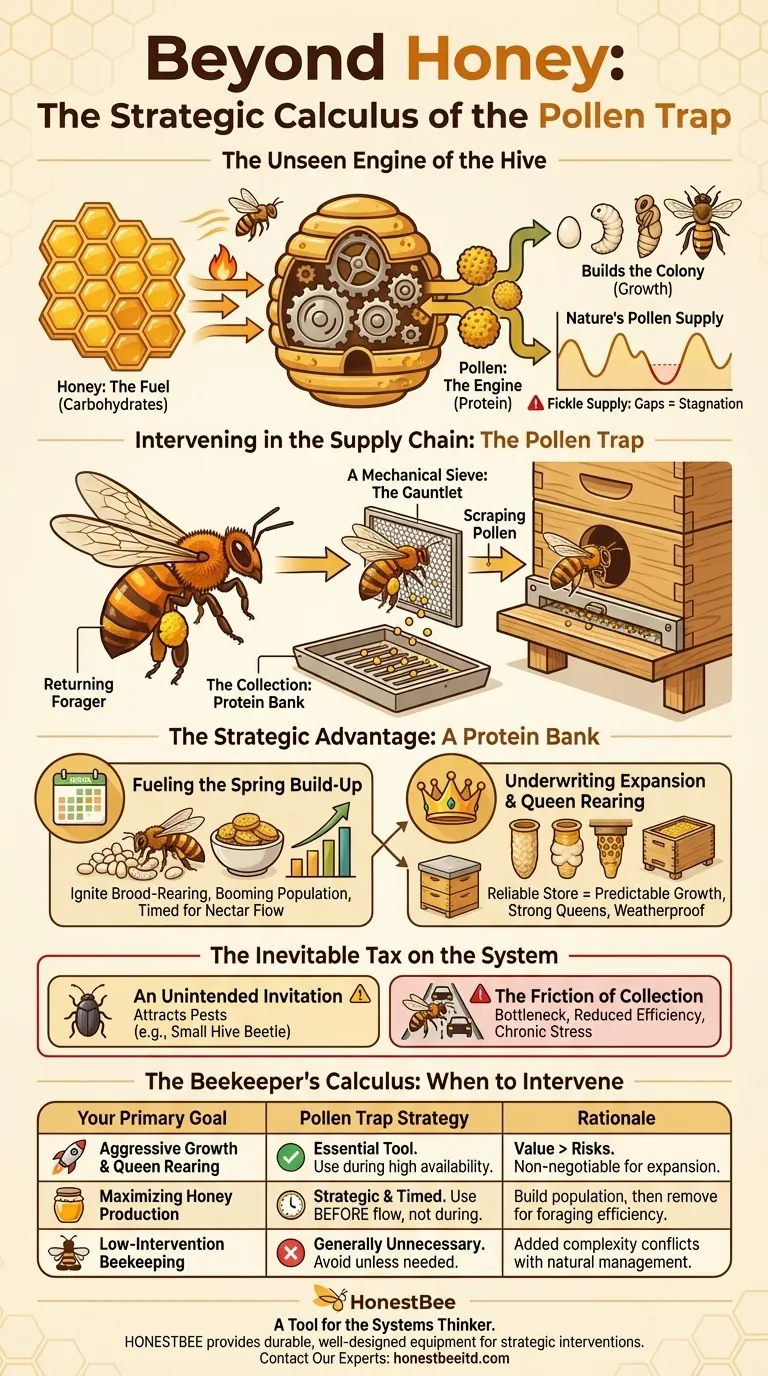
When we think of a beehive, we picture honey. We see a whirlwind of activity geared towards producing that liquid gold. But honey is just the fuel—the carbohydrates that power the flight muscles and keep the colony warm.
The actual engine of growth, the raw material for building the bees themselves, is pollen.
Pollen is protein. It’s the substance that allows a colony to turn eggs into larvae, larvae into pupae, and pupae into the next generation of workers. Without a steady, abundant supply of pollen, a colony cannot grow. It stagnates.
But nature’s pollen supply is fickle. It ebbs and flows with the seasons, leaving gaps in early spring or during a summer dearth. For a commercial beekeeper, these gaps aren't just an inconvenience; they are a critical business risk that can halt expansion in its tracks.
Intervening in the Supply Chain
This is where human ingenuity intervenes. The pollen trap is a simple, elegant piece of engineering designed to do one thing: build a strategic protein reserve.
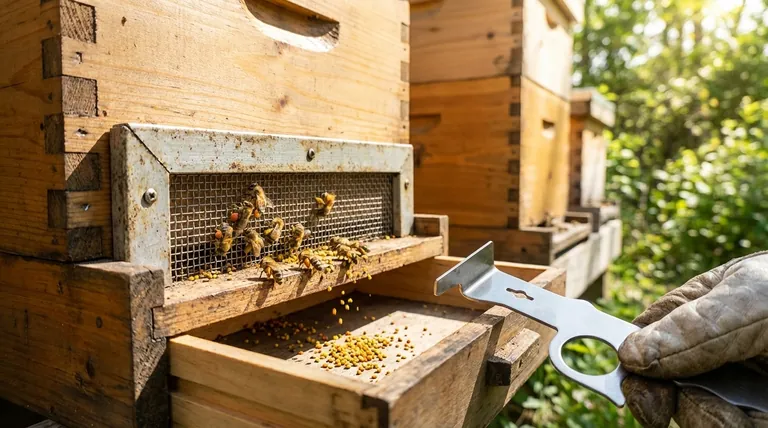
Think of it as a tollbooth at the hive entrance. Returning foragers, their legs heavy with precious pollen pellets, are guided through a mesh screen. It’s a passage just wide enough for the bee, but not for its entire load.
A Mechanical Sieve
The mechanism is beautifully direct:
- The Gauntlet: A forager bee squeezes through a precisely sized hole in a mesh plate.
- The Action: The edges of the hole gently scrape the pollen pellets from her legs.
- The Collection: The dislodged pellets fall through a screen into a protected collection tray below.
The bee enters the hive, having paid a "tax" on her delivery, still carrying enough pollen to satisfy the colony’s immediate needs. But the beekeeper has now started to accumulate a valuable surplus.
The Strategic Advantage of a Protein Bank
This harvested pollen isn't just a bonus; it's a tool for overcoming nature’s limitations. It becomes a "protein bank" that the beekeeper can draw upon to drive specific, high-value outcomes.
Fueling the Spring Build-Up
In early spring, a queen is ready to lay thousands of eggs a day, but the fields may still be bare. This is the most critical moment for colony growth. By providing supplemental pollen patties made from the previous year's harvest, a beekeeper can ignite the brood-rearing furnace weeks before nature would allow. The result is a booming population, perfectly timed to capitalize on the main nectar flow.
Underwriting Expansion and Queen Rearing
You cannot build new factories without raw materials. For a beekeeper, raising queens or creating new colonies ("nucs") are the equivalent of factory expansion. These activities are incredibly protein-intensive. A reliable store of pollen means you are no longer at the mercy of the weather. You can produce strong, well-fed queens and healthy new colonies on a predictable schedule.
The Inevitable Tax on the System
Every intervention in a complex system, however, has second-order effects. A savvy beekeeper understands that the benefits of a pollen trap are not free. They come with costs that must be managed.
An Unintended Invitation
The scent of fresh, collected pollen in the trap's tray is a powerful attractant. Unfortunately, it doesn't just attract the beekeeper. Pests, particularly the destructive Small Hive Beetle, can be drawn to this easy food source, increasing their pressure on the colony.
The Friction of Collection
The trap is, by design, a bottleneck. It introduces a small amount of friction at the hive's busiest intersection. This can slow down the traffic of foragers, and over thousands of trips, potentially reduce the hive's overall efficiency. This constant navigation can also place a low, chronic level of stress on the colony.
The Beekeeper's Calculus: When to Intervene
A pollen trap is not an "always on" device. It is a strategic tool, and its use is a calculated decision based on your primary goal. The decision-making process looks something like this:
| Your Primary Goal | Pollen Trap Strategy | Rationale |
|---|---|---|
| Aggressive Growth & Queen Rearing | Essential Tool. Use during periods of high pollen availability. | The value of a protein reserve far outweighs the risks. This is non-negotiable for expansion. |
| Maximizing Honey Production | Strategic & Timed. Use before the main nectar flow, not during. | Build the population up pre-flow, then remove the trap to maximize foraging efficiency when it counts most. |
| Low-Intervention Beekeeping | Generally Unnecessary. Avoid unless a specific problem arises. | The added complexity and disruption conflict with the goal of letting the colony manage itself. |
A Tool for the Systems Thinker
Ultimately, the pollen trap is more than just a piece of equipment. It's a lever that allows a beekeeper to shift from being a passive honey harvester to an active manager of a complex biological system.
Using it effectively requires foresight and an understanding of trade-offs. It requires high-quality, reliable equipment that performs its function without causing undue stress or damage. As a leading supplier to commercial apiaries, HONESTBEE provides the durable, well-designed pollen traps and wholesale equipment necessary for these precise interventions. We understand that when you're managing an entire system, every component matters.
To ensure your operation has the tools it needs to strategically manage its protein supply and drive growth, Contact Our Experts.
Visual Guide
Related Products
- Removable Plastic Pollen Trap With Ventilated Tray for Bees Pollen Collector
- 30 cm Plastic Entrance Hole Bee Pollen Trap and Collector
- Plastic Bee Pollen Trap Strips Comb Catcher Collector
- High-Efficiency Diamond Maze Bee Escape for Clearing Supers
- Professional Bucket Style Wasp and Moth Pheromone Trap
Related Articles
- The Interface Problem: How Pollen Trap Design Shapes Colony Behavior and Harvest Quality
- How to Install Pollen Traps Without Stressing Your Hive: A Beekeeper’s Guide
- The Paradox of the Pollen Trap: Engineering for Harvest and Hive Health
- How Pollen Traps Transform Beekeeping: From Hive Health to Additional Income
- Redirecting the Flow: The Behavioral Science of a Pollen Trap