The Traffic Jam at the Front Door
A forager bee, legs heavy with bright orange pellets, returns from a long flight. For her, the hive entrance is a high-speed, low-drag portal. It is the final, crucial step in a complex logistical chain.
Now, imagine we place an obstacle there. A precisely engineered grid.
This isn't just a piece of equipment; it's an interface modification. And like any change to a high-traffic system, it has consequences that ripple through the entire organization. The choice of a pollen trap is less about the hardware and more about understanding—and respecting—the intricate workflow of the colony.
A Universal Principle of Gentle Friction
At their core, all pollen traps operate on a beautifully simple principle of physics. They create a point of gentle friction.
The Stripping Grid
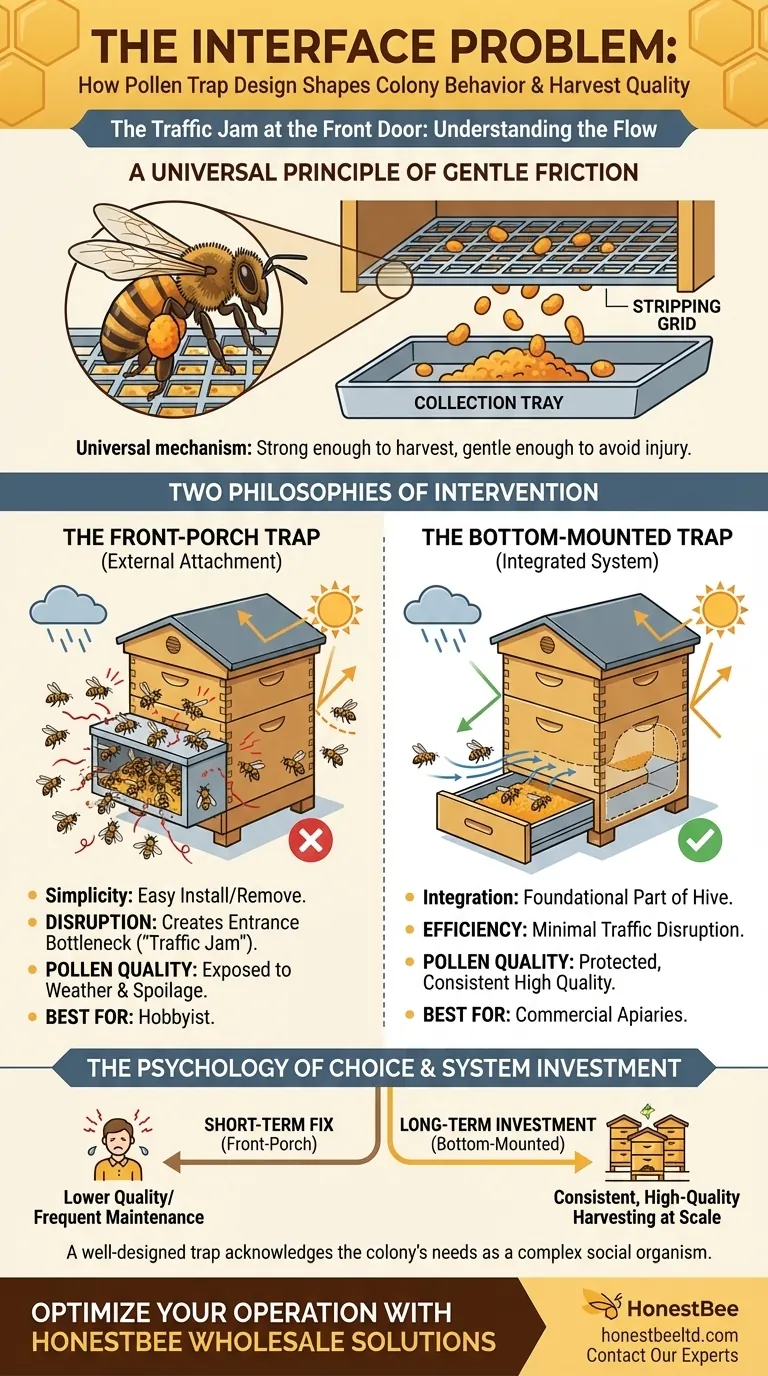
Returning foragers are guided through a screen or plate with openings just large enough for a bee, but small enough to dislodge the pollen pellets from their "pollen baskets." It's a feat of engineering: strong enough to harvest, yet gentle enough to avoid injury.
The Collection Tray
The dislodged pollen falls into a collection tray below. This is the beekeeper's interface—a drawer designed for easy access, ventilation to prevent mold, and protection from the elements.
The elegance of the system is universal. The critical difference lies in where this interface is placed.
Two Philosophies of Intervention
The placement of the trap reflects a beekeeper's core operational philosophy: are you adding an external tool, or are you integrating a new function into the system's foundation?
H3: The Front-Porch Trap: An Exercise in Simplicity
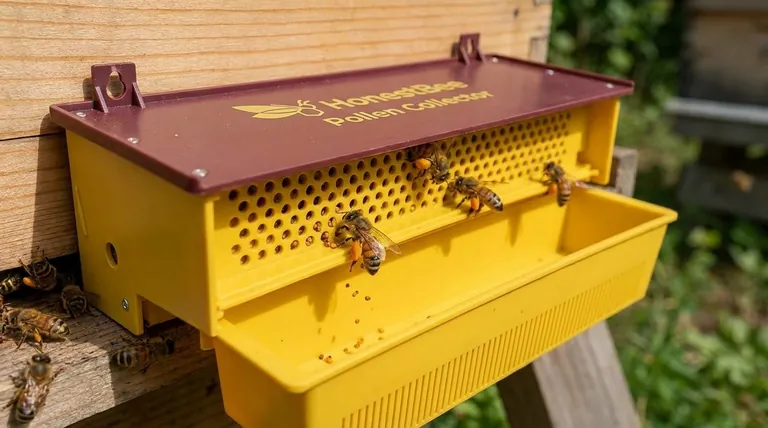
Mounted at the hive's main entrance, this design is the essence of simplicity. It's easy to install and remove, appealing to our human desire for flexibility and minimal commitment.
But this simplicity comes at a cost to the colony. It creates a bottleneck at the busiest point in the hive. This "traffic jam" can increase stress, slow down foraging operations, and leave the collected pollen exposed to rain and humidity, demanding more frequent collection to prevent spoilage.
H3: The Bottom-Mounted Trap: A Commitment to Integration
This design replaces the hive's entire bottom board, making pollen collection a fundamental, integrated part of the hive's architecture.
The genius of this approach is its subtlety. The stripping grid is inside, and the collection tray is often accessed from the rear. This moves the entire harvesting operation "backstage," away from the busy entrance.
The benefits are systemic:
- Reduced Traffic Disruption: Foragers enter a calmer environment, improving overall colony efficiency.
- Superior Pollen Quality: The pollen is protected from rain and direct sun, preserving its integrity.
- Operational Efficiency: The beekeeper can harvest without disturbing the flight path of the bees.
The Psychology of Choice: Seeing the Whole System
Why would anyone choose a design that creates a bottleneck? The answer lies in human psychology. We often favor what is immediately easy (installing a front-porch trap) over what is systemically optimal.
This is the classic trade-off between a short-term fix and a long-term investment.
A well-designed trap, regardless of type, acknowledges the colony's own needs. Features like a separate, larger bypass exit for drones and the queen aren't just details; they are a profound acknowledgment that we are working with a complex social organism, not just a production unit. Failing to provide these escape routes is like closing all but one door in a busy office building.
Choosing a System, Not Just a Tool
For the commercial beekeeper, the goal is consistent, high-quality harvesting at scale, with minimal stress on the colonies that power the business. When viewed through this lens, the choice becomes an investment in infrastructure.
The following table clarifies the decision:
| Feature | Front-Porch (Entrance) Trap | Bottom-Mounted Trap |
|---|---|---|
| Design Philosophy | External, temporary attachment | Integrated, foundational system |
| Beekeeper Effort | Low initial setup, frequent harvest | Higher initial setup, efficient harvest |
| Colony Impact | High congestion at entrance | Minimal disruption to traffic flow |
| Pollen Quality | Exposed to weather | Protected, consistently higher quality |
| Best For | Hobbyist, occasional collection | Commercial apiaries, consistent output |
At HONESTBEE, we specialize in supplying commercial apiaries and distributors with equipment that understands this distinction. Our wholesale solutions, including robust and efficiently designed bottom-mounted pollen traps, are built for operators who see their apiary as a complete system, where colony health and harvest quality are two sides of the same coin.
To optimize your operation with equipment designed for performance and colony well-being, Contact Our Experts.
Visual Guide
Related Products
- Removable Plastic Pollen Trap With Ventilated Tray for Bees Pollen Collector
- 30 cm Plastic Entrance Hole Bee Pollen Trap and Collector
- Plastic Bee Pollen Trap Strips Comb Catcher Collector
- High-Efficiency Diamond Maze Bee Escape for Clearing Supers
- Professional Bucket Style Wasp and Moth Pheromone Trap
Related Articles
- How to Install Pollen Traps Without Stressing Your Hive: A Beekeeper’s Guide
- The Paradox of the Pollen Trap: Engineering for Harvest and Hive Health
- Beyond Honey: The Strategic Calculus of the Pollen Trap
- How Pollen Traps Transform Beekeeping: From Hive Health to Additional Income
- Redirecting the Flow: The Behavioral Science of a Pollen Trap